


WES & WGS Bioinformatics Pipeline Development
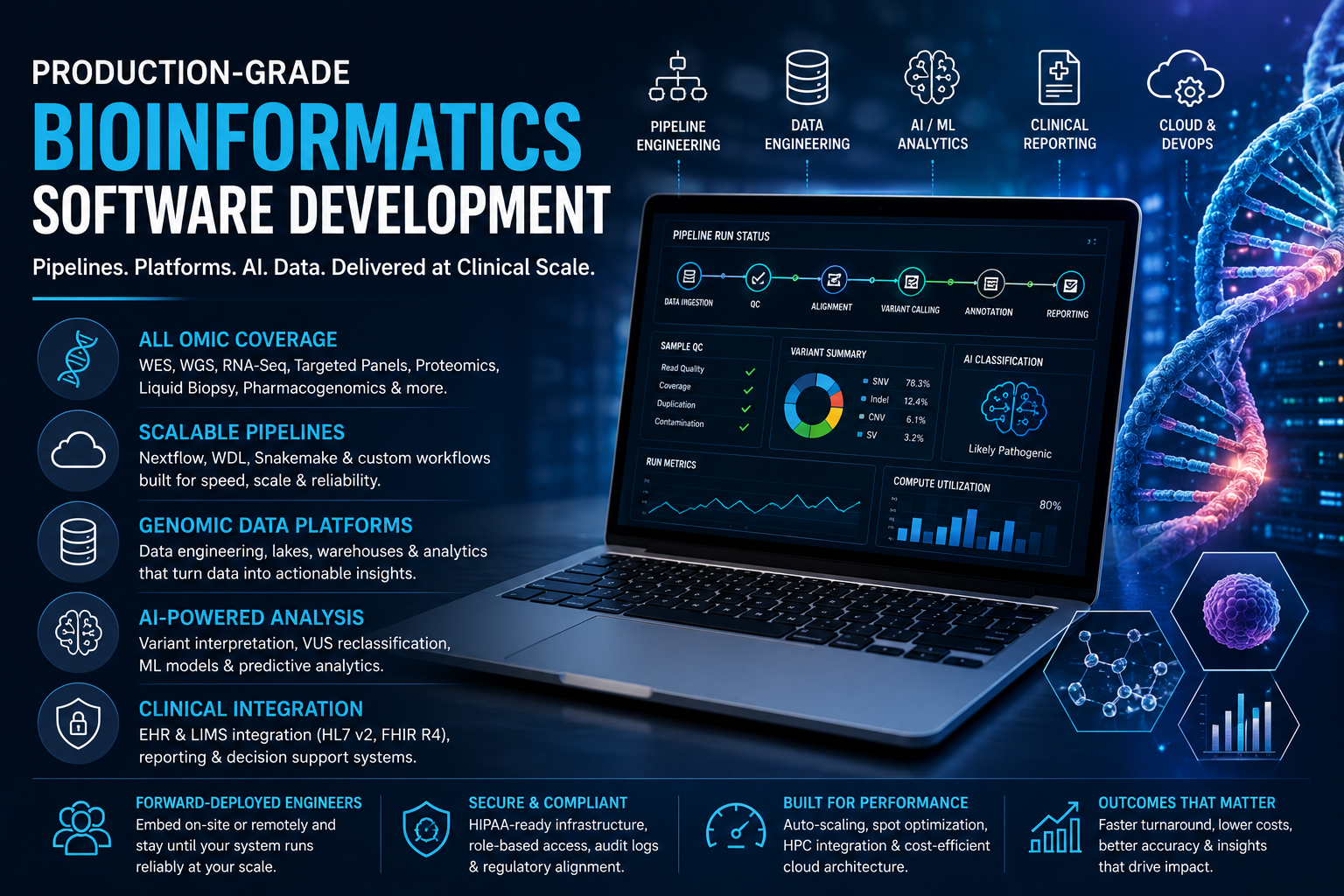
Bioinformatics software development is no longer just about creating sequencing pipelines. Modern genomics organizations need reliable systems that can process large datasets, automate analysis, integrate clinical systems, and support AI driven interpretation.
A production ready bioinformatics platform connects the complete workflow:
Sequencing → Data Processing → Quality Control → Variant Analysis → Interpretation → Reporting → Clinical Systems
What Does Bioinformatics Software Development Include?
A modern bioinformatics software development partner can build solutions across multiple areas, including:
- WES and WGS bioinformatics pipelines
- RNA Seq and transcriptomics
- Targeted gene panel pipelines
- Liquid biopsy and cfDNA analysis
- Pharmacogenomics software
- Proteomics platforms
- Genomic data engineering
- AI powered variant interpretation
- Clinical reporting systems
- EHR and LIMS integration
These systems help laboratories and life sciences organizations move from fragmented analysis workflows toward connected, scalable platforms.
Building Reliable Bioinformatics Pipelines
As sequencing volume increases, manually running workflows becomes difficult. Bioinformatics pipeline development can automate processes such as alignment, variant calling, annotation, quality control, and reporting.
Workflow orchestration tools such as Nextflow, WDL, and Snakemake can help manage complex computational workflows across cloud and HPC environments.
Production pipelines also need monitoring, automated QC gates, failure detection, retry logic, version management, and observability.
The goal isn't simply to make a pipeline work once.
It's to make it run reliably at production scale.
Genomic Data Engineering
Genomic data often exists across sequencing files, clinical systems, laboratory databases, and research platforms.
Genomic data engineering brings these datasets together through data lakes, warehouses, ETL pipelines, metadata systems, and governed data platforms.
This foundation can support:
- Cohort analysis
- Variant reanalysis
- Biomarker discovery
- Precision medicine
- Machine learning
- Clinical reporting
A well designed genomic data platform makes genomic information easier to manage, search, analyze, and reuse.
AI Powered Bioinformatics
AI is becoming an important part of modern genomic analysis.
AI powered bioinformatics can assist with:
- Variant prioritization
- Variant interpretation
- Evidence aggregation
- Pathogenicity prediction
- Tumor classification
- Biomarker discovery
- Polygenic risk analysis
For clinical applications, AI should support rather than replace expert review.
A human in the loop workflow allows AI to surface evidence and recommendations while qualified professionals review and approve the final interpretation.
Connecting Bioinformatics With Clinical Systems
Bioinformatics systems rarely work alone.
Modern platforms may integrate with EHRs, LIMS, HL7 v2, FHIR R4, and clinical reporting systems.
This can automate workflows from sample accessioning and sequencing through analysis, report generation, and result delivery.
The result is a more connected workflow with fewer manual handoffs.
Cloud Infrastructure for Bioinformatics
Large genomic datasets require scalable infrastructure.
Bioinformatics platforms can operate across AWS, Google Cloud, Azure, and on premises HPC environments, depending on an organization's security, compliance, cost, and workload requirements.
Cloud and DevOps technologies can provide scalable compute, automated infrastructure, workflow execution, and monitoring.
The Future of Bioinformatics
The future of bioinformatics isn't just better algorithms. It is the integration of:
Bioinformatics + Software Engineering + Data Engineering + Cloud + AI + DevOps
Organizations that bring these capabilities together can build production grade bioinformatics platforms capable of supporting research, clinical genomics, precision medicine, and growing sequencing workloads.
The ultimate goal is simple: turn complex biological data into reliable software systems that people can actually use.
 Spanish
 English
 Arabic
 French
 Portuguese
 Deutsch
 Turkish
 Dutch
Dutch
 Italiano
 Russian
 Romaian
 Portuguese (Brazil)
 Greek
Greek