


Registration of Non Governmental Organization: A Practical Guide
Introduction
Starting an NGO begins with a clear purpose and a commitment to social change. However, turning that vision into a legally recognized entity requires completing the registration of non governmental organization process. Registration provides an official identity, helps build trust among donors and stakeholders, and allows organizations to operate within the legal framework.
In India, NGOs play an important role in areas such as education, healthcare, women's welfare, child development, environmental conservation, and community support. Choosing the right registration structure is one of the first and most important decisions for any nonprofit initiative.
This guide by Ngoexperts explains the different registration options, required documents, and the steps involved in establishing an NGO in India.
Why Is NGO Registration Important?
Many groups begin charitable activities informally. However, legal registration offers several advantages.
Some key benefits include:
-
Establishes legal recognition
-
Improves credibility among donors and funding agencies
-
Helps open bank accounts in the organization's name
-
Allows the NGO to enter contracts and own property
-
Supports applications for grants and government schemes
-
Creates a defined governance structure
Registration also demonstrates accountability and transparency, which are essential for long-term operations.
Types of NGO Registration in India
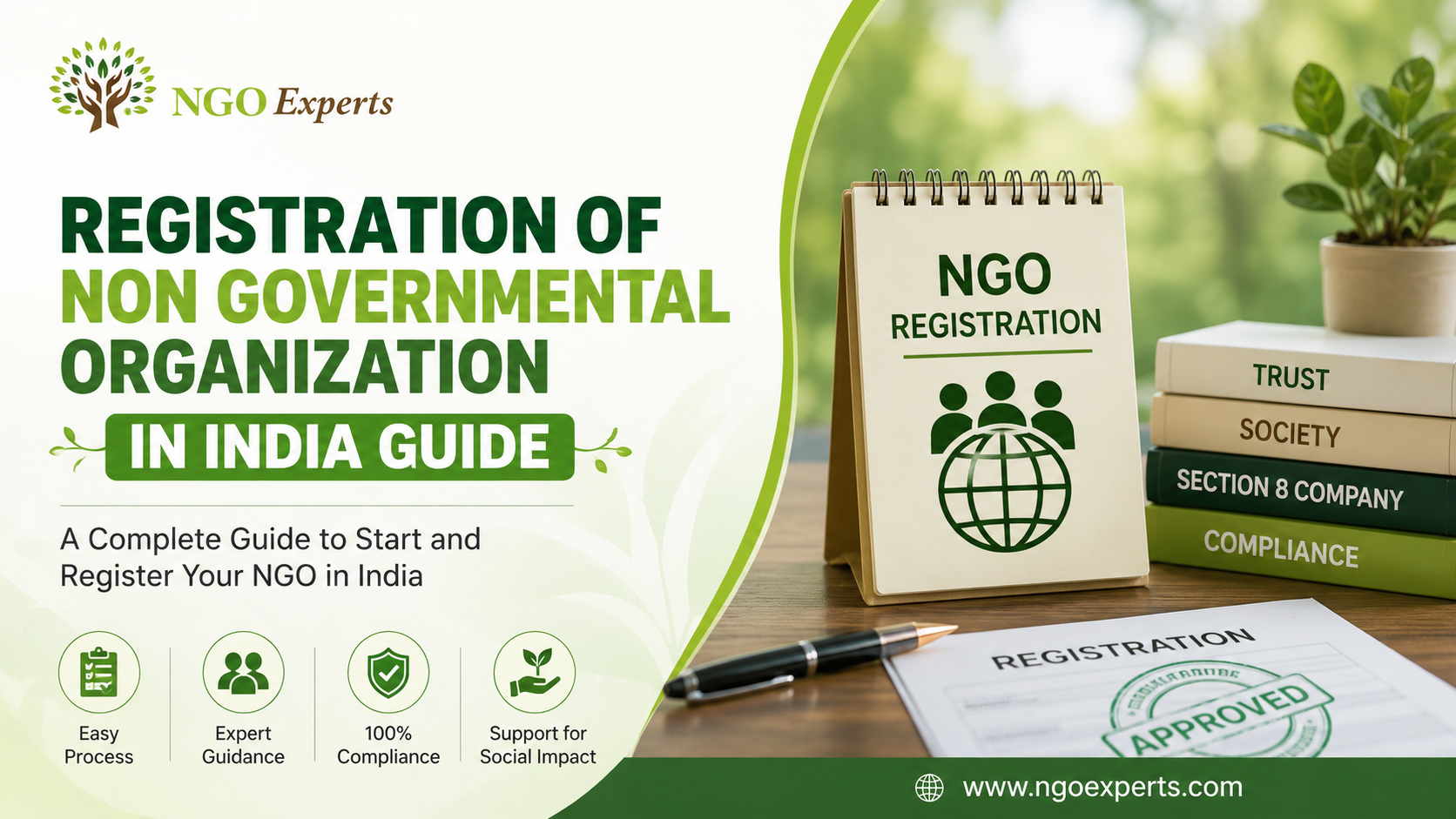
The registration of non governmental organization can be completed under different legal structures. The choice depends on the objectives, management style, and future plans of the founders.
1. Trust Registration
A Trust is generally formed for charitable and religious purposes.
Features of a Trust
-
Governed by the Indian Trusts Act in certain jurisdictions
-
Managed by trustees
-
Requires a Trust Deed
-
Suitable for philanthropic activities
Trusts are often preferred by families or individuals planning to undertake charitable work through a simple structure.
2. Society Registration
Societies are formed by a group of people working toward a common social objective.
Features of a Society
-
Registered under the Societies Registration Act, 1860
-
Managed by a governing body
-
Requires a Memorandum of Association
-
Suitable for cultural, educational, literary, and welfare activities
Societies offer flexibility in member participation and administration.
3. Section 8 Company Registration
A Section 8 Company operates under the Companies Act, 2013.
Features of a Section 8 Company
-
Separate legal identity
-
Limited liability for members
-
Structured governance requirements
-
Suitable for organizations seeking a formal corporate framework
Income earned by the company must be used solely for its charitable objectives.
Documents Required for NGO Registration
The documentation process may vary depending on the chosen structure. However, some commonly required documents include:
Identity and Address Proof
For founders, trustees, directors, or members:
-
PAN Card
-
Aadhaar Card
-
Passport-sized photographs
-
Voter ID, Passport, or Driving Licence
Registered Office Documents
Applicants generally need:
-
Utility bill
-
Rent agreement, if applicable
-
No Objection Certificate (NOC) from the property owner
Organization-Specific Documents
Depending on the registration type:
-
Trust Deed
-
Memorandum of Association
-
Articles of Association
-
Rules and Regulations
Preparing complete and accurate documents can reduce delays during the approval process.
Step-by-Step Registration Process
Although procedures differ slightly across structures, the overall approach remains similar.
Step 1: Define the Objectives
Clearly identify the purpose of the NGO. Objectives should reflect the intended charitable activities and future plans.
Step 2: Choose the Appropriate Structure
Evaluate whether a Trust, Society, or Section 8 Company best fits the organization's needs.
Consider factors such as:
-
Number of members
-
Administrative preferences
-
Funding plans
-
Compliance requirements
Step 3: Select a Name
Choose a suitable name that does not conflict with existing registrations and reflects the organization's mission.
Step 4: Draft Governing Documents
Prepare the necessary legal documents outlining objectives, management procedures, and operational rules.
Step 5: Submit the Application
File the registration application with the appropriate authority along with supporting documents.
Step 6: Receive the Registration Certificate
Upon approval, the relevant authority issues the registration certificate, confirming the NGO's legal status.
Compliance After Registration
Completing the registration of non governmental organization process is only the beginning.
Registered NGOs must continue to meet legal obligations.
Common responsibilities include:
-
Maintaining financial records
-
Conducting meetings as required
-
Filing annual returns
-
Updating statutory registers
-
Complying with applicable regulations
Proper record-keeping supports accountability and helps maintain public confidence.
Additional Registrations NGOs May Consider
After obtaining registration, many organizations apply for further approvals based on their activities.
12A Registration
This registration may provide income tax exemptions on eligible income used for charitable purposes.
80G Registration
It allows qualifying donors to claim deductions on donations made to the NGO.
FCRA Registration
Organizations intending to receive foreign contributions may require approval under the Foreign Contribution Regulation Act, subject to eligibility conditions.
These registrations should be considered according to the NGO's operational requirements.
Common Mistakes to Avoid
Applicants often encounter delays due to avoidable errors.
Some examples include:
-
Choosing unclear or unrelated objectives
-
Submitting incomplete documents
-
Selecting an unsuitable legal structure
-
Providing incorrect information in forms
-
Ignoring post-registration responsibilities
Careful planning and document review can help avoid these issues.
Conclusion
The registration of non governmental organization is an important step for anyone planning to work in the nonprofit sector. Choosing the right legal structure, preparing accurate documentation, and understanding compliance requirements can provide a stable foundation for future activities.
Whether the goal is to support education, healthcare, environmental causes, or community welfare, proper registration helps establish legitimacy and encourages responsible governance.
If you are planning to register an NGO and need guidance through the process, Ngoexperts can assist you in understanding the available options and completing the required formalities with clarity and confidence.
 Portuguese
 English
 Arabic
 French
 Spanish
 Deutsch
 Turkish
 Dutch
Dutch
 Italiano
 Russian
 Romaian
 Portuguese (Brazil)
 Greek
Greek