• The Living Room Screen Is No Longer Just a Television

    4K displays have crossed a major threshold. What used to be a passive panel for evening broadcasts is now an intelligent, edge-computing hub for the connected home.

    A few shifts redefining the global 4K TV Market:

    Mini-LED & OLED Maturation: Advanced local dimming and quantum-dot OLED panels are delivering studio-grade contrast and peak brightness at increasingly accessible price points.

    Large-Format Migration: Falling mother-glass production costs have accelerated consumer adoption of 65-inch, 75-inch, and 85-inch displays.

    On-Device AI Upscaling: Dedicated neural processors reconstruct legacy HD content frame by frame, rendering sports and older titles with near-native 4K sharpness.

    Monetization Beyond Hardware: Operating platforms are evolving into long-term revenue engines powered by Connected TV (CTV) advertising, integrated FAST channels, and unified Matter-enabled smart home controls.

    For display makers and ecosystem developers, the mandate is clear: long-term brand equity will belong to platforms that blend superior picture silicon with intuitive, low-latency software experiences.

    Explore the complete market assessment and growth analysis:

    https://www.maximizemarketresearch.com/market-report/global-4k-tv-market/63245/

    #4KTV #SmartTV #DisplayTechnology #MiniLED #OLED #ConsumerElectronics #MarketResearch
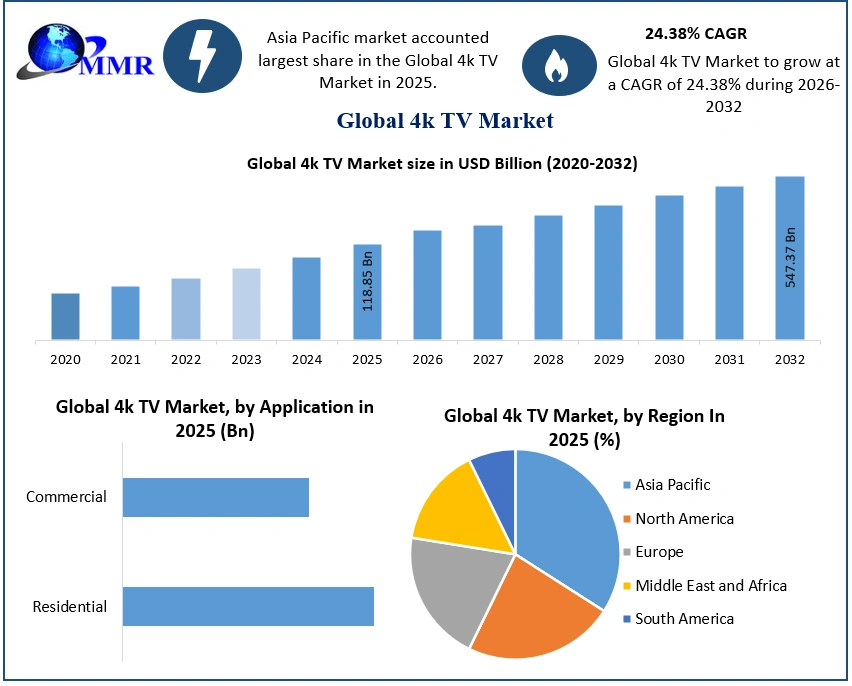
    The Living Room Screen Is No Longer Just a Television 4K displays have crossed a major threshold. What used to be a passive panel for evening broadcasts is now an intelligent, edge-computing hub for the connected home. A few shifts redefining the global 4K TV Market: Mini-LED & OLED Maturation: Advanced local dimming and quantum-dot OLED panels are delivering studio-grade contrast and peak brightness at increasingly accessible price points. Large-Format Migration: Falling mother-glass production costs have accelerated consumer adoption of 65-inch, 75-inch, and 85-inch displays. On-Device AI Upscaling: Dedicated neural processors reconstruct legacy HD content frame by frame, rendering sports and older titles with near-native 4K sharpness. Monetization Beyond Hardware: Operating platforms are evolving into long-term revenue engines powered by Connected TV (CTV) advertising, integrated FAST channels, and unified Matter-enabled smart home controls. For display makers and ecosystem developers, the mandate is clear: long-term brand equity will belong to platforms that blend superior picture silicon with intuitive, low-latency software experiences. Explore the complete market assessment and growth analysis: https://www.maximizemarketresearch.com/market-report/global-4k-tv-market/63245/ #4KTV #SmartTV #DisplayTechnology #MiniLED #OLED #ConsumerElectronics #MarketResearch
    WWW.MAXIMIZEMARKETRESEARCH.COM
    4K TV Market: Increasing Consumer Demand, the Proliferation of Content, Falling Prices and Improved Accessibility
    The 4k TV Market size was valued at USD 118.85 Billion in 2025 and the total 4k TV revenue is expected to grow at a CAGR of 24.38%
    0 Comments 0 Shares 1K Views 0 Reviews

  • The standard of veterinary care is rapidly shifting from 2D radiography to high-precision 3D imaging.

    Driven by pet humanization, expanding pet insurance coverage, and the rise of specialty referral networks, the Veterinary CT Scanner Market is experiencing substantial global adoption. Advanced multi-slice and low-dose cone-beam CT (CBCT) systems are enabling practitioners to perform complex oncology staging, orthopedic evaluations, and trauma diagnostics with shorter scan times and minimal sedation risks.

    For clinical networks and practice leaders, in-house computed tomography is moving from an aspirational luxury to an essential clinical and revenue-generating asset.

    Explore the market dynamics, technological shifts, and growth forecasts shaping the industry:

    Download PDF Brochure: https://www.maximizemarketresearch.com/request-sample/14612/

    Full Strategic Report: https://www.maximizemarketresearch.com/market-report/veterinary-ct-scanner-market/14612/

    #VeterinaryMedicine #MedicalImaging #VetTech #AnimalHealth #VeterinaryCT #HealthcareInnovation #MarketResearch
    The standard of veterinary care is rapidly shifting from 2D radiography to high-precision 3D imaging. Driven by pet humanization, expanding pet insurance coverage, and the rise of specialty referral networks, the Veterinary CT Scanner Market is experiencing substantial global adoption. Advanced multi-slice and low-dose cone-beam CT (CBCT) systems are enabling practitioners to perform complex oncology staging, orthopedic evaluations, and trauma diagnostics with shorter scan times and minimal sedation risks. For clinical networks and practice leaders, in-house computed tomography is moving from an aspirational luxury to an essential clinical and revenue-generating asset. Explore the market dynamics, technological shifts, and growth forecasts shaping the industry: Download PDF Brochure: https://www.maximizemarketresearch.com/request-sample/14612/ Full Strategic Report: https://www.maximizemarketresearch.com/market-report/veterinary-ct-scanner-market/14612/ #VeterinaryMedicine #MedicalImaging #VetTech #AnimalHealth #VeterinaryCT #HealthcareInnovation #MarketResearch
    WWW.MAXIMIZEMARKETRESEARCH.COM
    Request Sample
    for Request Sample fill the form
    0 Comments 0 Shares 1K Views 0 Reviews
  • In the #mining industry, precision and durability aren’t just optional; they’re critical for day-to-day operations. Every #truckload of ore, minerals, aggregates, or raw material has to be measured accurately, so operations stay efficient, revenue doesn’t quietly slip away, and compliance is maintained with safety and transport rules.

    Read More: https://trakblaze.weebly.com/home/5-essential-features-every-heavy-duty-mining-weighbridge-needs
    In the #mining industry, precision and durability aren’t just optional; they’re critical for day-to-day operations. Every #truckload of ore, minerals, aggregates, or raw material has to be measured accurately, so operations stay efficient, revenue doesn’t quietly slip away, and compliance is maintained with safety and transport rules. Read More: https://trakblaze.weebly.com/home/5-essential-features-every-heavy-duty-mining-weighbridge-needs
    0 Comments 0 Shares 1K Views 0 Reviews

  • Organizations now treat accessibility as more than a compliance requirement or an optional feature for their operations. The requirement has developed into a vital business approach that affects both revenue growth and customer satisfaction and brand value.

    Read More: https://www.linkedin.com/pulse/roi-accessibility-why-inclusive-design-business-necessity-tomar-l1wfc/
    Organizations now treat accessibility as more than a compliance requirement or an optional feature for their operations. The requirement has developed into a vital business approach that affects both revenue growth and customer satisfaction and brand value. Read More: https://www.linkedin.com/pulse/roi-accessibility-why-inclusive-design-business-necessity-tomar-l1wfc/
    WWW.LINKEDIN.COM
    The ROI of Accessibility: Why Inclusive Design is a Business Necessity, Not an Afterthought
    Organizations now treat accessibility as more than a compliance requirement or an optional feature for their operations. The requirement has developed into a vital business approach that affects both revenue growth and customer satisfaction and brand value.
    0 Comments 0 Shares 435 Views 0 Reviews
  • Axial Spondyloarthritis Market Size, Share & Trends, Growth and Forecast

    In today’s fast-paced business environment, organizations must rely on accurate insights and structured data to remain competitive and sustainable. Recognizing this growing demand, Emergen Research has introduced its advanced Axial Spondyloarthritis market research content, a comprehensive solution designed to help businesses understand evolving market trends and make informed strategic decisions. This offering is built to support companies across various industries by providing meaningful insights and practical guidance.

    A key strength of this research lies in its ability to simplify complex data into actionable knowledge. Businesses often struggle with interpreting large volumes of information, but this content is designed to present insights in a clear and structured manner. By focusing on usability, the report ensures that decision-makers can quickly understand the data and apply it effectively to their strategies.

    Axial Spondyloarthritis Market Size and Overview

    The Axial Spondyloarthritis market is expected to grow from an estimated USD 5.8 billion in 2024 to USD 10.8 billion in 2033, at a CAGR of 7.10%.

    The global Axial Spondyloarthritis market size is expected to grow from 5.8 billion by the end of 2024 to 10.8 billion by 2033, registering a revenue CAGR of 7.10% during the forecast period.

    The major Axial Spondyloarthritis market growth factors are advancements of biological and new therapeutic options in the pipeline, and rapid uptake of premium-priced interleukin inhibitors. The rising prevalence of this chronic inflammatory condition and increasing awareness about its diagnosis and treatment is further propelling the market growth.

    Improved diagnostic techniques, such as advanced imaging methods like MRI, have made it easier for healthcare providers to identify axSpA at earlier stages, enabling timely intervention.

    Additionally, the growing focus on autoimmune and inflammatory diseases has led to increased funding for research, resulting in the development of novel biologics and targeted therapies that effectively manage axSpA symptoms and improve patientsâ€â„¢ quality of life.

    As per the study published in July 2021 titled 'Investigating Diagnosis, Treatment, and Burden of Disease in Patients with Ankylosing Spondylitis in Central Eastern Europe and the United States: A Real-World Study, the prevalence of ankylosing spondylitis ranged from 9 to 30 per 10,000 persons, which is lower than previous estimates.

    Another key driver is the expanding availability of advanced treatment options, such as tumor necrosis factor (TNF) inhibitors and interleukin-17 (IL-17) inhibitors, which offer significant relief for patients. Rising healthcare expenditures and access to specialty care in emerging markets further fuel the demand for these therapies.

    Moreover, awareness campaigns and patient advocacy groups have contributed to better understanding and early management of the disease, fostering market growth. The combined impact of technological advancements, therapeutic innovation, and growing awareness is driving the expansion of the axial spondyloarthritis market globally. Around 60% to 70% of patients with ankylosing spondylitis (AS) develop irreversible structural changes that result in spinal fusion and reduced spinal mobility.

    Another significant aspect of the Axial Spondyloarthritis market research content is its emphasis on continuous innovation and expert-driven analysis. The research is developed by a team of experienced professionals who possess a deep understanding of industry dynamics. Their insights help businesses uncover hidden opportunities, understand competitive pressures, and anticipate future challenges.

    Request Free Sample Copy (To Understand the Complete Structure of this Report [Summary + TOC]) @ https://www.emergenresearch.com/request-free-sample/4034
    Axial Spondyloarthritis Market Size, Share & Trends, Growth and Forecast In today’s fast-paced business environment, organizations must rely on accurate insights and structured data to remain competitive and sustainable. Recognizing this growing demand, Emergen Research has introduced its advanced Axial Spondyloarthritis market research content, a comprehensive solution designed to help businesses understand evolving market trends and make informed strategic decisions. This offering is built to support companies across various industries by providing meaningful insights and practical guidance. A key strength of this research lies in its ability to simplify complex data into actionable knowledge. Businesses often struggle with interpreting large volumes of information, but this content is designed to present insights in a clear and structured manner. By focusing on usability, the report ensures that decision-makers can quickly understand the data and apply it effectively to their strategies. Axial Spondyloarthritis Market Size and Overview The Axial Spondyloarthritis market is expected to grow from an estimated USD 5.8 billion in 2024 to USD 10.8 billion in 2033, at a CAGR of 7.10%. The global Axial Spondyloarthritis market size is expected to grow from 5.8 billion by the end of 2024 to 10.8 billion by 2033, registering a revenue CAGR of 7.10% during the forecast period. The major Axial Spondyloarthritis market growth factors are advancements of biological and new therapeutic options in the pipeline, and rapid uptake of premium-priced interleukin inhibitors. The rising prevalence of this chronic inflammatory condition and increasing awareness about its diagnosis and treatment is further propelling the market growth. Improved diagnostic techniques, such as advanced imaging methods like MRI, have made it easier for healthcare providers to identify axSpA at earlier stages, enabling timely intervention. Additionally, the growing focus on autoimmune and inflammatory diseases has led to increased funding for research, resulting in the development of novel biologics and targeted therapies that effectively manage axSpA symptoms and improve patients’ quality of life. As per the study published in July 2021 titled 'Investigating Diagnosis, Treatment, and Burden of Disease in Patients with Ankylosing Spondylitis in Central Eastern Europe and the United States: A Real-World Study, the prevalence of ankylosing spondylitis ranged from 9 to 30 per 10,000 persons, which is lower than previous estimates. Another key driver is the expanding availability of advanced treatment options, such as tumor necrosis factor (TNF) inhibitors and interleukin-17 (IL-17) inhibitors, which offer significant relief for patients. Rising healthcare expenditures and access to specialty care in emerging markets further fuel the demand for these therapies. Moreover, awareness campaigns and patient advocacy groups have contributed to better understanding and early management of the disease, fostering market growth. The combined impact of technological advancements, therapeutic innovation, and growing awareness is driving the expansion of the axial spondyloarthritis market globally. Around 60% to 70% of patients with ankylosing spondylitis (AS) develop irreversible structural changes that result in spinal fusion and reduced spinal mobility. Another significant aspect of the Axial Spondyloarthritis market research content is its emphasis on continuous innovation and expert-driven analysis. The research is developed by a team of experienced professionals who possess a deep understanding of industry dynamics. Their insights help businesses uncover hidden opportunities, understand competitive pressures, and anticipate future challenges. Request Free Sample Copy (To Understand the Complete Structure of this Report [Summary + TOC]) @ https://www.emergenresearch.com/request-free-sample/4034
    0 Comments 0 Shares 3K Views 0 Reviews
  • Automotive Windshield Market Global Industry Analysis, Size, Share, Growth, Trends, and Forecasts 2024–2034

    In an increasingly competitive and data-driven business world, organizations must rely on accurate insights to guide their strategies and decisions. Understanding market behavior, tracking industry developments, and identifying growth opportunities are no longer optional—they are essential for survival and long-term success. Recognizing this growing demand for reliable intelligence, Emergen Research has launched its comprehensive Automotive Windshield market research content, a powerful resource designed to support businesses across various industries.

    One of the most notable aspects of this research is its strong focus on delivering actionable insights. Instead of simply presenting large volumes of raw data, the report is structured to help businesses translate information into practical strategies. Whether a company is planning expansion, optimizing operations, or exploring new opportunities, the recommendations provided in this content can play a crucial role in guiding decision-making processes.

    Automotive Windshield Market Size And Overview

    The Automotive Windshield market is expected to grow from an estimated USD 24.8 billion in 2024 to USD 40.5 billion in 2033, at a CAGR of 5.60%.

    The global Automotive Windshield market size is expected to grow from 24.8 billion by the end of 2024 to 40.5 billion by 2033, registering a revenue CAGR of 5.60% during the forecast period.

    The major Automotive Windshield market growth factors are surging global automotive production, increasing adoption of electric & autonomous vehicles, and increasing use of windshields for the latest display technologies.

    Increasing demand for vehicles globally, driven by population growth, urbanization, and rising disposable incomes is propelling the market growth. As the automotive industry continues to expand, there is a greater need for windshield replacement and manufacturing to accommodate new vehicles on the road.

    Additionally, advancements in automotive safety technologies, such as advanced driver-assistance systems (ADAS), are contributing to this growth. Modern windshields are being designed to integrate sensors and cameras for features like lane-keeping assistance, adaptive cruise control, and collision avoidance, thereby increasing demand for specialized windshields with higher performance and durability.

    According to the vehicle production statistics published by the European Automobile Manufacturers Association (ACEA), vehicle production in the European Union surged by nearly 14% in the first three quarters of 2023 compared to 2022.

    Another factor contributing to the growth of the automotive windshield market is the shift towards lightweight materials aimed at improving fuel efficiency and reducing carbon emissions. Automotive manufacturers are increasingly adopting laminated and tempered glass to reduce weight while enhancing the structural integrity of vehicles.

    Furthermore, the growing trend toward electric vehicles (EVs) and eco-friendly cars is driving the demand for advanced windshields that offer better insulation and UV protection, which improves energy efficiency and cabin comfort. These factors, coupled with innovations in windshield manufacturing and the expansion of the global automotive market, are fueling significant growth in the sector.

    According to the International Energy Agency (IEA), over 2.3 million electric passenger cars were sold globally in the first quarter of 2023, which was 25% higher than in the 1st quarter of 2022. Therefore, rising demand for lightweight, sustainable windshields for efficient vehicle operations is anticipated to flourish during the forecast period.

    The Automotive Windshield market research content has been developed through a rigorous process that combines advanced data analytics with deep industry expertise. Emergen Research’s team of analysts has carefully studied historical data, current trends, and future projections to create a comprehensive and reliable resource. The content includes a wide range of materials such as detailed market reports, whitepapers, case studies, and trend analyses. These resources cover multiple sectors including healthcare, technology, finance, manufacturing, and consumer goods, ensuring that the insights are relevant to businesses operating in diverse markets.

    Request Free Sample Copy (To Understand the Complete Structure of this Report [Summary + TOC]) @ https://www.emergenresearch.com/request-free-sample/4033
    Automotive Windshield Market Global Industry Analysis, Size, Share, Growth, Trends, and Forecasts 2024–2034 In an increasingly competitive and data-driven business world, organizations must rely on accurate insights to guide their strategies and decisions. Understanding market behavior, tracking industry developments, and identifying growth opportunities are no longer optional—they are essential for survival and long-term success. Recognizing this growing demand for reliable intelligence, Emergen Research has launched its comprehensive Automotive Windshield market research content, a powerful resource designed to support businesses across various industries. One of the most notable aspects of this research is its strong focus on delivering actionable insights. Instead of simply presenting large volumes of raw data, the report is structured to help businesses translate information into practical strategies. Whether a company is planning expansion, optimizing operations, or exploring new opportunities, the recommendations provided in this content can play a crucial role in guiding decision-making processes. Automotive Windshield Market Size And Overview The Automotive Windshield market is expected to grow from an estimated USD 24.8 billion in 2024 to USD 40.5 billion in 2033, at a CAGR of 5.60%. The global Automotive Windshield market size is expected to grow from 24.8 billion by the end of 2024 to 40.5 billion by 2033, registering a revenue CAGR of 5.60% during the forecast period. The major Automotive Windshield market growth factors are surging global automotive production, increasing adoption of electric & autonomous vehicles, and increasing use of windshields for the latest display technologies. Increasing demand for vehicles globally, driven by population growth, urbanization, and rising disposable incomes is propelling the market growth. As the automotive industry continues to expand, there is a greater need for windshield replacement and manufacturing to accommodate new vehicles on the road. Additionally, advancements in automotive safety technologies, such as advanced driver-assistance systems (ADAS), are contributing to this growth. Modern windshields are being designed to integrate sensors and cameras for features like lane-keeping assistance, adaptive cruise control, and collision avoidance, thereby increasing demand for specialized windshields with higher performance and durability. According to the vehicle production statistics published by the European Automobile Manufacturers Association (ACEA), vehicle production in the European Union surged by nearly 14% in the first three quarters of 2023 compared to 2022. Another factor contributing to the growth of the automotive windshield market is the shift towards lightweight materials aimed at improving fuel efficiency and reducing carbon emissions. Automotive manufacturers are increasingly adopting laminated and tempered glass to reduce weight while enhancing the structural integrity of vehicles. Furthermore, the growing trend toward electric vehicles (EVs) and eco-friendly cars is driving the demand for advanced windshields that offer better insulation and UV protection, which improves energy efficiency and cabin comfort. These factors, coupled with innovations in windshield manufacturing and the expansion of the global automotive market, are fueling significant growth in the sector. According to the International Energy Agency (IEA), over 2.3 million electric passenger cars were sold globally in the first quarter of 2023, which was 25% higher than in the 1st quarter of 2022. Therefore, rising demand for lightweight, sustainable windshields for efficient vehicle operations is anticipated to flourish during the forecast period. The Automotive Windshield market research content has been developed through a rigorous process that combines advanced data analytics with deep industry expertise. Emergen Research’s team of analysts has carefully studied historical data, current trends, and future projections to create a comprehensive and reliable resource. The content includes a wide range of materials such as detailed market reports, whitepapers, case studies, and trend analyses. These resources cover multiple sectors including healthcare, technology, finance, manufacturing, and consumer goods, ensuring that the insights are relevant to businesses operating in diverse markets. Request Free Sample Copy (To Understand the Complete Structure of this Report [Summary + TOC]) @ https://www.emergenresearch.com/request-free-sample/4033
    0 Comments 0 Shares 5K Views 0 Reviews
  • Ni-Fe Precision Alloy Market Outlook 2023–2030

    Global Ni-Fe Precision Alloy market size was valued at USD 580 million in 2023 and is projected to reach USD 850 million by 2030, growing at a CAGR of 5.6% during the forecast period. While the U.S. market accounted for 25% of global revenue in 2023.

    Download FREE Sample Report: https://www.24chemicalresearch.com/download-sample/270426/global-nife-precision-alloy-forecast-market-2024-2030-232
    Ni-Fe Precision Alloy Market Outlook 2023–2030 Global Ni-Fe Precision Alloy market size was valued at USD 580 million in 2023 and is projected to reach USD 850 million by 2030, growing at a CAGR of 5.6% during the forecast period. While the U.S. market accounted for 25% of global revenue in 2023. Download FREE Sample Report: https://www.24chemicalresearch.com/download-sample/270426/global-nife-precision-alloy-forecast-market-2024-2030-232
    Sample Report: Ni-Fe Precision Alloy Market, Global Outlook and Forecast 2026-2033
    Download Sample Report PDF : Global Ni-Fe Precision Alloy market was valued at USD million in 2023 and is projected to reach USD million by 2030, at a CAGR of % during the forecast period.
    0 Comments 0 Shares 558 Views 0 Reviews
  • Embedded Die Packaging Technology Market Forecast, Trend Analysis & Competition Tracking - Global Market Insights 2024 to 2034

    In today’s fast-paced business environment, organizations must rely on accurate insights and structured data to remain competitive and sustainable. Recognizing this growing demand, Emergen Research has introduced its advanced Embedded Die Packaging Technology market research content, a comprehensive solution designed to help businesses understand evolving market trends and make informed strategic decisions. This offering is built to support companies across various industries by providing meaningful insights and practical guidance.

    A key strength of this research lies in its ability to simplify complex data into actionable knowledge. Businesses often struggle with interpreting large volumes of information, but this content is designed to present insights in a clear and structured manner. By focusing on usability, the report ensures that decision-makers can quickly understand the data and apply it effectively to their strategies.

    Embedded Die Packaging Technology Market Size and Overview

    The Embedded Die Packaging Technology Market is expected to grow from an estimated USD 70.2 billion in 2024 to USD 384.5 billion in 2033, at a CAGR of 20.80%.

    The global Embedded Die Packaging Technology Market size is expected to grow from 70.2 billion by the end of 2024 to 384.5 billion by 2033, registering a revenue CAGR of 20.80% during the forecast period.

    The Embedded Die Packaging Technology Market is anticipated to grow due to factors such as rising demand for miniaturized electronic devices, government support for semiconductor innovation, and increasing adoption of advanced packaging in IoT and 5G applications. The global drive to improve semiconductor technology is one of the most important reasons for the embedded die packaging technology market.

    Government policies and funding initiatives have been pivotal in the adoption process of this high-end packaging solution. A clear example of such an initiative has been the U.S. CHIPS and Science Act of 2022, which committed $52.7 billion to boost the domestic ecosystem of semiconductor manufacturing.

    Much of these funds are allocated to research and development for advanced packaging techniques, and embedded die technologies fall in this category. The goals of the act encourage research into smaller, higher-performing chips packaged in compact systems-embedded die systems.

    In the same way, in Europe, the EU Chips Act has dedicated €43 billion to fortify the region's semiconductor capacity. The act particularly underlines advanced packaging techniques, including embedded die technology, to realize greater energy efficiency, miniaturization, and integration.

    This initiative targets the doubling of the semiconductor market share of Europe to 20% by 2030, where embedded die packaging is crucial to achieving the objectives. Additionally, reports from SEMI (Semiconductor Equipment and Materials International) highlight the effect of embedded die packaging technology on manufacturing efficiency.

    In 2023, semiconductor production efficiency was found to increase by 12% with the use of embedded die solutions, while material and energy costs relating to traditional packaging techniques decreased drastically. Embedded die packaging, for instance, is reported to reduce power consumption by 20-30%. According to NIST, it helps meet the energy sustainability goals globally and aids in developing environmentally friendly products. Governments of China, Japan, and South Korea have started big semiconductor development programs to capture the world market for electronics.

    It is seen in the Made in China 2025 initiative, for instance, which focuses on investing heavily in advanced semiconductor manufacturing technologies, including embedded die packaging, which will reduce imports and position China as a leader in microelectronics.

    Government-supported initiatives provide an enabling environment and have placed the adoption of this technology at the core of future electronics and semiconductor industries. By enabling miniaturization and enhancing performance, embedded die packaging addresses the growing need for compact, efficient, and multifunctional devices across industries, including automotive, telecommunications, and consumer electronics.

    Another significant aspect of the Embedded Die Packaging Technology market research content is its emphasis on continuous innovation and expert-driven analysis. The research is developed by a team of experienced professionals who possess a deep understanding of industry dynamics. Their insights help businesses uncover hidden opportunities, understand competitive pressures, and anticipate future challenges.

    Request Free Sample Copy (To Understand the Complete Structure of this Report [Summary + TOC]) @ https://www.emergenresearch.com/request-free-sample/4010

    Embedded Die Packaging Technology Market Forecast, Trend Analysis & Competition Tracking - Global Market Insights 2024 to 2034 In today’s fast-paced business environment, organizations must rely on accurate insights and structured data to remain competitive and sustainable. Recognizing this growing demand, Emergen Research has introduced its advanced Embedded Die Packaging Technology market research content, a comprehensive solution designed to help businesses understand evolving market trends and make informed strategic decisions. This offering is built to support companies across various industries by providing meaningful insights and practical guidance. A key strength of this research lies in its ability to simplify complex data into actionable knowledge. Businesses often struggle with interpreting large volumes of information, but this content is designed to present insights in a clear and structured manner. By focusing on usability, the report ensures that decision-makers can quickly understand the data and apply it effectively to their strategies. Embedded Die Packaging Technology Market Size and Overview The Embedded Die Packaging Technology Market is expected to grow from an estimated USD 70.2 billion in 2024 to USD 384.5 billion in 2033, at a CAGR of 20.80%. The global Embedded Die Packaging Technology Market size is expected to grow from 70.2 billion by the end of 2024 to 384.5 billion by 2033, registering a revenue CAGR of 20.80% during the forecast period. The Embedded Die Packaging Technology Market is anticipated to grow due to factors such as rising demand for miniaturized electronic devices, government support for semiconductor innovation, and increasing adoption of advanced packaging in IoT and 5G applications. The global drive to improve semiconductor technology is one of the most important reasons for the embedded die packaging technology market. Government policies and funding initiatives have been pivotal in the adoption process of this high-end packaging solution. A clear example of such an initiative has been the U.S. CHIPS and Science Act of 2022, which committed $52.7 billion to boost the domestic ecosystem of semiconductor manufacturing. Much of these funds are allocated to research and development for advanced packaging techniques, and embedded die technologies fall in this category. The goals of the act encourage research into smaller, higher-performing chips packaged in compact systems-embedded die systems. In the same way, in Europe, the EU Chips Act has dedicated €43 billion to fortify the region's semiconductor capacity. The act particularly underlines advanced packaging techniques, including embedded die technology, to realize greater energy efficiency, miniaturization, and integration. This initiative targets the doubling of the semiconductor market share of Europe to 20% by 2030, where embedded die packaging is crucial to achieving the objectives. Additionally, reports from SEMI (Semiconductor Equipment and Materials International) highlight the effect of embedded die packaging technology on manufacturing efficiency. In 2023, semiconductor production efficiency was found to increase by 12% with the use of embedded die solutions, while material and energy costs relating to traditional packaging techniques decreased drastically. Embedded die packaging, for instance, is reported to reduce power consumption by 20-30%. According to NIST, it helps meet the energy sustainability goals globally and aids in developing environmentally friendly products. Governments of China, Japan, and South Korea have started big semiconductor development programs to capture the world market for electronics. It is seen in the Made in China 2025 initiative, for instance, which focuses on investing heavily in advanced semiconductor manufacturing technologies, including embedded die packaging, which will reduce imports and position China as a leader in microelectronics. Government-supported initiatives provide an enabling environment and have placed the adoption of this technology at the core of future electronics and semiconductor industries. By enabling miniaturization and enhancing performance, embedded die packaging addresses the growing need for compact, efficient, and multifunctional devices across industries, including automotive, telecommunications, and consumer electronics. Another significant aspect of the Embedded Die Packaging Technology market research content is its emphasis on continuous innovation and expert-driven analysis. The research is developed by a team of experienced professionals who possess a deep understanding of industry dynamics. Their insights help businesses uncover hidden opportunities, understand competitive pressures, and anticipate future challenges. Request Free Sample Copy (To Understand the Complete Structure of this Report [Summary + TOC]) @ https://www.emergenresearch.com/request-free-sample/4010
    0 Comments 0 Shares 5K Views 0 Reviews
  • Proton Therapy Systems Market Growth Prospects, Key Vendors And Future Scenario Forecast to 2034

    In today’s fast-paced business environment, organizations must rely on accurate insights and structured data to remain competitive and sustainable. Recognizing this growing demand, Emergen Research has introduced its advanced Proton Therapy Systems market research content, a comprehensive solution designed to help businesses understand evolving market trends and make informed strategic decisions. This offering is built to support companies across various industries by providing meaningful insights and practical guidance.

    A key strength of this research lies in its ability to simplify complex data into actionable knowledge. Businesses often struggle with interpreting large volumes of information, but this content is designed to present insights in a clear and structured manner. By focusing on usability, the report ensures that decision-makers can quickly understand the data and apply it effectively to their strategies.

    Proton Therapy Systems Market Size and Overview

    The Proton Therapy Systems market is expected to grow from an estimated USD 0.81 billion in 2024 to USD 1.6 billion in 2033 at a CAGR of 8.00%.

    The global Proton Therapy Systems market size is expected to grow from 0.81 billion by the end of 2024 to 1.6 billion by 2033, registering a revenue CAGR of 8.00% during the forecast period. The growing number of proton therapy facilities opening all across the world is the main driver of the proton therapy market development. The National Association for Proton Treatment estimates that around 90 proton treatment facilities exist globally, with many more in different phases of development.

    Proton therapy is becoming more accessible as more facilities open, and a more practical therapeutic choice for patients. With several proton therapy centres running and more under development, the United States is now the biggest market for proton treatment. Proton treatment is also a major business in Europe; numerous new facilities are planned to launch in the next years.

    For instance, in June 2024, Mevion Medical Systems acquired and set up a MEVION S250-FIT proton therapy machine in association with the US nonprofit Atlantic Health machine. With modern proton therapy technology, Atlantic Health System seeks to raise the calibre of cancer treatments. American corporation Mevion Medical Equipment specializes in the production of proton treatment equipment.

    Major companies involved in the proton treatment systems market concentrate their efforts on the development of more compact and easily accessible systems, including self-shielded proton accelerators, to tackle problems of facility space and installation difficulty. A self-shielded proton accelerator reduces exterior shielding structures often required for conventional proton therapy systems, therefore improving safety and simplifying installation.

    For instance, October 2022 saw the introduction of US-based medical equipment company Mevion Medical Systems, its most recent creation, the MEVION S250-FIT proton therapy system. The only comprehensive proton treatment option accessible for use with contemporary LINAC vaults is Mevion's unique self-shielded proton accelerator. It facilitates the fast acceptance of innovative technologies like ARC therapy. The FIT approach promises to reduce challenges to the acceptability of proton treatment drastically.

    Another significant aspect of the Proton Therapy Systems market research content is its emphasis on continuous innovation and expert-driven analysis. The research is developed by a team of experienced professionals who possess a deep understanding of industry dynamics. Their insights help businesses uncover hidden opportunities, understand competitive pressures, and anticipate future challenges.

    Request Free Sample Copy (To Understand the Complete Structure of this Report [Summary + TOC]) @ https://www.emergenresearch.com/request-free-sample/4008
    Proton Therapy Systems Market Growth Prospects, Key Vendors And Future Scenario Forecast to 2034 In today’s fast-paced business environment, organizations must rely on accurate insights and structured data to remain competitive and sustainable. Recognizing this growing demand, Emergen Research has introduced its advanced Proton Therapy Systems market research content, a comprehensive solution designed to help businesses understand evolving market trends and make informed strategic decisions. This offering is built to support companies across various industries by providing meaningful insights and practical guidance. A key strength of this research lies in its ability to simplify complex data into actionable knowledge. Businesses often struggle with interpreting large volumes of information, but this content is designed to present insights in a clear and structured manner. By focusing on usability, the report ensures that decision-makers can quickly understand the data and apply it effectively to their strategies. Proton Therapy Systems Market Size and Overview The Proton Therapy Systems market is expected to grow from an estimated USD 0.81 billion in 2024 to USD 1.6 billion in 2033 at a CAGR of 8.00%. The global Proton Therapy Systems market size is expected to grow from 0.81 billion by the end of 2024 to 1.6 billion by 2033, registering a revenue CAGR of 8.00% during the forecast period. The growing number of proton therapy facilities opening all across the world is the main driver of the proton therapy market development. The National Association for Proton Treatment estimates that around 90 proton treatment facilities exist globally, with many more in different phases of development. Proton therapy is becoming more accessible as more facilities open, and a more practical therapeutic choice for patients. With several proton therapy centres running and more under development, the United States is now the biggest market for proton treatment. Proton treatment is also a major business in Europe; numerous new facilities are planned to launch in the next years. For instance, in June 2024, Mevion Medical Systems acquired and set up a MEVION S250-FIT proton therapy machine in association with the US nonprofit Atlantic Health machine. With modern proton therapy technology, Atlantic Health System seeks to raise the calibre of cancer treatments. American corporation Mevion Medical Equipment specializes in the production of proton treatment equipment. Major companies involved in the proton treatment systems market concentrate their efforts on the development of more compact and easily accessible systems, including self-shielded proton accelerators, to tackle problems of facility space and installation difficulty. A self-shielded proton accelerator reduces exterior shielding structures often required for conventional proton therapy systems, therefore improving safety and simplifying installation. For instance, October 2022 saw the introduction of US-based medical equipment company Mevion Medical Systems, its most recent creation, the MEVION S250-FIT proton therapy system. The only comprehensive proton treatment option accessible for use with contemporary LINAC vaults is Mevion's unique self-shielded proton accelerator. It facilitates the fast acceptance of innovative technologies like ARC therapy. The FIT approach promises to reduce challenges to the acceptability of proton treatment drastically. Another significant aspect of the Proton Therapy Systems market research content is its emphasis on continuous innovation and expert-driven analysis. The research is developed by a team of experienced professionals who possess a deep understanding of industry dynamics. Their insights help businesses uncover hidden opportunities, understand competitive pressures, and anticipate future challenges. Request Free Sample Copy (To Understand the Complete Structure of this Report [Summary + TOC]) @ https://www.emergenresearch.com/request-free-sample/4008
    0 Comments 0 Shares 2K Views 0 Reviews
  • Preimplantation Genetic Testing Market: Global Industry Analysis by Size, Share, Growth, Sourcing Strategy, Scope, Demand and Forecast to 2034

    Emergen Research presents an in-depth analysis of the Global Preimplantation Genetic Testing Market, offering a detailed understanding of industry trends, growth patterns, and future opportunities. By considering historical data from earlier years and using 2019 as the base year, the study delivers a clear and structured outlook of how the Preimplantation Genetic Testing market is expected to evolve.

    The research content has been designed to assist investors, stakeholders, and business strategists in making informed decisions. It provides strategic recommendations that enable organizations to maximize returns on their investments while identifying new avenues for growth. The study carefully evaluates both established players and emerging participants in the market, helping businesses understand the competitive positioning and future potential of different companies.

    Preimplantation Genetic Testing Market Size and Overview

    The preimplantation genetic testing market is expected to grow from an estimated USD 0.8 billion in 2024 to USD 2.2 billion in 2033, at a CAGR of 11.90%.

    The global preimplantation genetic testing market size is expected to grow from 0.8 billion by the end of 2024 to 2.2 billion by 2033, registering a revenue CAGR of 11.90% during the forecast period. Preimplantation genetic testing (PGT) is gaining significant attention within the global assisted reproductive technologies (ART) industry.

    The advancement in PGT methods is driving better outcomes for families experiencing infertility, as it allows the identification of genetic conditions in embryos prior to implantation. According to the American Society for Reproductive Medicine (ASRM), the prevalence of genetic disorders, including aneuploidy and single gene disorders, has spurred the growth of the PGT market. Additionally, PGT procedures enable the selection of healthy embryos for implantation, which enhances pregnancy rates and reduces the risk of genetic diseases.

    Furthermore, the increasing use of advanced technologies like next-generation sequencing (NGS) and fluorescence in situ hybridization (FISH) is contributing to the robust market growth. The market is further being propelled by rising awareness of genetic screening among patients and the availability of improved treatment options through fertility clinics and diagnostic laboratories.

    Market trends indicate a growing preference for non-invasive methods and improved genetic testing solutions. For instance, a report by the International Society for Prenatal Diagnosis (ISPD) noted that over 15 million genetic testing procedures were conducted globally in 2023, showcasing the expanding need for genetic screening in reproductive health. This market expansion is also supported by technological innovations, such as single-nucleotide polymorphism (SNP) testing and advances in genomic analysis, which allow for more precise and reliable genetic profiling.

    A key feature of the report is its ability to address critical business questions that directly impact market strategies. It explores which segments are expected to demonstrate strong growth, how consumer demand is likely to shift, and what macroeconomic and microeconomic factors are influencing the market. Additionally, it provides insights into the role of technological advancements and research and development activities in shaping the future of the Preimplantation Genetic Testing market.

    Request Free Sample Copy (To Understand the Complete Structure of this Report [Summary + TOC]) @ https://www.emergenresearch.com/request-free-sample/4006
    Preimplantation Genetic Testing Market: Global Industry Analysis by Size, Share, Growth, Sourcing Strategy, Scope, Demand and Forecast to 2034 Emergen Research presents an in-depth analysis of the Global Preimplantation Genetic Testing Market, offering a detailed understanding of industry trends, growth patterns, and future opportunities. By considering historical data from earlier years and using 2019 as the base year, the study delivers a clear and structured outlook of how the Preimplantation Genetic Testing market is expected to evolve. The research content has been designed to assist investors, stakeholders, and business strategists in making informed decisions. It provides strategic recommendations that enable organizations to maximize returns on their investments while identifying new avenues for growth. The study carefully evaluates both established players and emerging participants in the market, helping businesses understand the competitive positioning and future potential of different companies. Preimplantation Genetic Testing Market Size and Overview The preimplantation genetic testing market is expected to grow from an estimated USD 0.8 billion in 2024 to USD 2.2 billion in 2033, at a CAGR of 11.90%. The global preimplantation genetic testing market size is expected to grow from 0.8 billion by the end of 2024 to 2.2 billion by 2033, registering a revenue CAGR of 11.90% during the forecast period. Preimplantation genetic testing (PGT) is gaining significant attention within the global assisted reproductive technologies (ART) industry. The advancement in PGT methods is driving better outcomes for families experiencing infertility, as it allows the identification of genetic conditions in embryos prior to implantation. According to the American Society for Reproductive Medicine (ASRM), the prevalence of genetic disorders, including aneuploidy and single gene disorders, has spurred the growth of the PGT market. Additionally, PGT procedures enable the selection of healthy embryos for implantation, which enhances pregnancy rates and reduces the risk of genetic diseases. Furthermore, the increasing use of advanced technologies like next-generation sequencing (NGS) and fluorescence in situ hybridization (FISH) is contributing to the robust market growth. The market is further being propelled by rising awareness of genetic screening among patients and the availability of improved treatment options through fertility clinics and diagnostic laboratories. Market trends indicate a growing preference for non-invasive methods and improved genetic testing solutions. For instance, a report by the International Society for Prenatal Diagnosis (ISPD) noted that over 15 million genetic testing procedures were conducted globally in 2023, showcasing the expanding need for genetic screening in reproductive health. This market expansion is also supported by technological innovations, such as single-nucleotide polymorphism (SNP) testing and advances in genomic analysis, which allow for more precise and reliable genetic profiling. A key feature of the report is its ability to address critical business questions that directly impact market strategies. It explores which segments are expected to demonstrate strong growth, how consumer demand is likely to shift, and what macroeconomic and microeconomic factors are influencing the market. Additionally, it provides insights into the role of technological advancements and research and development activities in shaping the future of the Preimplantation Genetic Testing market. Request Free Sample Copy (To Understand the Complete Structure of this Report [Summary + TOC]) @ https://www.emergenresearch.com/request-free-sample/4006
    0 Comments 0 Shares 3K Views 0 Reviews
  • Global Acesulfame-K Market Trends, Revenue & Forecast 2030

    Global Acesulfame-K Market continues its steady expansion, valued at US$ 247.5 million in 2023 with projections indicating growth at a CAGR of 3.8% through 2030.

    Download FREE Sample Report: https://www.24chemicalresearch.com/download-sample/275731/global-acesulfamek-market-2024-359

    Global Acesulfame-K Market Trends, Revenue & Forecast 2030 Global Acesulfame-K Market continues its steady expansion, valued at US$ 247.5 million in 2023 with projections indicating growth at a CAGR of 3.8% through 2030. Download FREE Sample Report: https://www.24chemicalresearch.com/download-sample/275731/global-acesulfamek-market-2024-359
    Sample Report: Global Acesulfame-K Market Research Report 2026(Status and Outlook)
    Download Sample Report PDF : Global Acesulfame-K market was valued at USD million in 2023 and is projected to reach USD million by 2030, at a CAGR of % during the forecast period.
    0 Comments 0 Shares 270 Views 0 Reviews
  • How Will the Non Metal Strappings Market Evolve by 2032? Key Trends, Demand Drivers & Revenue Insights

    Global Non Metal Strappings Market demonstrates steady expansion, with a valuation of USD 2.32 billion in 2023. Industry analysts forecast this market to grow at a 3.3% CAGR, reaching approximately USD 2.92 billion by 2030.

    Download FREE Sample Report: https://www.24chemicalresearch.com/download-sample/285389/global-non-metal-strappings-forecast-market-2025-2032-204


    How Will the Non Metal Strappings Market Evolve by 2032? Key Trends, Demand Drivers & Revenue Insights Global Non Metal Strappings Market demonstrates steady expansion, with a valuation of USD 2.32 billion in 2023. Industry analysts forecast this market to grow at a 3.3% CAGR, reaching approximately USD 2.92 billion by 2030. Download FREE Sample Report: https://www.24chemicalresearch.com/download-sample/285389/global-non-metal-strappings-forecast-market-2025-2032-204
    Sample Report: Non Metal Strappings Market, Global Outlook and Forecast 2026-2033
    Download Sample Report PDF : Global Non Metal Strappings market was valued at USD 2324 million in 2023 and is projected to reach USD 2917.01 million by 2030, at a CAGR of 3.30%.
    0 Comments 0 Shares 555 Views 0 Reviews
More Results