• Global MBS Resin Market Size, Share & Forecast 2027 – 2034

    The Global MBS Resin Market was valued at USD 1.18 Billion in 2026 and is projected to reach USD 1.78 Billion by 2034, growing at a CAGR of 5.3% during 2027-2034, according to Stellar Market Research (SMR). MBS (methyl methacrylate-butadiene-styrene) resin is a core-shell impact modifier: a butadiene rubber core absorbs impact energy and a methyl methacrylate-styrene shell bonds the core to the host polymer. The market covers transparent, general purpose, high impact, high gloss, heat resistant and flame retardant MBS resin, supplied as powder, granules and other forms for PVC impact modification, PVC processing enhancement, transparency and clarity, surface gloss and heat resistance. Buyers are PVC compounders, film and sheet converters, pipe and profile extruders, engineering-plastic blenders and medical-device makers, served through direct sales, distributors and wholesalers and online sales.
    Global MBS Resin Market Size, Share & Forecast 2027 – 2034 The Global MBS Resin Market was valued at USD 1.18 Billion in 2026 and is projected to reach USD 1.78 Billion by 2034, growing at a CAGR of 5.3% during 2027-2034, according to Stellar Market Research (SMR). MBS (methyl methacrylate-butadiene-styrene) resin is a core-shell impact modifier: a butadiene rubber core absorbs impact energy and a methyl methacrylate-styrene shell bonds the core to the host polymer. The market covers transparent, general purpose, high impact, high gloss, heat resistant and flame retardant MBS resin, supplied as powder, granules and other forms for PVC impact modification, PVC processing enhancement, transparency and clarity, surface gloss and heat resistance. Buyers are PVC compounders, film and sheet converters, pipe and profile extruders, engineering-plastic blenders and medical-device makers, served through direct sales, distributors and wholesalers and online sales.
    Global MBS Resin Market Size, Share & Forecast 2027 ??? 2034
    The Global MBS Resin Market was valued at USD 1.18 Billion in 2026 and is projected to reach USD 1.78 Billion by 2034, growing at a CAGR of 5.3% during 2027-2034
    0 Comments 0 Shares 52 Views 0 Reviews
  • Pyromellitic Dianhydride (PMDA) Market Size, Share & Forecast 2027 – 2034

    The Global Pyromellitic Dianhydride (PMDA) Market was valued at USD 192.0 Million in 2026 and is projected to reach USD 337.4 Million by 2034, growing at a CAGR of 7.3% during 2027-2034, according to Stellar Market Research (SMR). Pyromellitic dianhydride (CAS 89-32-7), also known as 1,2,4,5-benzenetetracarboxylic dianhydride, is the aromatic dianhydride monomer behind high-temperature polyimide chemistry. The market covers electronic grade, industrial grade and high-purity grade PMDA supplied as powder, crystalline and granular forms, and used in polyimide resins, polyimide films, high-temperature coatings, adhesives and sealants, electrical insulation materials and specialty chemical intermediates. Buyers are polyimide manufacturers, specialty chemical manufacturers, electrical insulation material producers, advanced material manufacturers and industrial chemical formulators.
    Pyromellitic Dianhydride (PMDA) Market Size, Share & Forecast 2027 – 2034 The Global Pyromellitic Dianhydride (PMDA) Market was valued at USD 192.0 Million in 2026 and is projected to reach USD 337.4 Million by 2034, growing at a CAGR of 7.3% during 2027-2034, according to Stellar Market Research (SMR). Pyromellitic dianhydride (CAS 89-32-7), also known as 1,2,4,5-benzenetetracarboxylic dianhydride, is the aromatic dianhydride monomer behind high-temperature polyimide chemistry. The market covers electronic grade, industrial grade and high-purity grade PMDA supplied as powder, crystalline and granular forms, and used in polyimide resins, polyimide films, high-temperature coatings, adhesives and sealants, electrical insulation materials and specialty chemical intermediates. Buyers are polyimide manufacturers, specialty chemical manufacturers, electrical insulation material producers, advanced material manufacturers and industrial chemical formulators.
    Pyromellitic Dianhydride (PMDA) Market Size, Share & Forecast 2027 ??? 2034
    The Global Pyromellitic Dianhydride (PMDA) Market was valued at USD 192.0 Million in 2026 and is projected to reach USD 337.4 Million by 2034
    0 Comments 0 Shares 60 Views 0 Reviews

  • Global Edible Water Pods Market Size, Share & Forecast 2027 – 2034

    The Global Edible Water Pods Market was valued at USD 0.31 Billion in 2026 and is projected to reach USD 1.02 Billion by 2034, growing at a CAGR of 16.0% during 2027-2034, according to Stellar Market Research (SMR). Edible water pods, also called edible water capsules, edible water bubbles or edible water bottles, are bite-sized, biodegradable pouches that hold water, electrolyte drinks or flavored beverages inside a thin edible membrane made from seaweed, algae or plant-based biopolymers. The market covers single-chamber and multi-chamber pods, flavored and functional pods, made with spherification, encapsulation and biopolymer film technology, and sold to sports organizers, event venues, retailers, institutions and emergency-relief buyers as a plastic-free alternative to single-use bottles and cups.
    Global Edible Water Pods Market Size, Share & Forecast 2027 – 2034 The Global Edible Water Pods Market was valued at USD 0.31 Billion in 2026 and is projected to reach USD 1.02 Billion by 2034, growing at a CAGR of 16.0% during 2027-2034, according to Stellar Market Research (SMR). Edible water pods, also called edible water capsules, edible water bubbles or edible water bottles, are bite-sized, biodegradable pouches that hold water, electrolyte drinks or flavored beverages inside a thin edible membrane made from seaweed, algae or plant-based biopolymers. The market covers single-chamber and multi-chamber pods, flavored and functional pods, made with spherification, encapsulation and biopolymer film technology, and sold to sports organizers, event venues, retailers, institutions and emergency-relief buyers as a plastic-free alternative to single-use bottles and cups.
    Global Edible Water Pods Market Size, Share & Forecast 2027 ??? 2034
    Global Edible Water Pods Market was valued at USD 0.31 Billion in 2026 and is projected to reach USD 1.02 Billion by 2034, growing at a CAGR of 16.0% during 2027-2034
    0 Comments 0 Shares 42 Views 0 Reviews
  • Global Ataxia Market Size & Forecast

    The Global Ataxia Market was valued at USD 1.38 billion in 2025 and is projected to reach USD 3.65 billion by 2034, growing at a CAGR of 11.4% during 2026–2034, according to Stellar Market Research (SMR). Ataxia is a neurological condition and a group of disorders, defined by loss of voluntary muscle coordination, an unsteady gait, slurred speech and abnormal eye movements, most often caused by damage or degeneration of the cerebellum and its connections. The ataxia market covers the drugs, gene and cell therapies, rehabilitation, supportive care and the diagnostic pathway used for hereditary, acquired and sporadic ataxias.
    Global Ataxia Market Size & Forecast The Global Ataxia Market was valued at USD 1.38 billion in 2025 and is projected to reach USD 3.65 billion by 2034, growing at a CAGR of 11.4% during 2026–2034, according to Stellar Market Research (SMR). Ataxia is a neurological condition and a group of disorders, defined by loss of voluntary muscle coordination, an unsteady gait, slurred speech and abnormal eye movements, most often caused by damage or degeneration of the cerebellum and its connections. The ataxia market covers the drugs, gene and cell therapies, rehabilitation, supportive care and the diagnostic pathway used for hereditary, acquired and sporadic ataxias.
    Global Ataxia Market Size & Forecast
    The Global Ataxia Market was valued at USD 1.38 billion in 2025 and is projected to reach USD 3.65 billion by 2034, growing at a CAGR of 11.4% during 2026???2034
    0 Comments 0 Shares 47 Views 0 Reviews
  • Industrial Edge Market Forecast: Real‑Time Analytics & Predictive Maintenance

    Industrial Edge Market Set to Transform Industry Automation with Nearly USD 68 Billion Valuation by 2032

    The Industrial Edge Market is rapidly emerging as a cornerstone of digital transformation across key sectors, enabling real‑time data processing, enhanced automation, and tangible improvements in operational efficiency. According to Stellar Market Research, the market is valued at USD 20.31 billion in 2024 and projected to reach USD 67.97 billion by 2032, expanding at a robust CAGR of 16.3% during the forecast period.

    Get Request Free Sample Report : https://www.stellarmr.com/report/req_sample/industrial-edge-market/2593
    Market Estimation & Definition
    Industrial edge refers to the deployment of computing resources, analytics tools, and data management capabilities at or near the source of data generation — typically within industrial environments such as factories, energy plants, and logistics hubs. By processing data locally rather than transmitting it to distant cloud servers, industrial edge solutions enable real‑time analytics, low latency communication, and improved responsiveness for critical workflows.

    This approach bridges Information Technology (IT) and Operational Technology (OT), empowering industries to move beyond traditional cloud‑centric models. Key drivers — including Industrial IoT (IIoT), artificial intelligence (AI), machine learning, and 5G connectivity — are accelerating enterprise investments in edge architectures.

    Market Growth Drivers & Opportunity
    Several macro and technology‑centric factors are propelling the Industrial Edge Market forward:

    1. Real‑Time Decision‑Making Needs:
    Modern industries generate massive volumes of sensor and machine‑level data. Traditional cloud dependency introduces latency, hindering mission‑critical decisions. Edge computing processes this data closer to the source, allowing faster insights and actions, particularly in manufacturing and logistics.

    2. Industry 4.0 Adoption:
    Industrial automation, robotics, and connected equipment characterize Industry 4.0. Industrial edge is fundamental to enabling intelligent operations, predictive maintenance, quality control, and autonomous systems, creating an enormous growth runway across sectors.

    Get Request Free Sample Report : https://www.stellarmr.com/report/req_sample/industrial-edge-market/2593

    Conclusion
    The Industrial Edge Market is on a strong growth trajectory, accelerating digital transformation across critical industrial segments. With real‑time processing, AI integration, enhanced security, and 5G‑powered connectivity, edge computing is redefining how industries operate and innovate. As markets in the United States and Germany continue expansion alongside rapid adoption in Asia‑Pacific, the future holds tremendous momentum for edge solutions that foster smarter, faster, and more resilient industrial systems.

    About us

    Phase 3,Navale IT Zone, S.No. 51/2A/2,

    Office No. 202, 2nd floor,

    Near, Navale Brg,Narhe,

    Pune, Maharashtra 411041

    sales@stellarmr.com

    Industrial Edge Market Forecast: Real‑Time Analytics & Predictive Maintenance Industrial Edge Market Set to Transform Industry Automation with Nearly USD 68 Billion Valuation by 2032 The Industrial Edge Market is rapidly emerging as a cornerstone of digital transformation across key sectors, enabling real‑time data processing, enhanced automation, and tangible improvements in operational efficiency. According to Stellar Market Research, the market is valued at USD 20.31 billion in 2024 and projected to reach USD 67.97 billion by 2032, expanding at a robust CAGR of 16.3% during the forecast period. Get Request Free Sample Report : https://www.stellarmr.com/report/req_sample/industrial-edge-market/2593 Market Estimation & Definition Industrial edge refers to the deployment of computing resources, analytics tools, and data management capabilities at or near the source of data generation — typically within industrial environments such as factories, energy plants, and logistics hubs. By processing data locally rather than transmitting it to distant cloud servers, industrial edge solutions enable real‑time analytics, low latency communication, and improved responsiveness for critical workflows. This approach bridges Information Technology (IT) and Operational Technology (OT), empowering industries to move beyond traditional cloud‑centric models. Key drivers — including Industrial IoT (IIoT), artificial intelligence (AI), machine learning, and 5G connectivity — are accelerating enterprise investments in edge architectures. Market Growth Drivers & Opportunity Several macro and technology‑centric factors are propelling the Industrial Edge Market forward: 1. Real‑Time Decision‑Making Needs: Modern industries generate massive volumes of sensor and machine‑level data. Traditional cloud dependency introduces latency, hindering mission‑critical decisions. Edge computing processes this data closer to the source, allowing faster insights and actions, particularly in manufacturing and logistics. 2. Industry 4.0 Adoption: Industrial automation, robotics, and connected equipment characterize Industry 4.0. Industrial edge is fundamental to enabling intelligent operations, predictive maintenance, quality control, and autonomous systems, creating an enormous growth runway across sectors. Get Request Free Sample Report : https://www.stellarmr.com/report/req_sample/industrial-edge-market/2593 Conclusion The Industrial Edge Market is on a strong growth trajectory, accelerating digital transformation across critical industrial segments. With real‑time processing, AI integration, enhanced security, and 5G‑powered connectivity, edge computing is redefining how industries operate and innovate. As markets in the United States and Germany continue expansion alongside rapid adoption in Asia‑Pacific, the future holds tremendous momentum for edge solutions that foster smarter, faster, and more resilient industrial systems. About us Phase 3,Navale IT Zone, S.No. 51/2A/2, Office No. 202, 2nd floor, Near, Navale Brg,Narhe, Pune, Maharashtra 411041 sales@stellarmr.com

    0 Comments 0 Shares 5K Views 0 Reviews
  • Technology Meets Comfort: Smart Features and Innovations in Office Chairs

    Global Office Chairs Market Report Analysis — Growth, Drivers, Trends, Segmentation & Competitive Insights

    The global office chairs market is on a steady growth path as workplaces evolve and the demand for ergonomic, comfortable, and adaptable seating solutions rises across corporate offices, co‑working spaces, and home office setups. Engineered to support long working hours while promoting posture and well‑being, office chairs are increasingly seen as essential productivity tools rather than just functional furniture.

    1. Market Estimation & Definition
    Office chairs are specialized seating furniture designed for work environments with features like adjustable height, lumbar support, armrests, swivel bases, and ergonomic enhancements to ensure comfort and reduce musculoskeletal strain. These products serve diverse settings including corporate offices, meeting rooms, home offices, and shared workspaces.

    According to the latest research from Stellar Market Research, the global office chairs market was valued at approximately USD 14.69 billion in 2024 and is projected to reach nearly USD 22.22 billion by 2032, growing at a compound annual growth rate (CAGR) of around 5.31 % during the forecast period from 2025 to 2032.

    Request Free Sample Report : https://www.stellarmr.com/report/req_sample/Office-Chairs-Market/1829

    2. Market Growth Drivers & Opportunity
    Workplace Ergonomics & Employee Well‑Being:
    With greater awareness of health issues related to prolonged sitting—such as lower back pain and poor posture—employers and individuals alike are increasingly investing in ergonomic seating solutions that enhance comfort and productivity.

    Hybrid and Remote Work Models:
    The shift to hybrid work and remote working arrangements has expanded demand beyond traditional office environments. Home office setups now require high‑quality office chairs that deliver ergonomic support similar to corporate settings, creating substantial opportunities for manufacturers.

    Innovation & Technology Integration:
    Technological improvements, including posture‑monitoring features, dynamic seating mechanisms, and materials that improve support and airflow, are driving product differentiation. Such innovations attract premium buyers and enhance the user experience.

    Corporate Investments & Workspace Modernization:
    Growing corporate focus on modern, flexible workspaces—including co‑working setups—also boosts demand for versatile seating options tailored to varied usage scenarios.

    3. What Lies Ahead: Emerging Trends Shaping the Future
    Ergonomic Evolution:
    Ergonomic chairs are gaining market share over traditional seating due to growing emphasis on reducing workplace injuries and enhancing productivity. Advanced lumbar support, adjustable features, and posture‑enhancing designs are expected to lead product innovation.

    Sustainability & Eco‑Friendly Materials:
    Manufacturers are increasingly adopting recycled, recyclable, and sustainably sourced materials to meet consumer demand for environmentally responsible products and help companies meet ESG goals.

    About us

    Phase 3,Navale IT Zone, S.No. 51/2A/2,

    Office No. 202, 2nd floor,

    Near, Navale Brg,Narhe,

    Pune, Maharashtra 411041

    sales@stellarmr.com
    Technology Meets Comfort: Smart Features and Innovations in Office Chairs Global Office Chairs Market Report Analysis — Growth, Drivers, Trends, Segmentation & Competitive Insights The global office chairs market is on a steady growth path as workplaces evolve and the demand for ergonomic, comfortable, and adaptable seating solutions rises across corporate offices, co‑working spaces, and home office setups. Engineered to support long working hours while promoting posture and well‑being, office chairs are increasingly seen as essential productivity tools rather than just functional furniture. 1. Market Estimation & Definition Office chairs are specialized seating furniture designed for work environments with features like adjustable height, lumbar support, armrests, swivel bases, and ergonomic enhancements to ensure comfort and reduce musculoskeletal strain. These products serve diverse settings including corporate offices, meeting rooms, home offices, and shared workspaces. According to the latest research from Stellar Market Research, the global office chairs market was valued at approximately USD 14.69 billion in 2024 and is projected to reach nearly USD 22.22 billion by 2032, growing at a compound annual growth rate (CAGR) of around 5.31 % during the forecast period from 2025 to 2032. Request Free Sample Report : https://www.stellarmr.com/report/req_sample/Office-Chairs-Market/1829 2. Market Growth Drivers & Opportunity Workplace Ergonomics & Employee Well‑Being: With greater awareness of health issues related to prolonged sitting—such as lower back pain and poor posture—employers and individuals alike are increasingly investing in ergonomic seating solutions that enhance comfort and productivity. Hybrid and Remote Work Models: The shift to hybrid work and remote working arrangements has expanded demand beyond traditional office environments. Home office setups now require high‑quality office chairs that deliver ergonomic support similar to corporate settings, creating substantial opportunities for manufacturers. Innovation & Technology Integration: Technological improvements, including posture‑monitoring features, dynamic seating mechanisms, and materials that improve support and airflow, are driving product differentiation. Such innovations attract premium buyers and enhance the user experience. Corporate Investments & Workspace Modernization: Growing corporate focus on modern, flexible workspaces—including co‑working setups—also boosts demand for versatile seating options tailored to varied usage scenarios. 3. What Lies Ahead: Emerging Trends Shaping the Future Ergonomic Evolution: Ergonomic chairs are gaining market share over traditional seating due to growing emphasis on reducing workplace injuries and enhancing productivity. Advanced lumbar support, adjustable features, and posture‑enhancing designs are expected to lead product innovation. Sustainability & Eco‑Friendly Materials: Manufacturers are increasingly adopting recycled, recyclable, and sustainably sourced materials to meet consumer demand for environmentally responsible products and help companies meet ESG goals. About us Phase 3,Navale IT Zone, S.No. 51/2A/2, Office No. 202, 2nd floor, Near, Navale Brg,Narhe, Pune, Maharashtra 411041 sales@stellarmr.com
    0 Comments 0 Shares 2K Views 0 Reviews
  • PVC Additives Market Press Release Analysis

    Market Estimation & Definition
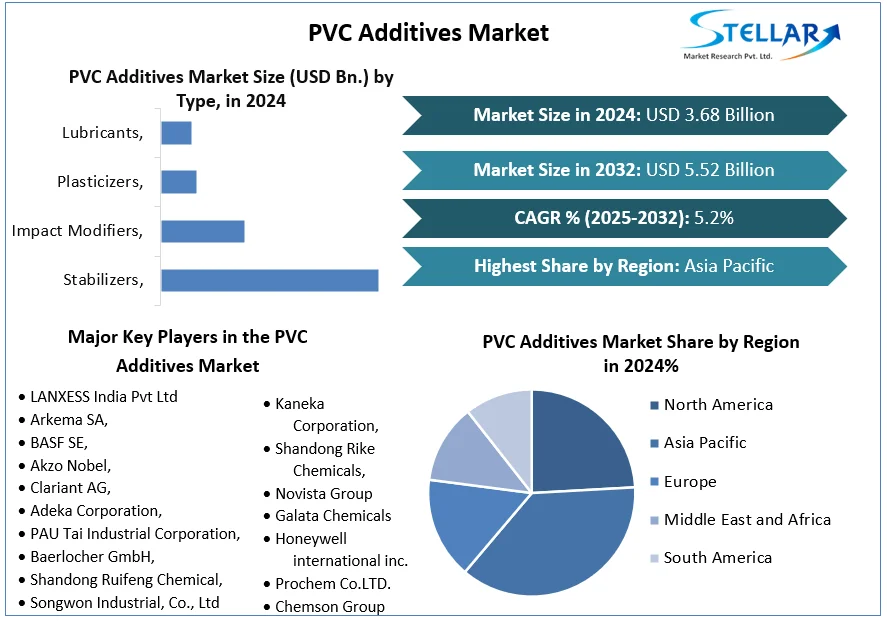
    The global PVC additives market represents a critical segment of the broader polymer additives industry, supporting the performance, durability, and flexibility of polyvinyl chloride across multiple applications. According to the Stellar Market Research report, the market was valued at USD 3.68 billion in 2024 and is forecast to reach USD 5.52 billion by 2032, expanding at a CAGR of 5.2% during 2025–2032.
    PVC additives include stabilizers, plasticizers, lubricants, and impact modifiers that enhance heat stability, flexibility, processing ease, and mechanical strength of PVC materials. These additives play a vital role in end-use sectors such as construction, packaging, automotive, and electrical applications where PVC’s durability and cost-efficiency offer strong performance advantages.

    Request Free Sample Report : https://www.stellarmr.com/report/req_sample/PVC-Additives-Market/2471

    Market Growth Drivers & Opportunity
    The market is being strongly driven by the rising adoption of lightweight and cost-efficient materials in construction, infrastructure, and industrial sectors. PVC’s ability to replace traditional materials such as steel, iron, and concrete is significantly accelerating demand for additives that enhance its performance and lifespan.
    Another major growth driver is the increasing demand for stabilizers that improve thermal stability and durability in applications such as pipes, roofing membranes, window profiles, and electrical insulation.
    Rapid urbanization, infrastructure investments, and growth in packaging—particularly food and medical packaging—are also fueling the need for advanced PVC formulations. Additionally, opportunities are expanding in sustainable and recyclable additive technologies as manufacturers develop eco-friendly alternatives to meet regulatory and environmental expectations.

    What Lies Ahead: Emerging Trends Shaping the Future
    The future of the PVC additives market will be shaped by sustainability and technological innovation. Industry participants are focusing on bio-based plasticizers, low-toxicity stabilizers, and recyclable additive systems that support green building standards and circular economy initiatives.
    Smart infrastructure development and the adoption of high-performance materials in modern urban projects are further accelerating demand for advanced additive formulations. Innovations in additives that improve clarity, heat resistance, and mechanical performance are expected to redefine product standards across packaging and construction segments.

    Request Free Sample Report : https://www.stellarmr.com/report/req_sample/PVC-Additives-Market/2471

    Press Release Conclusion
    The global PVC additives market is on a stable growth trajectory, supported by increasing demand for lightweight, durable, and sustainable materials across construction, automotive, and packaging sectors. While environmental regulations and recycling challenges remain key restraints, continuous innovation in eco-friendly additives and circular material solutions is expected to unlock new opportunities.
    As industries continue to prioritize performance, sustainability, and cost-efficiency, the PVC additives market is poised to play a crucial role in shaping next-generation material solutions worldwide, reinforcing its position as a vital component of the global polymer industry.

    About us

    Phase 3,Navale IT Zone, S.No. 51/2A/2,

    Office No. 202, 2nd floor,

    Near, Navale Brg,Narhe,

    Pune, Maharashtra 411041

    sales@stellarmr.com
    PVC Additives Market Press Release Analysis Market Estimation & Definition The global PVC additives market represents a critical segment of the broader polymer additives industry, supporting the performance, durability, and flexibility of polyvinyl chloride across multiple applications. According to the Stellar Market Research report, the market was valued at USD 3.68 billion in 2024 and is forecast to reach USD 5.52 billion by 2032, expanding at a CAGR of 5.2% during 2025–2032. PVC additives include stabilizers, plasticizers, lubricants, and impact modifiers that enhance heat stability, flexibility, processing ease, and mechanical strength of PVC materials. These additives play a vital role in end-use sectors such as construction, packaging, automotive, and electrical applications where PVC’s durability and cost-efficiency offer strong performance advantages. Request Free Sample Report : https://www.stellarmr.com/report/req_sample/PVC-Additives-Market/2471 Market Growth Drivers & Opportunity The market is being strongly driven by the rising adoption of lightweight and cost-efficient materials in construction, infrastructure, and industrial sectors. PVC’s ability to replace traditional materials such as steel, iron, and concrete is significantly accelerating demand for additives that enhance its performance and lifespan. Another major growth driver is the increasing demand for stabilizers that improve thermal stability and durability in applications such as pipes, roofing membranes, window profiles, and electrical insulation. Rapid urbanization, infrastructure investments, and growth in packaging—particularly food and medical packaging—are also fueling the need for advanced PVC formulations. Additionally, opportunities are expanding in sustainable and recyclable additive technologies as manufacturers develop eco-friendly alternatives to meet regulatory and environmental expectations. What Lies Ahead: Emerging Trends Shaping the Future The future of the PVC additives market will be shaped by sustainability and technological innovation. Industry participants are focusing on bio-based plasticizers, low-toxicity stabilizers, and recyclable additive systems that support green building standards and circular economy initiatives. Smart infrastructure development and the adoption of high-performance materials in modern urban projects are further accelerating demand for advanced additive formulations. Innovations in additives that improve clarity, heat resistance, and mechanical performance are expected to redefine product standards across packaging and construction segments. Request Free Sample Report : https://www.stellarmr.com/report/req_sample/PVC-Additives-Market/2471 Press Release Conclusion The global PVC additives market is on a stable growth trajectory, supported by increasing demand for lightweight, durable, and sustainable materials across construction, automotive, and packaging sectors. While environmental regulations and recycling challenges remain key restraints, continuous innovation in eco-friendly additives and circular material solutions is expected to unlock new opportunities. As industries continue to prioritize performance, sustainability, and cost-efficiency, the PVC additives market is poised to play a crucial role in shaping next-generation material solutions worldwide, reinforcing its position as a vital component of the global polymer industry. About us Phase 3,Navale IT Zone, S.No. 51/2A/2, Office No. 202, 2nd floor, Near, Navale Brg,Narhe, Pune, Maharashtra 411041 sales@stellarmr.com
    0 Comments 0 Shares 4K Views 0 Reviews
  • US Vertical Farming Market Trends: Automation, AI, and Energy-Efficient Systems Dominate

    United States Vertical Farming Market Set to Surge Toward USD 9.91 Billion by 2029, Driven by Urban Agriculture Innovation

    The United States vertical farming market is entering a transformative phase as the agriculture sector embraces technology-driven production systems to meet growing urban food demand. According to insights from the Stellar Market Research study on the United States vertical farming market, the industry is positioned for robust expansion over the forecast period as investments in controlled environment agriculture intensify.

    Request Free Sample Report : https://www.stellarmr.com/report/req_sample/United-States-Vertical-Farming-Market/465
    Market Estimation & Definition
    Vertical farming refers to the practice of cultivating crops in vertically stacked layers or controlled indoor environments such as warehouses, high-rise buildings, or shipping containers. These systems rely on advanced technologies such as LED lighting, hydroponics, aeroponics, and automation to optimize crop yield while minimizing land and water usage.

    The United States vertical farming market was valued at approximately USD 2.00 billion in 2022 and is projected to reach nearly USD 9.91 billion by 2029, expanding at a CAGR of about 25.65% during the forecast period. This rapid growth trajectory reflects increasing demand for fresh, locally grown produce, alongside technological advancements that improve operational efficiency and scalability.

    Market Growth Drivers & Opportunity
    The primary driver of the vertical farming market in the United States is the rising need for sustainable food production in urban areas. Rapid urbanization, limited availability of arable land, and growing concerns about climate change are encouraging farmers and investors to adopt indoor farming technologies. Vertical farming offers year-round production, reduced transportation costs, and minimal pesticide use, making it an attractive alternative to conventional agriculture.

    Technological advancements in LED lighting, automation, and artificial intelligence are also accelerating adoption. These technologies enhance yield predictability and reduce operational costs, thereby improving profitability. Additionally, increased consumer awareness regarding organic and pesticide-free produce is further strengthening market demand.

    Government initiatives supporting food security and sustainability, along with rising venture capital investments in agri-tech startups, are creating new opportunities for market expansion. The development of modular farming units and scalable container-based systems is enabling small and mid-scale operators to enter the market, expanding the competitive landscape.

    What Lies Ahead: Emerging Trends Shaping the Future
    Several trends are reshaping the future of vertical farming in the United States. The integration of AI-driven farm management systems is enabling real-time monitoring of crop health, water usage, and nutrient levels. This leads to optimized productivity and reduced waste.

    Another major trend is the increasing adoption of renewable energy solutions such as solar-powered farms, which help reduce the high energy consumption associated with indoor farming operations. Urban retail integration is also gaining momentum, with vertical farms being established within or near supermarkets to ensure hyper-local supply chains.

    Furthermore, the industry is witnessing a shift toward diversified crop production beyond leafy greens, including fruits, herbs, and specialty crops. This diversification is expanding the commercial viability of vertical farming across different consumer segments.

    Request Free Sample Report : https://www.stellarmr.com/report/req_sample/United-States-Vertical-Farming-Market/465


    About us

    Phase 3,Navale IT Zone, S.No. 51/2A/2,

    Office No. 202, 2nd floor,

    Near, Navale Brg,Narhe,

    Pune, Maharashtra 411041

    sales@stellarmr.com
    US Vertical Farming Market Trends: Automation, AI, and Energy-Efficient Systems Dominate United States Vertical Farming Market Set to Surge Toward USD 9.91 Billion by 2029, Driven by Urban Agriculture Innovation The United States vertical farming market is entering a transformative phase as the agriculture sector embraces technology-driven production systems to meet growing urban food demand. According to insights from the Stellar Market Research study on the United States vertical farming market, the industry is positioned for robust expansion over the forecast period as investments in controlled environment agriculture intensify. Request Free Sample Report : https://www.stellarmr.com/report/req_sample/United-States-Vertical-Farming-Market/465 Market Estimation & Definition Vertical farming refers to the practice of cultivating crops in vertically stacked layers or controlled indoor environments such as warehouses, high-rise buildings, or shipping containers. These systems rely on advanced technologies such as LED lighting, hydroponics, aeroponics, and automation to optimize crop yield while minimizing land and water usage. The United States vertical farming market was valued at approximately USD 2.00 billion in 2022 and is projected to reach nearly USD 9.91 billion by 2029, expanding at a CAGR of about 25.65% during the forecast period. This rapid growth trajectory reflects increasing demand for fresh, locally grown produce, alongside technological advancements that improve operational efficiency and scalability. Market Growth Drivers & Opportunity The primary driver of the vertical farming market in the United States is the rising need for sustainable food production in urban areas. Rapid urbanization, limited availability of arable land, and growing concerns about climate change are encouraging farmers and investors to adopt indoor farming technologies. Vertical farming offers year-round production, reduced transportation costs, and minimal pesticide use, making it an attractive alternative to conventional agriculture. Technological advancements in LED lighting, automation, and artificial intelligence are also accelerating adoption. These technologies enhance yield predictability and reduce operational costs, thereby improving profitability. Additionally, increased consumer awareness regarding organic and pesticide-free produce is further strengthening market demand. Government initiatives supporting food security and sustainability, along with rising venture capital investments in agri-tech startups, are creating new opportunities for market expansion. The development of modular farming units and scalable container-based systems is enabling small and mid-scale operators to enter the market, expanding the competitive landscape. What Lies Ahead: Emerging Trends Shaping the Future Several trends are reshaping the future of vertical farming in the United States. The integration of AI-driven farm management systems is enabling real-time monitoring of crop health, water usage, and nutrient levels. This leads to optimized productivity and reduced waste. Another major trend is the increasing adoption of renewable energy solutions such as solar-powered farms, which help reduce the high energy consumption associated with indoor farming operations. Urban retail integration is also gaining momentum, with vertical farms being established within or near supermarkets to ensure hyper-local supply chains. Furthermore, the industry is witnessing a shift toward diversified crop production beyond leafy greens, including fruits, herbs, and specialty crops. This diversification is expanding the commercial viability of vertical farming across different consumer segments. Request Free Sample Report : https://www.stellarmr.com/report/req_sample/United-States-Vertical-Farming-Market/465 About us Phase 3,Navale IT Zone, S.No. 51/2A/2, Office No. 202, 2nd floor, Near, Navale Brg,Narhe, Pune, Maharashtra 411041 sales@stellarmr.com
    0 Comments 0 Shares 6K Views 0 Reviews
  • US Antibody Drug Conjugates Market Expected to Grow at 15.2% CAGR Through 2032

    US Antibody Drug Conjugates Market Set for Robust Growth Amid Rising Oncology Innovations

    Market Estimation & Definition
    The US Antibody Drug Conjugates (ADC) market is witnessing significant expansion as precision oncology advances reshape cancer treatment paradigms. According to Stellar Market Research, the US ADC market was valued at USD 1.49 billion in 2024 and is projected to reach nearly USD 4.64 billion by 2032, growing at a CAGR of 15.2% during the forecast period.
    Antibody drug conjugates are an advanced class of targeted cancer therapies that combine monoclonal antibodies with cytotoxic payloads. This design enables highly selective targeting of cancer cells while minimizing damage to healthy tissue, positioning ADCs as a transformative therapeutic approach in oncology care.

    Request Free Sample Report : https://www.stellarmr.com/report/req_sample/US-Antibody-Drug-Conjugates-Market/1618

    Market Growth Drivers & Opportunities
    The primary driver of the US ADC market is the increasing incidence of cancer across multiple indications such as breast, lung, blood, and solid tumors. As cancer prevalence rises, demand for effective and safer targeted therapies continues to surge.
    Strong investment in oncology research and healthcare infrastructure further fuels innovation, enabling rapid development of next-generation ADCs with improved efficacy and safety profiles. Expanding reimbursement frameworks and clinical adoption also support the commercialization of ADC therapies in the US healthcare system.

    In addition, growing collaborations between biotechnology firms and pharmaceutical giants are creating opportunities for accelerated development, licensing agreements, and pipeline expansion. Technological advancements in linker chemistry and payload engineering are opening new avenues to treat previously untargetable tumors, thereby expanding the therapeutic scope of ADCs.


    About us
    Phase 3,Navale IT Zone, S.No. 51/2A/2,

    Office No. 202, 2nd floor,

    Near, Navale Brg,Narhe,

    Pune, Maharashtra 411041

    sales@stellarmr.com
    US Antibody Drug Conjugates Market Expected to Grow at 15.2% CAGR Through 2032 US Antibody Drug Conjugates Market Set for Robust Growth Amid Rising Oncology Innovations Market Estimation & Definition The US Antibody Drug Conjugates (ADC) market is witnessing significant expansion as precision oncology advances reshape cancer treatment paradigms. According to Stellar Market Research, the US ADC market was valued at USD 1.49 billion in 2024 and is projected to reach nearly USD 4.64 billion by 2032, growing at a CAGR of 15.2% during the forecast period. Antibody drug conjugates are an advanced class of targeted cancer therapies that combine monoclonal antibodies with cytotoxic payloads. This design enables highly selective targeting of cancer cells while minimizing damage to healthy tissue, positioning ADCs as a transformative therapeutic approach in oncology care. Request Free Sample Report : https://www.stellarmr.com/report/req_sample/US-Antibody-Drug-Conjugates-Market/1618 Market Growth Drivers & Opportunities The primary driver of the US ADC market is the increasing incidence of cancer across multiple indications such as breast, lung, blood, and solid tumors. As cancer prevalence rises, demand for effective and safer targeted therapies continues to surge. Strong investment in oncology research and healthcare infrastructure further fuels innovation, enabling rapid development of next-generation ADCs with improved efficacy and safety profiles. Expanding reimbursement frameworks and clinical adoption also support the commercialization of ADC therapies in the US healthcare system. In addition, growing collaborations between biotechnology firms and pharmaceutical giants are creating opportunities for accelerated development, licensing agreements, and pipeline expansion. Technological advancements in linker chemistry and payload engineering are opening new avenues to treat previously untargetable tumors, thereby expanding the therapeutic scope of ADCs. About us Phase 3,Navale IT Zone, S.No. 51/2A/2, Office No. 202, 2nd floor, Near, Navale Brg,Narhe, Pune, Maharashtra 411041 sales@stellarmr.com
    0 Comments 0 Shares 3K Views 0 Reviews
  • Male Fertility Testing Products Drive New Growth Opportunities

    Fertility Testing Market: Empowering Reproductive Health Through Precision Diagnostics

    The Fertility Testing Market is experiencing consistent growth driven by rising infertility rates, increasing awareness of reproductive health, and the adoption of convenient at-home diagnostics. According to Stellar Market Research, the global fertility testing market was valued at approximately USD 630.33 million in 2024 and is projected to expand to around USD 1,124.19 million by 2032, growing at a Compound Annual Growth Rate (CAGR) of about 7.5 % during the 2025-2032 period.

    Request Free Sample Report : https://www.stellarmr.com/report/req_sample/fertility-testing-market/2358

    Market Estimation & Definition

    Fertility testing refers to a suite of diagnostic solutions and tools designed to assess reproductive health in individuals and couples, helping identify factors that may affect the ability to conceive naturally. These tests encompass a broad range of products — including ovulation prediction kits, male fertility testing products, and fertility monitors — as well as analyses conducted in clinical settings. They may rely on samples such as urine, saliva, or blood and are used to measure hormone levels, ovulatory cycles, sperm quality, and other critical fertility indicators.

    The purpose of fertility testing is to guide couples in understanding their reproductive health, optimizing timing, identifying underlying issues, and making informed decisions about treatments or lifestyle adjustments that could enhance their chances of conception.

    Market Growth Drivers & Opportunity

    Several factors are fueling the expansion of the fertility testing market:

    Increasing Infertility Prevalence: Infertility affects a significant portion of the global population, often prompting individuals to seek diagnostic assessments. Delayed parenthood due to career, lifestyle or socio-economic factors has amplified this trend, with many couples pursuing early evaluation to guide family planning decisions.

    Growing Awareness & Education: Public understanding of reproductive health and fertility diagnostics has improved, leading to earlier adoption of testing. Awareness campaigns, healthcare initiatives, and fertility education programs underscore the importance of timely evaluation and intervention.

    Shift to At-Home Testing: Consumers increasingly prefer home-based fertility tests for privacy, convenience and affordability. Ovulation predictor kits and self-administrable male fertility tests allow couples to monitor reproductive health without frequent clinical visits, driving demand for remote, user-friendly diagnostics.

    Technological Advancements: Innovations in biosensor technology, digital integration, and smart monitoring devices — including smartphone-connected test kits — are improving test accuracy, user experience and accessibility, particularly in emerging markets.

    Together, these drivers position the fertility testing market as a key component of preventative and reproductive healthcare services.

    Request Free Sample Report : https://www.stellarmr.com/report/req_sample/fertility-testing-market/2358

    What Lies Ahead: Emerging Trends Shaping the Future

    The future of fertility testing is being shaped by several notable trends:

    Digital Integration and AI-Powered Diagnostics: Smart fertility solutions that integrate mobile apps, cloud analytics and artificial intelligence are enabling personalized cycle predictions, real-time insights and improved accuracy in fertility assessment.

    Expansion of Male Fertility Testing: Historically, female fertility assessment has dominated the market, but male fertility testing is gaining traction as awareness grows that male factors contribute significantly to infertility. Home-based sperm analysis kits and microfluidic diagnostic tools are expanding this segment.

    Multi-Parameter At-Home Panels: New products increasingly test multiple reproductive biomarkers simultaneously, offering deeper insights into hormonal balance, ovulation timing and overall reproductive health in non-clinical settings.

    These trends reflect a broader shift toward personalized, connected and accessible fertility solutions that empower individuals with actionable reproductive health data.

    Segmentation Analysis

    The fertility testing market is segmented based on several key factors:

    About us

    Phase 3,Navale IT Zone, S.No. 51/2A/2,

    Office No. 202, 2nd floor,

    Near, Navale Brg,Narhe,

    Pune, Maharashtra 411041

    sales@stellarmr.com
    Male Fertility Testing Products Drive New Growth Opportunities Fertility Testing Market: Empowering Reproductive Health Through Precision Diagnostics The Fertility Testing Market is experiencing consistent growth driven by rising infertility rates, increasing awareness of reproductive health, and the adoption of convenient at-home diagnostics. According to Stellar Market Research, the global fertility testing market was valued at approximately USD 630.33 million in 2024 and is projected to expand to around USD 1,124.19 million by 2032, growing at a Compound Annual Growth Rate (CAGR) of about 7.5 % during the 2025-2032 period. Request Free Sample Report : https://www.stellarmr.com/report/req_sample/fertility-testing-market/2358 Market Estimation & Definition Fertility testing refers to a suite of diagnostic solutions and tools designed to assess reproductive health in individuals and couples, helping identify factors that may affect the ability to conceive naturally. These tests encompass a broad range of products — including ovulation prediction kits, male fertility testing products, and fertility monitors — as well as analyses conducted in clinical settings. They may rely on samples such as urine, saliva, or blood and are used to measure hormone levels, ovulatory cycles, sperm quality, and other critical fertility indicators. The purpose of fertility testing is to guide couples in understanding their reproductive health, optimizing timing, identifying underlying issues, and making informed decisions about treatments or lifestyle adjustments that could enhance their chances of conception. Market Growth Drivers & Opportunity Several factors are fueling the expansion of the fertility testing market: Increasing Infertility Prevalence: Infertility affects a significant portion of the global population, often prompting individuals to seek diagnostic assessments. Delayed parenthood due to career, lifestyle or socio-economic factors has amplified this trend, with many couples pursuing early evaluation to guide family planning decisions. Growing Awareness & Education: Public understanding of reproductive health and fertility diagnostics has improved, leading to earlier adoption of testing. Awareness campaigns, healthcare initiatives, and fertility education programs underscore the importance of timely evaluation and intervention. Shift to At-Home Testing: Consumers increasingly prefer home-based fertility tests for privacy, convenience and affordability. Ovulation predictor kits and self-administrable male fertility tests allow couples to monitor reproductive health without frequent clinical visits, driving demand for remote, user-friendly diagnostics. Technological Advancements: Innovations in biosensor technology, digital integration, and smart monitoring devices — including smartphone-connected test kits — are improving test accuracy, user experience and accessibility, particularly in emerging markets. Together, these drivers position the fertility testing market as a key component of preventative and reproductive healthcare services. Request Free Sample Report : https://www.stellarmr.com/report/req_sample/fertility-testing-market/2358 What Lies Ahead: Emerging Trends Shaping the Future The future of fertility testing is being shaped by several notable trends: Digital Integration and AI-Powered Diagnostics: Smart fertility solutions that integrate mobile apps, cloud analytics and artificial intelligence are enabling personalized cycle predictions, real-time insights and improved accuracy in fertility assessment. Expansion of Male Fertility Testing: Historically, female fertility assessment has dominated the market, but male fertility testing is gaining traction as awareness grows that male factors contribute significantly to infertility. Home-based sperm analysis kits and microfluidic diagnostic tools are expanding this segment. Multi-Parameter At-Home Panels: New products increasingly test multiple reproductive biomarkers simultaneously, offering deeper insights into hormonal balance, ovulation timing and overall reproductive health in non-clinical settings. These trends reflect a broader shift toward personalized, connected and accessible fertility solutions that empower individuals with actionable reproductive health data. Segmentation Analysis The fertility testing market is segmented based on several key factors: About us Phase 3,Navale IT Zone, S.No. 51/2A/2, Office No. 202, 2nd floor, Near, Navale Brg,Narhe, Pune, Maharashtra 411041 sales@stellarmr.com
    0 Comments 0 Shares 4K Views 0 Reviews
  • The Rise of E-Bikes in Bike-Sharing Fleets Across Spain

    Spain Bike Sharing Market: Pedaling Towards Sustainable Urban Mobility

    The Spain Bike Sharing Market is expanding steadily as urban centers in the country embrace sustainable, healthy and low-emission transportation options. According to Stellar Market Research, the Spain bike sharing market was valued at approximately USD 385.04 million in 2024 and is expected to grow at a compound annual growth rate (CAGR) of about 4 % between 2025 and 2032, reaching nearly USD 526.96 million by 2032.

    Bike sharing — a key segment of the shared mobility ecosystem — refers to publicly accessible, short-term bicycle rental services where users can rent and return bikes at convenient locations across a city. These services include both e-bikes and conventional bikes, and can operate under different models such as free-floating, peer-to-peer (P2P), and station-based systems.

    Request Free Sample Report : https://www.stellarmr.com/report/req_sample/Spain-Bike-Sharing-Market/159

    Market Estimation & Definition

    Bike sharing systems provide bicycles for flexible public use, typically integrating mobile apps, GPS tracking, and digital payments to enable convenient rentals across urban areas. These systems support first- and last-mile connectivity, reduce reliance on private motor vehicles, and align with broader sustainability and smart city goals. The Spain bike sharing market’s valuation in 2024 reflects growing adoption in major cities like Madrid and Barcelona, where government-supported programs and private initiatives have made shared bikes an integral part of urban mobility.

    Market Growth Drivers & Opportunity

    The growth of the Spain bike sharing market is driven by several key factors:

    Environmental and Health Awareness: Rising awareness of air pollution, climate change and public health imperatives has oriented commuters toward eco-friendly transport alternatives such as bike sharing. These services help lower emissions and support active lifestyles, aligning with national and EU sustainability agendas.

    Urban Congestion and Mobility Challenges: Cities in Spain are deploying bike sharing to alleviate traffic congestion and provide efficient, flexible mobility options for short trips. Bike sharing reduces dependence on private cars, improve traffic flows and enhances access to employment and urban services.

    Tourism and Local Travel Patterns: Spain’s position as a major tourist destination fuels demand for short-term rentals and flexible travel modes within city centers. Bike sharing appeals to both residents and visitors looking for simple, affordable ways to explore urban spaces.

    Technological Enablement: Integration of mobile applications, QR-based unlocking and real-time mapping enhances user ease and service efficiency, encouraging wider adoption across diverse age groups and commuter profiles.

    Growth opportunities lie in expanding services to smaller cities and suburban regions, developing intermodal integration with public transport, and increasing investments in electric bike (e-bike) fleets, which typically yield higher ridership and longer trips within bike sharing systems.

    What Lies Ahead: Emerging Trends Shaping the Future

    Several emerging trends are influencing the Spain bike sharing market:

    Shift Toward Electric Bikes: Electric bicycles are gaining prominence within shared mobility, offering extended range and easier navigation of hilly terrain in cities like Barcelona and Seville. Electric models often support higher daily distances and enhance overall system use.

    Station Expansion and Integration: Traditional station-based systems — which remain dominant in Spain with approximately 70 % market share — are being expanded to cover wider urban territories and support increased ridership.

    Expansion Beyond Major Cities: Smaller Spanish cities such as Valladolid, Gijón and Santander have launched or expanded their own bike sharing systems to improve local mobility and reduce city emissions, indicating broad market diffusion beyond Madrid and Barcelona.

    Public-Private Partnerships: Collaborations between municipalities and private providers — including operators like PBSC, Movus, Donkey Republic and BICIMAD — are enabling better service coverage, more robust fleets, and improved user experience.

    Request Free Sample Report : https://www.stellarmr.com/report/req_sample/Spain-Bike-Sharing-Market/159


    About us

    Phase 3,Navale IT Zone, S.No. 51/2A/2,

    Office No. 202, 2nd floor,

    Near, Navale Brg,Narhe,

    Pune, Maharashtra 411041

    sales@stellarmr.com
    The Rise of E-Bikes in Bike-Sharing Fleets Across Spain Spain Bike Sharing Market: Pedaling Towards Sustainable Urban Mobility The Spain Bike Sharing Market is expanding steadily as urban centers in the country embrace sustainable, healthy and low-emission transportation options. According to Stellar Market Research, the Spain bike sharing market was valued at approximately USD 385.04 million in 2024 and is expected to grow at a compound annual growth rate (CAGR) of about 4 % between 2025 and 2032, reaching nearly USD 526.96 million by 2032. Bike sharing — a key segment of the shared mobility ecosystem — refers to publicly accessible, short-term bicycle rental services where users can rent and return bikes at convenient locations across a city. These services include both e-bikes and conventional bikes, and can operate under different models such as free-floating, peer-to-peer (P2P), and station-based systems. Request Free Sample Report : https://www.stellarmr.com/report/req_sample/Spain-Bike-Sharing-Market/159 Market Estimation & Definition Bike sharing systems provide bicycles for flexible public use, typically integrating mobile apps, GPS tracking, and digital payments to enable convenient rentals across urban areas. These systems support first- and last-mile connectivity, reduce reliance on private motor vehicles, and align with broader sustainability and smart city goals. The Spain bike sharing market’s valuation in 2024 reflects growing adoption in major cities like Madrid and Barcelona, where government-supported programs and private initiatives have made shared bikes an integral part of urban mobility. Market Growth Drivers & Opportunity The growth of the Spain bike sharing market is driven by several key factors: Environmental and Health Awareness: Rising awareness of air pollution, climate change and public health imperatives has oriented commuters toward eco-friendly transport alternatives such as bike sharing. These services help lower emissions and support active lifestyles, aligning with national and EU sustainability agendas. Urban Congestion and Mobility Challenges: Cities in Spain are deploying bike sharing to alleviate traffic congestion and provide efficient, flexible mobility options for short trips. Bike sharing reduces dependence on private cars, improve traffic flows and enhances access to employment and urban services. Tourism and Local Travel Patterns: Spain’s position as a major tourist destination fuels demand for short-term rentals and flexible travel modes within city centers. Bike sharing appeals to both residents and visitors looking for simple, affordable ways to explore urban spaces. Technological Enablement: Integration of mobile applications, QR-based unlocking and real-time mapping enhances user ease and service efficiency, encouraging wider adoption across diverse age groups and commuter profiles. Growth opportunities lie in expanding services to smaller cities and suburban regions, developing intermodal integration with public transport, and increasing investments in electric bike (e-bike) fleets, which typically yield higher ridership and longer trips within bike sharing systems. What Lies Ahead: Emerging Trends Shaping the Future Several emerging trends are influencing the Spain bike sharing market: Shift Toward Electric Bikes: Electric bicycles are gaining prominence within shared mobility, offering extended range and easier navigation of hilly terrain in cities like Barcelona and Seville. Electric models often support higher daily distances and enhance overall system use. Station Expansion and Integration: Traditional station-based systems — which remain dominant in Spain with approximately 70 % market share — are being expanded to cover wider urban territories and support increased ridership. Expansion Beyond Major Cities: Smaller Spanish cities such as Valladolid, Gijón and Santander have launched or expanded their own bike sharing systems to improve local mobility and reduce city emissions, indicating broad market diffusion beyond Madrid and Barcelona. Public-Private Partnerships: Collaborations between municipalities and private providers — including operators like PBSC, Movus, Donkey Republic and BICIMAD — are enabling better service coverage, more robust fleets, and improved user experience. Request Free Sample Report : https://www.stellarmr.com/report/req_sample/Spain-Bike-Sharing-Market/159 About us Phase 3,Navale IT Zone, S.No. 51/2A/2, Office No. 202, 2nd floor, Near, Navale Brg,Narhe, Pune, Maharashtra 411041 sales@stellarmr.com
    0 Comments 0 Shares 4K Views 0 Reviews
  • Grid‑Scale Storage: Supporting Renewable Adoption and Grid Stability

    Energy Storage Market: Powering the Global Energy Transition

    The Energy Storage Market is rapidly becoming an essential component of the global energy ecosystem as countries, utilities, and businesses strive to integrate renewable energy sources and enhance grid reliability. Energy storage systems (ESS) allow electricity — whether from intermittent solar, wind, or other sources — to be stored and released when needed, enabling better load balancing, grid stability, and greater energy independence. According to Stellar Market Research, the energy storage market was valued at about USD 29.69 billion in 2025 and is projected to grow at a compound annual growth rate (CAGR) of around 19 % from 2026 to 2032, reaching approximately USD 100.33 billion by 2032.

    Request Free Sample Report : https://www.stellarmr.com/report/req_sample/Energy-Storage-Market/291

    Market Estimation & Definition

    The energy storage market includes a variety of systems and technologies designed to capture electrical energy for later use. These systems support renewable energy integration, peak demand management, grid stabilization, backup power, and electrification of transportation — making them critical for modern and future energy infrastructures. Technologies commonly deployed include batteries, pumped‑storage hydroelectricity (PSH), thermal energy storage (TES), flywheel energy storage (FES), and other mechanical or chemical storage solutions.

    Energy storage is vital for overcoming the variability of renewable sources such as solar and wind, enabling energy generated during peak production to be stored and dispatched when required. This functionality enhances grid flexibility and supports sustainability goals.

    Request Free Sample Report : https://www.stellarmr.com/report/req_sample/Energy-Storage-Market/291

    Market Growth Drivers & Opportunity

    Several key drivers are propelling the energy storage market:

    Renewable Energy Integration: As global renewable energy generation — particularly solar and wind — increases, the need for storage solutions that smooth out supply fluctuations grows accordingly. Storage systems enable grid operators to balance variable generation with demand, ensuring reliability.

    Falling Costs and Incentives: The cost of energy storage solutions, especially battery technologies, has significantly declined in recent years — in some cases dropping by more than 70 % since 2013 — thanks to advancements in manufacturing and scale economies. Government incentives and policy support further lower the cost barrier and spur investments.

    Electric Mobility and Electrification: The growth of electric vehicles (EVs) and electrification of transportation continues to drive demand for energy storage systems. EV battery production and stationary storage technologies share many common components, creating synergies across markets.

    Urbanization and Industrial Growth: Rapid urbanization and rising energy demand in emerging economies increase the requirement for reliable, scalable energy infrastructure, including storage solutions that can support both residential and industrial needs.

    Opportunities also arise from behind‑the‑meter storage solutions for homes and businesses, microgrids in remote areas, and hybrid storage systems that combine multiple technologies to optimize performance across applications.

    However, high initial investment costs and unclear regulatory frameworks in some regions can present challenges that slow adoption, especially in developing markets where financing and policy support may lag.

    What Lies Ahead: Emerging Trends Shaping the Future

    Future growth in the energy storage market will be shaped by several prominent trends:

    Advanced Battery Technologies: Lithium‑ion batteries currently dominate the market due to their high energy density, efficiency, and decreasing cost. Continued innovation in battery chemistry and manufacturing — including solid‑state, flow, and next‑generation batteries — will further improve performance and reduce lifecycle costs.

    Grid‑Scale and Distributed Storage Expansion: Large‑scale battery installations at grid and utility levels are rapidly expanding, while distributed storage systems for commercial, industrial, and residential users are gaining traction as energy prices and reliability concerns rise.
    .

    About us

    Phase 3,Navale IT Zone, S.No. 51/2A/2,

    Office No. 202, 2nd floor,

    Near, Navale Brg,Narhe,

    Pune, Maharashtra 411041

    sales@stellarmr.com
    Grid‑Scale Storage: Supporting Renewable Adoption and Grid Stability Energy Storage Market: Powering the Global Energy Transition The Energy Storage Market is rapidly becoming an essential component of the global energy ecosystem as countries, utilities, and businesses strive to integrate renewable energy sources and enhance grid reliability. Energy storage systems (ESS) allow electricity — whether from intermittent solar, wind, or other sources — to be stored and released when needed, enabling better load balancing, grid stability, and greater energy independence. According to Stellar Market Research, the energy storage market was valued at about USD 29.69 billion in 2025 and is projected to grow at a compound annual growth rate (CAGR) of around 19 % from 2026 to 2032, reaching approximately USD 100.33 billion by 2032. Request Free Sample Report : https://www.stellarmr.com/report/req_sample/Energy-Storage-Market/291 Market Estimation & Definition The energy storage market includes a variety of systems and technologies designed to capture electrical energy for later use. These systems support renewable energy integration, peak demand management, grid stabilization, backup power, and electrification of transportation — making them critical for modern and future energy infrastructures. Technologies commonly deployed include batteries, pumped‑storage hydroelectricity (PSH), thermal energy storage (TES), flywheel energy storage (FES), and other mechanical or chemical storage solutions. Energy storage is vital for overcoming the variability of renewable sources such as solar and wind, enabling energy generated during peak production to be stored and dispatched when required. This functionality enhances grid flexibility and supports sustainability goals. Request Free Sample Report : https://www.stellarmr.com/report/req_sample/Energy-Storage-Market/291 Market Growth Drivers & Opportunity Several key drivers are propelling the energy storage market: Renewable Energy Integration: As global renewable energy generation — particularly solar and wind — increases, the need for storage solutions that smooth out supply fluctuations grows accordingly. Storage systems enable grid operators to balance variable generation with demand, ensuring reliability. Falling Costs and Incentives: The cost of energy storage solutions, especially battery technologies, has significantly declined in recent years — in some cases dropping by more than 70 % since 2013 — thanks to advancements in manufacturing and scale economies. Government incentives and policy support further lower the cost barrier and spur investments. Electric Mobility and Electrification: The growth of electric vehicles (EVs) and electrification of transportation continues to drive demand for energy storage systems. EV battery production and stationary storage technologies share many common components, creating synergies across markets. Urbanization and Industrial Growth: Rapid urbanization and rising energy demand in emerging economies increase the requirement for reliable, scalable energy infrastructure, including storage solutions that can support both residential and industrial needs. Opportunities also arise from behind‑the‑meter storage solutions for homes and businesses, microgrids in remote areas, and hybrid storage systems that combine multiple technologies to optimize performance across applications. However, high initial investment costs and unclear regulatory frameworks in some regions can present challenges that slow adoption, especially in developing markets where financing and policy support may lag. What Lies Ahead: Emerging Trends Shaping the Future Future growth in the energy storage market will be shaped by several prominent trends: Advanced Battery Technologies: Lithium‑ion batteries currently dominate the market due to their high energy density, efficiency, and decreasing cost. Continued innovation in battery chemistry and manufacturing — including solid‑state, flow, and next‑generation batteries — will further improve performance and reduce lifecycle costs. Grid‑Scale and Distributed Storage Expansion: Large‑scale battery installations at grid and utility levels are rapidly expanding, while distributed storage systems for commercial, industrial, and residential users are gaining traction as energy prices and reliability concerns rise. . About us Phase 3,Navale IT Zone, S.No. 51/2A/2, Office No. 202, 2nd floor, Near, Navale Brg,Narhe, Pune, Maharashtra 411041 sales@stellarmr.com
    0 Comments 0 Shares 4K Views 0 Reviews
More Results