


Rotavator: 10 Common Mistakes and How to Avoid Them
A rotavator transforms hours of exhausting manual digging into fast, uniform soil preparation. Whether you are breaking hardpan before sowing, aerating vegetable beds, or clearing weeds between rows, improper operation or neglected maintenance can shorten your machine's lifespan and hurt soil health.
Knowing what to avoid—and choosing a durable, well-engineered machine like the Mechnova 7HP Petrol Power Tiller (MT900GA-208CC)—ensures smoother field operations, deeper cultivation, and lower repair costs every season.
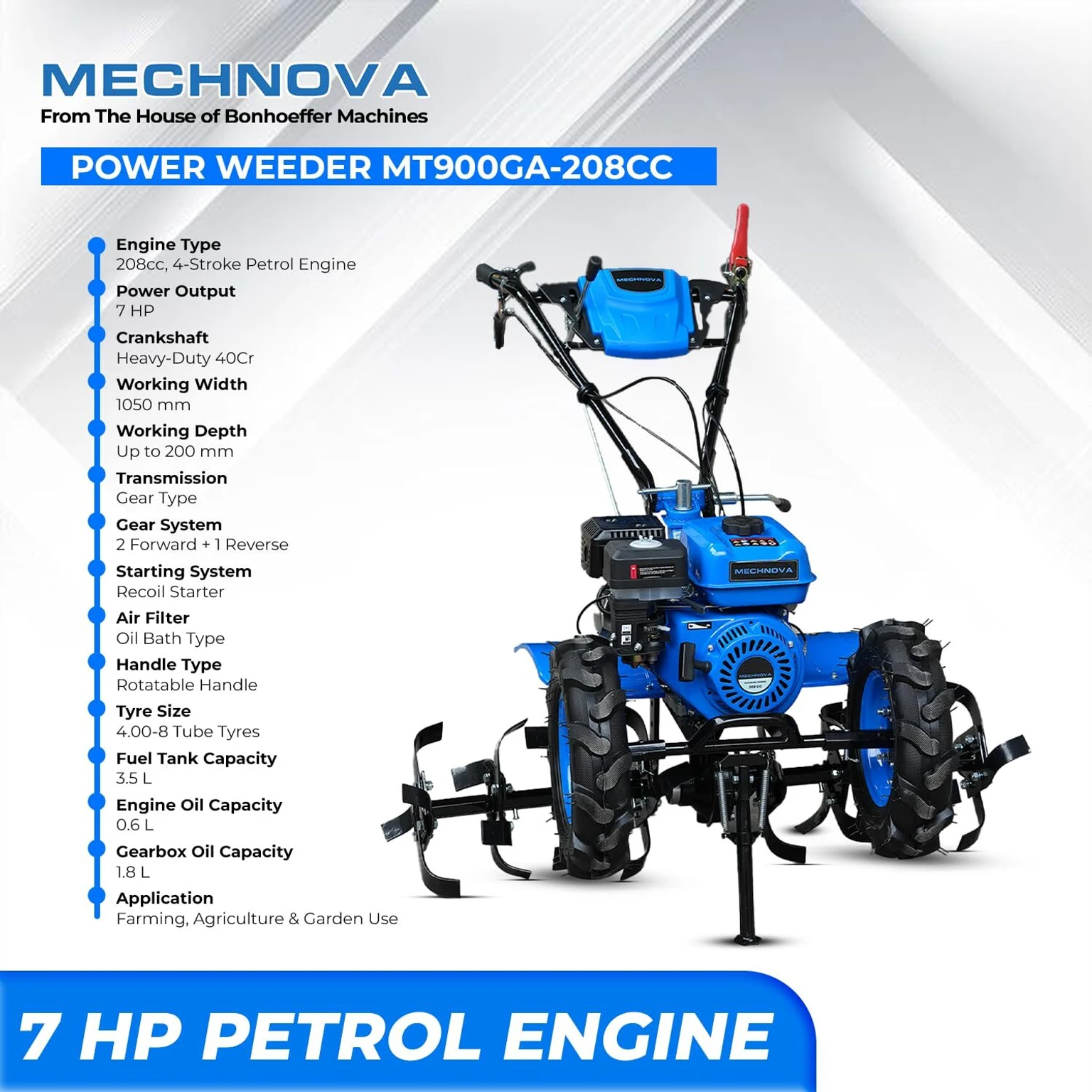
Key Specifications of the Mechnova 7HP Petrol Rotavator (MT900GA-208CC)
Before diving into best practices, here is what powers this heavy-duty rotavator:
-
Model: MT900GA-208CC
-
Engine Type: 7 HP, 208cc, 4-Stroke Air-Cooled Single-Cylinder Petrol Engine
-
Crankshaft: 40Cr Heavy-Duty Crankshaft
-
Transmission: Direct Gear Drive (2 Forward + 1 Reverse)
-
Working Width: Up to 1050 mm (4 Rotary Blade Groups)
-
Working Depth: Up to 200 mm (≥ 200 mm)
-
Rotary Blade Size: 30 cm
-
Tyres: 4.00-8 Inflatable Tube Tyres
-
Air Filter: Oil Bath Type
-
Fuel & Oil Capacities: Fuel Tank: 3.5 L | Engine Oil: 0.6 L | Gearbox Oil: 1.8 L
-
Handlebar: Adjustable & Rotatable
-
Weight: Approx. 85.8 kg
10 Common Rotavator Mistakes and How to Avoid Them
1. Tilling Soil When It Is Too Wet
Running a rotavator in waterlogged or sticky mud smears the soil into dense clods that bake rock-hard once dry, ruining root aeration.
-
How to avoid it: Wait until soil moisture reaches a crumbly, friable state—where a squeezed handful breaks apart easily when dropped.
2. Forcing Maximum Depth on the Very First Pass
Dropping the blades to full depth in hard, uncultivated ground puts extreme strain on the engine, crankshaft, and gearbox.
-
How to avoid it: Make a shallow first pass to break the top crust, then adjust the depth skid to reach the full 200 mm working depth on your second pass.
3. Skipping Pre-Operation Oil Checks
Running a new or serviced rotavator without verifying both engine oil and transmission oil levels can seize internal gears within minutes.
-
How to avoid it: Always check that the 0.6 L engine oil and 1.8 L gearbox oil chambers are filled to the recommended dipstick levels before pulling the recoil starter.
4. Neglecting the Air Filter in Dusty Fields
Soil cultivation throws dense clouds of fine dust directly around the engine intake. A clogged filter starves the engine of air, causing black smoke, power loss, and rapid cylinder wear.
-
How to avoid it: Clean and refill the oil bath air filter regularly—especially during dry summer tillage—to trap fine dust before it reaches the combustion chamber.
5. Operating at Full Throttle Without Adjusting Speed
Many operators push the throttle to the limit regardless of soil hardness, which wastes fuel and over-pulverizes topsoil into dust.
-
How to avoid it: Match your ground speed to soil resistance using the 2 forward gears—use the slower gear for tough, compacted soil and the higher gear for light secondary cultivation.
6. Dragging the Machine Backward Manually at Row Ends
Struggling to pull an 85+ kg machine backward in tight orchard corners or narrow vegetable beds leads to operator fatigue and back strain.
-
How to avoid it: Engage the built-in reverse gear to back out of tight headlands smoothly and safely.
7. Walking Directly Behind the Blades on Freshly Tilled Soil
Stepping right behind the rotary tines compacts the loose seedbed you just created.
-
How to avoid it: Use the rotatable handlebar to angle the controls to the side so you can walk comfortably beside the tilled path.
8. Ignoring Tangled Weeds, Roots, and Twine on the Rotor Shaft
Long grass, crop vines, and plastic twine wrap tightly around the rotary shaft, putting pressure on oil seals and causing leaks.
-
How to avoid it: Turn off the engine completely and clear wrapped debris from the 4 blade groups after every field session.
9. Tilling Over Large Stones and Hidden Tree Roots
Hitting buried rocks or thick roots at high blade RPMs can bend tines or damage standard engine crankshafts.
-
How to avoid it: Walk the plot beforehand to clear large stones, and rely on a machine equipped with a forged 40Cr heavy-duty crankshaft for added impact resistance.
10. Storing the Machine with Old Fuel and Caked Mud
Leaving stale petrol in the tank gums up the carburetor during the off-season, while dried mud traps moisture and rusts the blades.
-
How to avoid it: Wash and dry the 30 cm rotary blades, drain remaining fuel if storing for more than a month, and park the rotavator under a dry cover.
Why the Mechnova 7HP Petrol Rotavator Beats Competitors
When comparing a 7 HP rotavator for small-to-medium farms, orchards, and vegetable plots, key engineering details separate the Mechnova MT900GA-208CC from standard rival machines:
-
Full Gear Drive vs. Belt-Driven Competitors: Many entry-level power weeders rely on V-belts that stretch, slip, or overheat in tough clay. Mechnova’s direct gear-driven transmission—backed by a 1.8 L gearbox oil bath—delivers consistent torque straight to the tines with minimal maintenance.
-
Oil Bath Air Filter vs. Dry Paper Filters: Standard paper or foam elements clog rapidly in dusty Indian fields and require frequent replacements. The oil bath air filter captures fine dust particles efficiently and can be cleaned and reused repeatedly in the field.
-
Forged 40Cr Crankshaft Durability: Ordinary cast crankshafts are vulnerable to bending under sudden shock loads. A 40Cr alloy steel crankshaft improves fatigue strength and extends engine life across demanding seasonal schedules.
-
Wide 1050 mm Coverage with 3.5 L Fuel Tank: While smaller tillers force frequent stops to top up 1.5–2 L tanks, the 3.5-liter petrol tank paired with a 1050 mm working width covers more acreage per hour with fewer refueling interruptions.
-
Shock-Absorbing 4.00-8 Tube Tyres & Rotatable Handle: Large 4.00-8 inflatable tube tyres smooth out bumpy bunds and rough farm tracks, while the adjustable, rotatable handle keeps operation comfortable over long shifts.
Final Takeaway
Avoiding common operating and maintenance mistakes keeps your rotavator performing at peak efficiency while protecting your soil structure. Paired with the right field habits, the Mechnova 7HP 208cc Petrol Power Tiller (MT900GA-208CC) gives farmers the power, gear-driven reliability, and ergonomic control needed to prepare healthier seedbeds in a fraction of the time.
 Italiano
 English
 Arabic
 French
 Spanish
 Portuguese
 Deutsch
 Turkish
 Dutch
 Russian
 Romaian
 Portuguese (Brazil)
 Greek