


3D CAD Software Market Size, Growth Trends, and Industry Analysis 2034
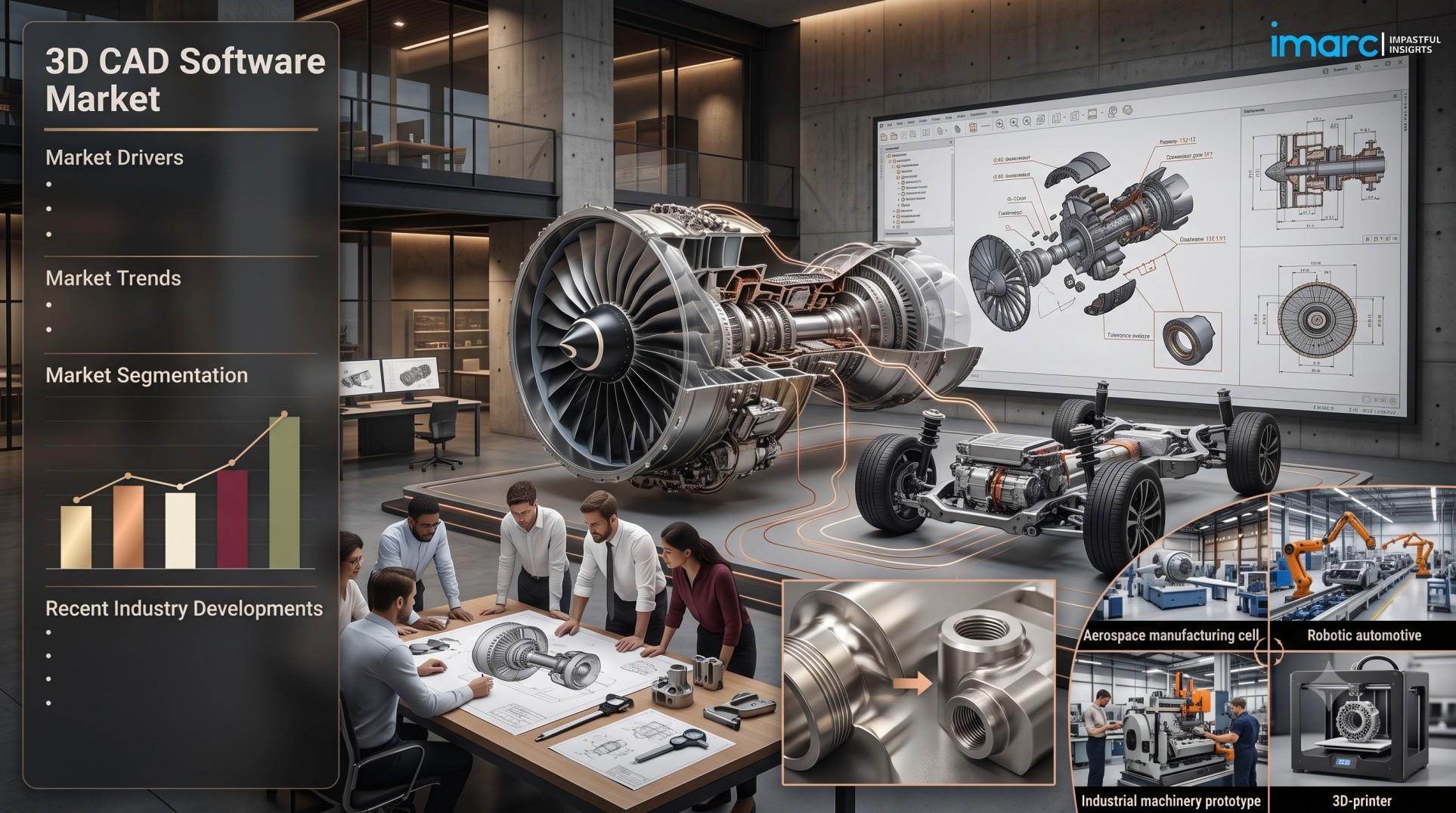
IMARC Group, a leading global market research and management consulting firm, has published its latest market intelligence report on the 3D CAD software market. The global 3D CAD software market size was valued at USD 13.2 Billion in 2025. Looking forward, IMARC Group estimates the market to reach USD 20.5 Billion by 2034, exhibiting a CAGR of 5.00% from 2026-2034, driven by rapid digitalization across automotive, aerospace, and construction industries, growing reliance on 3D printing and additive manufacturing for precision prototyping, expanding adoption of cloud-based design platforms that enable remote collaboration, and the integration of artificial intelligence and immersive visualization technologies into design workflows worldwide.
The market is experiencing steady growth momentum driven by the increasing dependence of modern product development on accurate digital models, virtual testing, and simulation before physical production begins. Engineers and designers across manufacturing, automotive, aerospace, healthcare, and infrastructure projects are relying on 3D CAD tools to shorten development cycles, reduce prototyping costs, and detect design flaws at stages where corrections are least expensive. Industries handling sensitive intellectual property, including defense and aerospace, continue to favor on-premises deployments for data security and control over large, complex design files, while cloud-based platforms are widening access for small and mid-sized firms and distributed teams. Simultaneously, the convergence of CAD with additive manufacturing, automation, and Industry 4.0 initiatives is extending the role of design software from a drafting utility to a core layer of the digital manufacturing chain.
How AI is Reshaping the Future of the 3D CAD Software Market
- AI-Driven Generative Design and Real-Time Design Suggestions: Machine learning models embedded in CAD platforms are generating design alternatives, recommending component placement and material choices, and flagging potential flaws while engineers work, allowing product teams to explore a far wider design space in less time. Leading vendors are now building 3D foundation models that reason directly about geometry and physical relationships, and are validating AI-generated outputs against parametric and physics-based constraints so that results remain manufacturable and accurate in real-world conditions.
- Automated Drawing Creation and Intelligent Error Detection: AI-assisted features are automating time-consuming documentation tasks, with one recent release of a major CAD suite reportedly generating up to 80% of drawing views with minimal user input, while error detection algorithms identify and correct design inconsistencies before they reach costly downstream stages. Embedded assistants and natural-language copilots are also lowering the learning curve for new users, helping organizations extract more productivity from their design teams without proportionally expanding headcount.
- AI-Enabled Additive Manufacturing and Workflow Automation: AI is linking design software directly to production, with partnerships such as the collaboration between Aibuild and Hyperion applying AI-driven automation to large-format polymer 3D printing across Australia, New Zealand, and Asia for construction, furniture, defense, and maritime applications. According to IBM, 34% of companies are already using AI and another 42% are exploring its applications, a trend that is steadily pulling automated part orientation, toolpath preparation, and material optimization into mainstream CAD workflows.
Grab a sample PDF of this report: https://www.imarcgroup.com/3d-cad-software-market/requestsample
3D CAD Software Market Trends and Drivers:
The global 3D CAD software market is witnessing steady expansion, fueled by the convergence of manufacturing digitalization, precision-driven product development, and the rising role of additive manufacturing in prototyping and production. Manufacturing remains the foundation of demand, accounting for around 26.9% of application share, as producers across automotive, aerospace, and electronics depend on 3D CAD tools to design components, test them virtually, and optimize production processes before committing to tooling. The adoption of Industry 4.0 principles is reinforcing this dependence, with smart factories requiring accurate digital models to design connected and efficient systems, while the growing use of 3D printing is making CAD an indispensable step in converting concepts into physical parts. On-premises deployments still hold roughly 70.7% of the market, reflecting the preference of regulated sectors for data security, offline operation, and seamless integration with existing engineering infrastructure.
Cloud adoption is emerging as a powerful structural driver, changing how design teams collaborate and how software is licensed and delivered. According to the Cloud Security Alliance, 98% of organizations now use some form of cloud computing, a level of readiness that is accelerating the shift toward browser-based and subscription CAD platforms. Lightweight, cross-platform solutions such as GstarCAD 365 allow multiple users to view, create, and manage drawings from any location in real time, reducing hardware dependence, lowering operational costs, and supporting distributed engineering teams that span offices, suppliers, and time zones. For smaller firms, subscription-based licensing and cloud delivery are lowering the entry barrier to sophisticated design tools that were once accessible only to large enterprises with established IT infrastructure.
Immersive visualization and sustainability-focused design are adding a further layer of demand that is reshaping product expectations for CAD vendors. Augmented and virtual reality allow designers and stakeholders to step into digital models, assess spatial fit, and refine details before prototypes are built, with a survey by Grid Raster indicating that 91% of enterprises are either already using or planning to adopt AR or VR technology. At the same time, CAD tools are increasingly equipped to simulate material behavior, minimize waste, estimate energy consumption, and evaluate environmental impact, helping engineers develop lighter, more efficient, and lower-carbon products. Industry alliances such as the capital partnership between NTT DATA and Alloyed to advance 3D metal printing for sustainable manufacturing illustrate how design software, materials science, and production technology are converging, and how sustainability considerations are moving from a secondary criterion to a core design requirement across the regulated European and North American industrial base.
Ask an analyst for customized report: https://www.imarcgroup.com/request?type=report&id=5556&flag=E
3D CAD Software Industry Segmentation:
The report has segmented the market into the following categories:
Breakup By Deployment:
- Cloud-Based
- On-Premises
On-premises deployment accounts for the largest share of the market at around 70.7%, driven by the control it offers over data security, customization, and integration with existing engineering infrastructure. Industries such as automotive, aerospace, and defense, which handle sensitive design data under stringent regulatory and security requirements, continue to prefer locally managed CAD environments that operate without dependence on internet connectivity and can handle large, complex assemblies efficiently, while companies with established IT infrastructure benefit from long-term cost savings and operational stability.
Breakup By Application:
- Architecture, Engineering and Construction (AEC)
- Manufacturing
- Automotive
- Healthcare
- Media and Entertainment
- Others
Manufacturing leads the application landscape with around 26.9% of the market, reflecting its extensive need for detailed design, prototyping, and virtual testing across automotive, aerospace, and electronics production. 3D CAD tools help manufacturers maintain precision in component development, streamline workflows, improve product quality, and shorten time-to-market, while the growing adoption of additive manufacturing and automation is deepening reliance on advanced design software that reduces errors and lowers production costs before manufacturing begins.
Breakup By Region:
- North America (United States, Canada)
- Asia Pacific (China, Japan, India, South Korea, Australia, Indonesia, Others)
- Europe (Germany, France, United Kingdom, Italy, Spain, Russia, Others)
- Latin America (Brazil, Mexico, Others)
- Middle East and Africa
North America dominates the global 3D CAD software market with the largest regional share of over 34.3%, driven by a strong industrial base, early adoption of digital design tools, and a well-established infrastructure for research and innovation, with the United States alone accounting for over 92.70% of regional revenue. The presence of automotive, aerospace, and electronics industries that depend on precision design, combined with a skilled professional workforce, growing focus on automation and advanced manufacturing, and supportive government policies, continues to reinforce the region's leadership, while cloud adoption and expanding use of 3D printing further strengthen demand for robust design and modeling tools.
Competitive Landscape:
The report provides a comprehensive analysis of the competitive landscape in the 3D CAD software market with detailed profiles of all major companies, including:
- Autodesk Inc.
- AVEVA Group plc
- Bentley Systems Incorporated
- Dassault Systemes SE
- Hexagon AB
- IronCAD LLC
- PTC Inc.
- SCHOTT SYSTEME GmbH
- Siemens AG
- Trimble Inc.
- ZWCAD Software Co. Ltd.
What Does The Full Report Cover?
If you are tracking the 3D CAD software market for investment decisions, market entry planning, competitive benchmarking, or strategic advisory, IMARC Group's report gives you everything in one place:
- Complete market sizing with revenue forecasts covering the full projection period
- Quantified growth driver analysis with impact scoring across deployment, application, and regional markets
- Sub-segment breakdowns for cloud-based, on-premises, architecture, engineering and construction, manufacturing, automotive, healthcare, and media and entertainment with individual share data
- Country-level data for the United States, Canada, Germany, France, the United Kingdom, Italy, Spain, Russia, China, Japan, India, South Korea, Australia, Indonesia, Brazil, and Mexico
- Competitive profiles of 11 leading companies with strategic landscape assessment
- Porter's Five Forces analysis covering the threat of new entrants, competitive rivalry, supplier power, buyer power, and threat of substitution
- Latest technology trends covering AI-assisted design, cloud-based collaboration, AR and VR integration, additive manufacturing linkages, and sustainability-focused design features shaping market competition and customer preference across key regional markets
Recent News and Developments in 3D CAD Software Market
- May 2026: Autodesk entered into a definitive agreement to acquire MaintainX in an all-cash transaction valued at approximately USD 3.6 Billion, with MaintainX expecting annualized recurring revenue in excess of USD 135 Million this year. The deal supports the creation of Autodesk Operations Solutions, extending the company's design and make portfolio into maintenance and asset operations so that real-world performance data can flow back into design.
- February 2026: Autodesk reported net revenue of USD 7.21 Billion for its latest fiscal year, an increase of 18% over the prior year, with recurring revenue accounting for 97% of the total. The results underline the scale of subscription-based design software and the momentum behind its cloud and AI investments.
- February 2026: Dassault Systèmes reported full-year revenue of EUR 6.24 Billion, up 4%, with software revenue rising 4% to EUR 5.64 Billion and recurring revenue representing 82% of software revenue. Growth in its 3DEXPERIENCE platform and cloud offerings, at 10% and 8% respectively, reflects the continued shift of design and engineering customers toward integrated cloud platforms.
- August 2025: GstarCAD launched GstarCAD 365, a cloud-based, lightweight, cross-platform CAD solution built for real-time communication and collaborative design. The platform supports multi-user access across devices and locations, helping distributed teams create, view, and manage drawings without dependence on a fixed workstation.
- March 2025: Siemens completed its acquisition of Altair Engineering at an enterprise value of approximately USD 10 Billion, the largest acquisition in the company's history. The deal adds mechanical and electromagnetic simulation, high-performance computing, data science, and AI capabilities to the Siemens Xcelerator portfolio, strengthening its position in AI-enabled engineering software.
Note: If you require specific details, data, or insights that are not currently included in the scope of this report, we are happy to accommodate your request. As part of our customization service, we will gather and provide the additional information you need, tailored to your specific requirements. Please let us know your exact needs, and we will ensure the report is updated accordingly to meet your expectations.
Key Questions This Report Answers
- What is the current global 3D CAD software market size and what is its projected value?
- Which deployment segment holds the largest share in the global 3D CAD software market?
- What are the key drivers of global 3D CAD software market growth?
- Which region dominates the global 3D CAD software market and why?
- How are AI integration, cloud adoption, AR and VR technologies, and sustainability considerations reshaping product development and competitive strategies in the 3D CAD software industry?
- Who are the top companies in the global 3D CAD software market and what are their competitive strategies?
- What are the investment and market entry opportunities across cloud-based, manufacturing, automotive, architecture and construction, and healthcare 3D CAD software segments?
About Us:
IMARC Group is a global management consulting firm that helps the world's most ambitious changemakers to create a lasting impact. The company provides a comprehensive suite of market entry and expansion services. IMARC offerings include thorough market assessment, feasibility studies, company incorporation assistance, factory setup support, regulatory approvals and licensing navigation, branding, marketing and sales strategies, competitive landscape and benchmarking analyses, pricing and cost research, and procurement research.
Media and Sales Contact
IMARC Group
Email: sales@imarcgroup.com
United States: +1-201-971-6302
India: +91-120-433-0800
United Kingdom: +44-753-714-6104

 English
 Arabic
 French
 Spanish
 Portuguese
 Deutsch
 Dutch
Dutch
 Italiano
 Russian
 Romaian
 Portuguese (Brazil)
 Greek
Greek