


Demand for Clear Food Information Boosts Nutritional Labelling Market Outlook to 2036
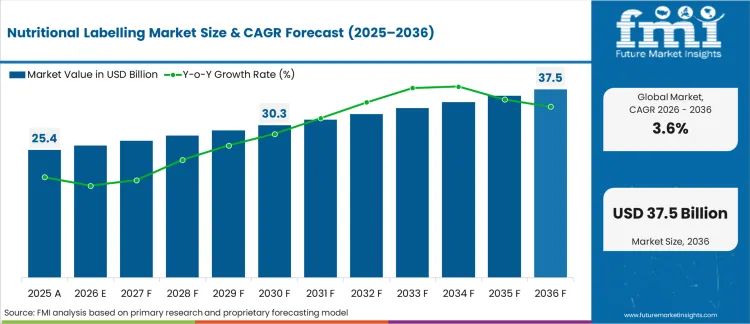
NEWARK, Del., June 6, 2026 — The global Nutritional Labelling Market is poised for steady expansion over the next decade, with market valuation projected to increase from USD 26,331.6 million in 2026 to USD 37,485.6 million by 2036, registering a CAGR of 3.6% during the forecast period, according to the latest analysis by Future Market Insights (FMI).
Growing regulatory scrutiny around food transparency, rising consumer awareness regarding nutrition, and the implementation of front-of-pack (FOP) warning systems across major economies are driving investments in advanced nutritional labeling technologies and compliance solutions. Food manufacturers, packaging providers, and regulatory service vendors are increasingly adopting automated labeling platforms to streamline compliance and reduce risks associated with inaccurate nutrient declarations.
The nutritional labelling market has evolved from a packaging requirement into a strategic compliance function that directly impacts product formulation, market access, and consumer trust. As governments worldwide introduce stricter standards for sugar, sodium, calorie, and fat disclosures, manufacturers are investing in digital infrastructure capable of managing complex regulatory requirements across multiple geographies.
👉 Get Access to the Report Sample: https://www.futuremarketinsights.com/reports/sample/rep-gb-1023
Regulatory Compliance Reshaping Packaging Strategies
Mandatory front-of-pack nutritional disclosure regulations are emerging as one of the most influential drivers of market growth. Governments are increasingly utilizing packaging labels as public health tools to address obesity, diabetes, and cardiovascular disease concerns.
Manufacturers are responding by implementing digital nutrition calculation engines, artwork automation systems, and real-time compliance monitoring platforms that enable rapid adaptation to changing regulatory frameworks.
"Front-of-pack transparency has evolved from a voluntary branding initiative into a regulatory necessity," said Nandini Roy Choudhury, Principal Consultant, Food & Beverage at Future Market Insights.
"Manufacturers are increasingly reformulating products while integrating digital traceability and automated nutrient validation systems into packaging workflows. Companies capable of managing regulatory complexity while maintaining consumer trust will establish a significant competitive advantage in the coming decade."
Market Value Analysis
|
Metric |
Value |
|
Industry Size (2026) |
USD 26,331.6 Million |
|
Industry Value (2036) |
USD 37,485.6 Million |
|
CAGR (2026–2036) |
3.6% |
Source: Future Market Insights, 2026
Key Market Drivers Fueling Growth
Rising Adoption of Front-of-Pack Warning Labels
Global health agencies and food regulators are increasingly mandating visual nutrition indicators designed to simplify dietary decisions for consumers. These initiatives are encouraging food manufacturers to upgrade legacy labeling systems and invest in automated compliance platforms.
Continuous Product Reformulation Activities
Frequent recipe modifications aimed at reducing sugar, sodium, and unhealthy fats are increasing demand for nutritional calculation software capable of updating labels in real time. Manufacturers require agile systems that can rapidly reflect ingredient changes across multiple packaging formats.
Digitalization of Food Supply Chains
Food companies are integrating supplier data, ingredient specifications, and nutrient databases directly into packaging workflows. Automated labeling solutions help eliminate manual data entry errors while improving regulatory accuracy and operational efficiency.
Demand for Clean Label and Transparency Initiatives
Consumers increasingly expect detailed nutritional information and ingredient transparency. This trend is encouraging manufacturers to adopt comprehensive labeling platforms capable of supporting nutrition claims, allergen declarations, and sustainability messaging.
Multiple Traffic Light Labels Lead Market Adoption
By label type, Multiple Traffic Light Labels are expected to account for 38.2% of market share in 2026.
Color-coded nutrition systems simplify complex dietary information through intuitive visual cues, enabling consumers to assess product health profiles quickly. Retailers and public health agencies continue to favor these formats because they improve understanding and support healthier purchasing decisions.
The adoption of traffic light systems is also accelerating due to growing alignment between regulatory authorities and retail chains seeking standardized nutritional communication formats.
FMCG Sector Remains Largest End User
The FMCG segment is projected to hold 54.6% market share in 2026, making it the largest end-user category within the nutritional labelling market.
High product turnover rates, frequent reformulations, and extensive packaging volumes require FMCG companies to maintain robust labeling infrastructures. Food and beverage manufacturers are increasingly deploying automated printing systems linked directly to centralized specification management platforms to ensure compliance and operational efficiency.
Regional Outlook
Asia Pacific Emerging as High-Growth Hub
Asia Pacific continues to witness strong growth due to rapid urbanization, expanding packaged food consumption, and tightening food safety regulations.
India is forecast to grow at 4.0% CAGR, the fastest among major analyzed markets, supported by rising consumer awareness and increasing transparency requirements within the packaged food industry.
China follows closely with 3.8% CAGR, driven by retail sector expansion and large-scale adoption of product master data management systems across food manufacturing operations.
Europe Focuses on Precision Compliance
European markets remain at the forefront of nutritional disclosure regulations.
Germany is projected to expand at 3.6% CAGR, supported by stringent nutrient declaration standards and growing investment in digital compliance infrastructure.
The United Kingdom is expected to grow at 3.4% CAGR, driven by widespread adoption of traffic-light labeling systems and ongoing product reformulation initiatives among leading food brands.
North America Accelerates Label Modernization
The United States is forecast to record a 3.5% CAGR through 2036 as manufacturers prepare for evolving front-of-pack nutrition requirements and increasingly rigorous regulatory oversight.
Food producers across North America are investing in automated nutrition verification systems to minimize legal exposure and maintain consumer confidence.
Latin America Maintains Strong Regulatory Momentum
Latin American countries continue to lead implementation of highly visible warning-label frameworks.
Brazil is projected to grow at 3.7% CAGR, supported by strict nutrient threshold regulations and increasing demand for compliance software solutions that help manufacturers navigate evolving labeling requirements.
Strategic Opportunities for Industry Participants
FMI identifies several opportunities expected to shape competitive positioning across the nutritional labelling ecosystem:
- Development of predictive formulation tools that simulate compliance outcomes before product commercialization.
- Expansion of integrated specification management and nutrition calculation platforms.
- Adoption of automated supplier-data synchronization systems.
- Growth in clean-label documentation and transparency-focused compliance services.
- Increased demand for multilingual and cross-border labeling solutions supporting global food trade.
Competitive Landscape
The nutritional labelling market is becoming increasingly technology-driven, with vendors focusing on integrated compliance ecosystems that combine nutrient calculation, regulatory management, artwork automation, and packaging execution.
Industry participants are pursuing acquisitions and strategic partnerships to strengthen software capabilities and expand service portfolios. The market is witnessing growing demand for end-to-end solutions capable of supporting multinational food manufacturers operating across diverse regulatory environments.
Key Players in the Nutritional Labelling Market
- TraceGains
- Trustwell
- Specright
- Online Labels Group
- Mérieux NutriSciences
- Avery Dennison
- 3M
- CCL Industries
- Zebra Technologies
- Brother Industries
Recent Industry Developments
- In January 2024, TraceGains acquired NutriCalc, expanding its nutrition calculation and labeling software capabilities.
- In September 2025, Mérieux NutriSciences completed the acquisition of the food testing business of Bureau Veritas, strengthening its global food safety and compliance portfolio.
As food labeling regulations continue to evolve and consumer expectations for transparency increase, the nutritional labelling market is expected to remain a critical enabler of compliance, product innovation, and consumer trust across the global food and beverage industry.
About Future Market Insights (FMI)
Future Market Insights is a leading provider of market intelligence, consulting services, and syndicated research reports. FMI delivers actionable insights across food and beverage, consumer goods, healthcare, agriculture, chemicals, biotechnology, industrial products, and emerging technologies, helping organizations identify growth opportunities and make informed strategic decisions in rapidly evolving markets.
Contact
Future Market Insights Inc.
Christiana Corporate
200 Continental Drive, Suite 401
Newark, Delaware 19713, USA
Email: sales@futuremarketinsights.com
Website: www.futuremarketinsights.com
 Italiano
 English
 Arabic
 French
 Spanish
 Portuguese
 Deutsch
 Turkish
 Dutch
Dutch
 Russian
 Romaian
 Portuguese (Brazil)
 Greek
Greek