


Rock Duster Market Opportunities to Push Size to US$ 586.42 Million by 2034
Rock dusting is a critical safety intervention in underground mining operations, specifically engineered to mitigate the risk of secondary coal dust explosions (Harteis et al., 2016). By deploying inert particulate matter, such as pulverized limestone, rock dusters effectively dilute the combustible potential of float coal dust accumulated along mine returns and intake airways (Sapko et al., 2019). Driven by stringent occupational safety regulations and a continuous global emphasis on protecting mining workforces, the industrial equipment segment facilitating this process is witnessing steady growth.
Market Valuation and Growth Trajectory
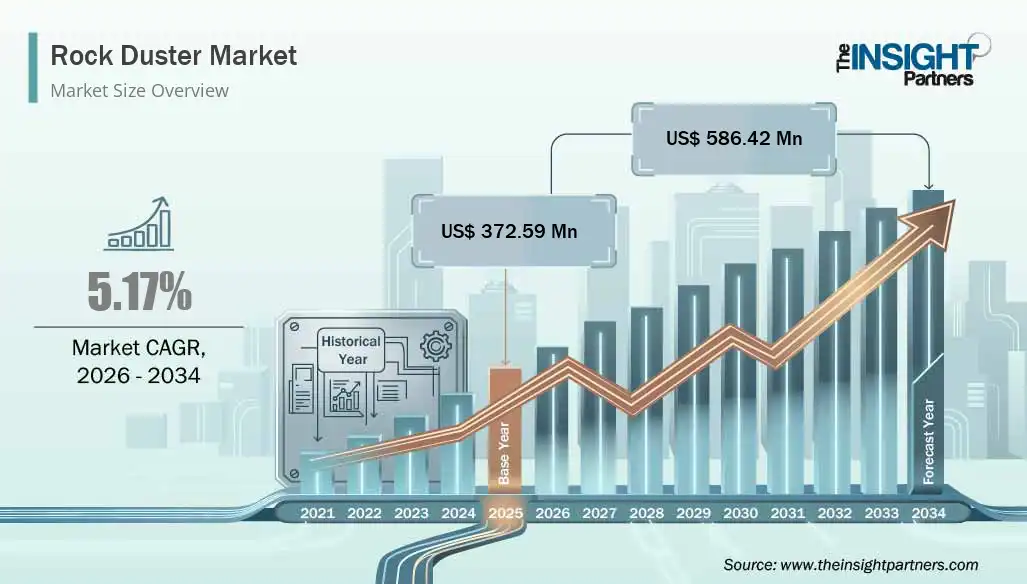
The Rock Duster Market is entering a phase of steady expansion, fueled by technological integration and infrastructure modernizations in the resource extraction sector. The global rock duster market size is projected to reach US$ 586.42 million by 2034 from US$ 372.59 million in 2025. The market is anticipated to register a compound annual growth rate (CAGR) of 5.17% during the forecast period 2026-2034.
This projected increment reflects a widespread shift from manual or basic dusting practices toward automated, continuous trickle and high-pressure distribution systems. These modern systems ensure optimal Total Incombustible Content (TIC) thresholds across deep-level mine networks without disrupting active extraction workflows.
Essential Drivers and Safety Regulations
The primary growth vector for rock dusting machinery remains the strict enforcement of underground safety protocols by regional authorities, such as the Mine Safety and Health Administration (MSHA) in the United States and similar global regulatory frameworks. Investigations show that maintaining a high percentage of inert material in return airways is critical, as rock dust blocks the rapid propagation of thermal energy during an initial ignition event (Perera et al., 2016).
Furthermore, advancements in the machinery's design focus on handling specialized treated rock dusts. Anti-caking variations coated with hydrophobic compounds resist moisture absorption, preventing the dust from forming a hard, non-dispersible crust when exposed to humid mine environments (Soo et al., 2016). Manufacturers are tailoring dusters with specialized nozzles and mechanical agitation units designed to break up dust aggregates, maximizing the airborne concentration of ultra-fine particles to counteract float coal dust dispersion downwind.
Download PDF Sample- https://www.theinsightpartners.com/sample/TIPRE00017206
Prominent Key Players
The global market features a blend of established industrial equipment providers and specialized engineering firms focused exclusively on mining safety solutions. Prominent key players operating in the rock duster ecosystem include:
-
A.L. Lee Corporation
-
Brain Industries (International) Pty Ltd
-
Damascus Corporation
-
DSI Underground
-
HafcoVac
-
Hager Equipment Co.
-
Irwin Car and Equipment
-
Johnson Industries
-
Saminco Inc.
-
STRATA WORLDWIDE
These industry players are increasingly investing in research and development to manufacture high-capacity, low-maintenance equipment. Innovation centers around mobile, vehicle-mounted flinger dusters for high-speed coverage along primary entries, as well as stationary, belt-powered trickle dusters built for autonomous deployment in remote tailgate returns.
Future Outlook
Looking ahead, the rock duster market will likely transform through the introduction of smart mining ecosystems and automated monitoring technologies. The future outlook points toward the incorporation of digital telemetry and real-time dust deposition sensors directly into automated rock dusting systems. This integration allows machinery to adjust discharge rates dynamically based on active coal dust production levels rather than functioning at static, predetermined time intervals.
Additionally, as traditional fossil-fuel mining faces long-term restructuring and energy transitions globally, equipment suppliers are expanding the application of rock-dusting and pneumatic-stowing technologies into underground metal, non-metal, and deep tunneling operations. Efforts to lower respirable dust exposure for equipment operators will further drive the adoption of enclosed, remotely operated pneumatic systems. This shift positions advanced rock dusters as a core component of sustainable, tech-driven hazard management systems in industrial mining.
Related Reports-
The Insight Partners is a one-stop industry research provider of actionable intelligence. We help our clients in getting solutions to their research requirements through our syndicated and consulting research services. We specialize in industries such as Semiconductor and Electronics, Aerospace and Defense, Automotive and Transportation, Biotechnology, Healthcare IT, Manufacturing and Construction, Medical Devices, Technology, Media, and Telecommunications, as well as chemicals and Materials.
Contact Us
If you have any queries about this report or if you would like further information, don’t hesitate to get in touch with us:
Contact Person: Ankit Mathur
E-mail: ankit.mathur@theinsightpartners.com
Phone: +1-646-491-9876
 Greek
Greek
 English
 Arabic
 French
 Spanish
 Portuguese
 Deutsch
 Turkish
 Dutch
Dutch
 Italiano
 Russian
 Romaian
 Portuguese (Brazil)