• https://m2squareconsultancy.com/reports/tactile-sensors-market
    https://m2squareconsultancy.com/reports/tactile-sensors-market
    0 Comments 0 Shares 13 Views 0 Reviews
  • https://m2squareconsultancy.com/reports/collision-avoidance-sensors-market
    https://m2squareconsultancy.com/reports/collision-avoidance-sensors-market
    M2SQUARECONSULTANCY.COM
    Collision Avoidance Sensors Market Size, Share, Forecasts to 2034
    The Global Collision Avoidance Sensors Market is expected to grow from USD 8.22 Billion in 2026 to USD 23.95 Billion by 2034, registering a CAGR of 14...
    0 Comments 0 Shares 13 Views 0 Reviews
  • https://m2squareconsultancy.com/reports/fire-sensors-and-detectors-market
    https://m2squareconsultancy.com/reports/fire-sensors-and-detectors-market
    M2SQUARECONSULTANCY.COM
    Fire Sensors and Detectors Market Size, Share, Forecasts to 2033
    Global Fire Sensors and Detectors Market Size is Valued at USD 4.4 Billion in 2025, is projected to reach USD 9.1 Billion by 2033, growing at a CAGR o...
    0 Comments 0 Shares 56 Views 0 Reviews
  • https://www.theinsightpartners.com/reports/fork-sensors-market
    https://www.theinsightpartners.com/reports/fork-sensors-market
    WWW.THEINSIGHTPARTNERS.COM
    Fork Sensors Market Size, Share & Growth by 2034
    Fork Sensors market is poised for steady growth, reaching US$ 1,117.99 million by 2034, growing at a CAGR of 6.47%. Explore size, share and key insights.
    0 Comments 0 Shares 80 Views 0 Reviews
  • The global Infrared Camera Market is on a rapid growth trajectory, expanding from USD 8.24 Billion in 2024 to reach USD 15.68 Billion by 2032 at an 8.37% CAGR, according to the latest strategic analysis by Maximize Market Research.

    Once confined to high-budget defense programs, thermal imaging is now a cornerstone of smart manufacturing and autonomous systems:

    Predictive Maintenance & Industry 4.0: 24/7 condition monitoring across high-voltage electrical assets, rotating machinery, and continuous process plants to stop downtime before it occurs.

    Defense & Counter-UAS: Uncooled microbolometers and cooled MWIR sensors powering next-gen soldier optics, armored vehicle sights, and anti-drone tracking suites.

    Automotive ADAS & Autonomous Mobility: Thermal sensor fusion delivering zero-lux pedestrian detection and penetrating adverse weather beyond the reach of standard RGB cameras or LiDAR.

    Optical Gas Imaging (OGI): Real-time visualization of fugitive methane and VOC leaks to meet stringent global emissions compliance.

    Discover full market dynamics, technology segmentation, and competitive benchmarking:

    Download PDF Brochure: https://www.maximizemarketresearch.com/request-sample/30953/

    Read the Complete Strategic Report: https://www.maximizemarketresearch.com/market-report/global-infrared-camera-market/30953/

    #InfraredCamera #ThermalImaging #PredictiveMaintenance #Industry40 #DefenseTech #ADAS #Optoelectronics #MachineVision #MarketResearch #MaximizeMarketResearch
    The global Infrared Camera Market is on a rapid growth trajectory, expanding from USD 8.24 Billion in 2024 to reach USD 15.68 Billion by 2032 at an 8.37% CAGR, according to the latest strategic analysis by Maximize Market Research. Once confined to high-budget defense programs, thermal imaging is now a cornerstone of smart manufacturing and autonomous systems: Predictive Maintenance & Industry 4.0: 24/7 condition monitoring across high-voltage electrical assets, rotating machinery, and continuous process plants to stop downtime before it occurs. Defense & Counter-UAS: Uncooled microbolometers and cooled MWIR sensors powering next-gen soldier optics, armored vehicle sights, and anti-drone tracking suites. Automotive ADAS & Autonomous Mobility: Thermal sensor fusion delivering zero-lux pedestrian detection and penetrating adverse weather beyond the reach of standard RGB cameras or LiDAR. Optical Gas Imaging (OGI): Real-time visualization of fugitive methane and VOC leaks to meet stringent global emissions compliance. Discover full market dynamics, technology segmentation, and competitive benchmarking: 📥 Download PDF Brochure: https://www.maximizemarketresearch.com/request-sample/30953/ 📊 Read the Complete Strategic Report: https://www.maximizemarketresearch.com/market-report/global-infrared-camera-market/30953/ #InfraredCamera #ThermalImaging #PredictiveMaintenance #Industry40 #DefenseTech #ADAS #Optoelectronics #MachineVision #MarketResearch #MaximizeMarketResearch
    WWW.MAXIMIZEMARKETRESEARCH.COM
    Request Sample
    for Request Sample fill the form
    0 Comments 0 Shares 1K Views 0 Reviews
  • Thermal imaging is no longer confined to military night operations—it has evolved into an indispensable, continuous diagnostic layer for the global industrial economy.

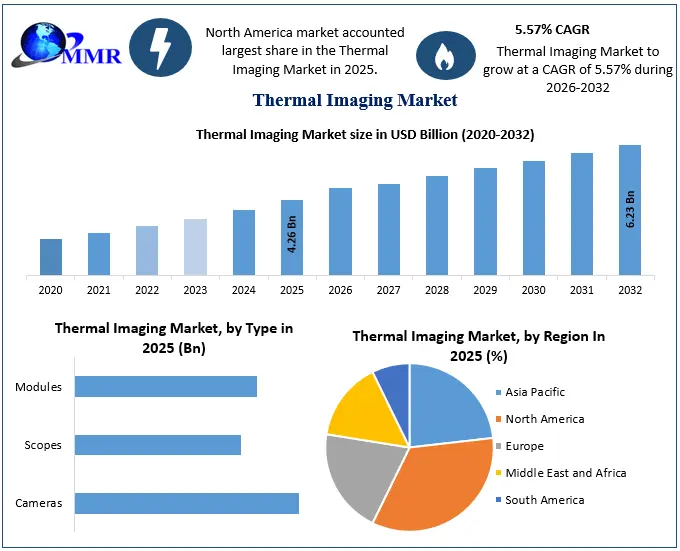
    From preventing catastrophic electrical arc flashes in data centers to guiding autonomous vehicles through dense fog, thermal thermography is replacing reactive maintenance with real-time predictive failure intelligence. According to research by Maximize Market Research, the Global Thermal Imaging Market was valued at $4.26B in 2025 and is projected to reach $6.23B by 2032 (5.57% CAGR).

    Key operational and technological catalysts:

    Mandatory adoption of electrical safety standards (e.g., NFPA 70B) driving continuous infrared asset monitoring

    Proliferation of low-cost, uncooled VOx microbolometers via Wafer-Level Packaging (WLP)

    Integration of edge AI for automated anomaly detection and pass/fail diagnostics

    Expanding deployment in autonomous drone payloads, perimeter defense, and automotive ADAS night-vision

    How is your organization leveraging infrared thermography to protect high-voltage assets and prevent unplanned downtime?

    Explore the full strategic market report: https://www.maximizemarketresearch.com/market-report/global-thermal-imaging-market/8054/

    #ThermalImaging #PredictiveMaintenance #InfraredCamera #IndustrialAutomation #DefenseTech #Optronics #SmartSensors #ConditionMonitoring #MarketResearch
    Thermal imaging is no longer confined to military night operations—it has evolved into an indispensable, continuous diagnostic layer for the global industrial economy. From preventing catastrophic electrical arc flashes in data centers to guiding autonomous vehicles through dense fog, thermal thermography is replacing reactive maintenance with real-time predictive failure intelligence. According to research by Maximize Market Research, the Global Thermal Imaging Market was valued at $4.26B in 2025 and is projected to reach $6.23B by 2032 (5.57% CAGR). Key operational and technological catalysts: Mandatory adoption of electrical safety standards (e.g., NFPA 70B) driving continuous infrared asset monitoring Proliferation of low-cost, uncooled VOx microbolometers via Wafer-Level Packaging (WLP) Integration of edge AI for automated anomaly detection and pass/fail diagnostics Expanding deployment in autonomous drone payloads, perimeter defense, and automotive ADAS night-vision How is your organization leveraging infrared thermography to protect high-voltage assets and prevent unplanned downtime? Explore the full strategic market report: https://www.maximizemarketresearch.com/market-report/global-thermal-imaging-market/8054/ #ThermalImaging #PredictiveMaintenance #InfraredCamera #IndustrialAutomation #DefenseTech #Optronics #SmartSensors #ConditionMonitoring #MarketResearch
    WWW.MAXIMIZEMARKETRESEARCH.COM
    Thermal Imaging Market - Global Industry Analysis and Forecast (2026-2032)
    The Thermal Imaging Market size was valued at USD 4.26 Billion in 2025 and the total Thermal Imaging revenue is expected to grow at a CAGR
    0 Comments 0 Shares 2K Views 0 Reviews
  • A water-efficient irrigation system delivering water directly to plant roots. Growth is driven by water scarcity and demand for higher agricultural yields. Used in high-value crops. Technology integration with sensors for automated irrigation is a major trend. Government subsidies and incentives support market expansion.

    https://www.wiseguyreports.com/reports/drip-irrigation-market
    A water-efficient irrigation system delivering water directly to plant roots. Growth is driven by water scarcity and demand for higher agricultural yields. Used in high-value crops. Technology integration with sensors for automated irrigation is a major trend. Government subsidies and incentives support market expansion. https://www.wiseguyreports.com/reports/drip-irrigation-market
    WWW.WISEGUYREPORTS.COM
    Drip Irrigation Market Trends & Forecast Data 2035
    The Drip Irrigation Market is expected to grow from 6.1 USD Billion in 2025 to 10.2 USD Billion by 2035. The Drip Irrigation Market CAGR (growth rate) is expected to be around 5.2% | Wiseguy Reports
    0 Comments 0 Shares 552 Views 0 Reviews
  • **Agricultural Pest Monitoring Equipment Market Summary (Approx. 500 Words)**

    According to Intel Market Research, the global Agricultural Pest Monitoring Equipment market was valued at **USD 2.207 billion in 2025** and is projected to reach **USD 3.894 billion by 2034**, registering a **compound annual growth rate (CAGR) of 8.7%** during the forecast period. Market growth is being driven by the increasing adoption of precision agriculture, rising demand for sustainable farming practices, and supportive government initiatives promoting smart agricultural technologies.

    Agricultural Pest Monitoring Equipment includes sensors, monitoring devices, data acquisition systems, analytics platforms, and alert mechanisms that help detect and track pest populations in real time. These solutions enable farmers to identify pest infestations early, optimize pesticide application, minimize crop losses, and improve overall productivity. The integration of Internet of Things (IoT) technologies and artificial intelligence (AI) has significantly enhanced the efficiency and accuracy of these monitoring systems.

    One of the major growth drivers is the increasing need for real-time crop protection. Early pest detection allows growers to take timely corrective actions, reducing excessive pesticide use while improving crop quality and yields. Technological advancements such as wireless sensors, cloud-based monitoring platforms, predictive analytics, and AI-powered decision support systems are further accelerating market adoption across both large commercial farms and small agricultural operations.

    Despite its promising outlook, the market faces several challenges. High initial investment costs for sensor networks, monitoring infrastructure, and analytics platforms can discourage adoption, especially among small-scale farmers. In addition, limited broadband connectivity in many rural areas restricts real-time data transmission. Regulatory compliance related to pesticide usage and agricultural data management also increases operational complexity for manufacturers. Furthermore, successful deployment requires technical expertise, creating a need for training and capacity building among farmers and agricultural workers.

    The market presents significant growth opportunities as governments and agricultural organizations continue to encourage precision farming and integrated pest management practices. Expanding rural digital infrastructure, favorable policy support, and strategic collaborations between technology providers, distributors, and research institutions are expected to improve accessibility and accelerate adoption. Emerging markets across Asia-Pacific, Latin America, and the Middle East & Africa are anticipated to witness strong growth due to increasing awareness of modern farming technologies and rising food security concerns.

    Regionally, North America currently holds the largest market share, supported by advanced agricultural technologies and strong regulatory frameworks promoting precision farming. Europe follows closely, driven by strict environmental regulations and sustainable agriculture initiatives. Asia-Pacific and Latin America are expected to experience the fastest growth owing to expanding agricultural activities, increasing technology adoption, and government investments. Meanwhile, the Middle East & Africa remains an emerging market with growing opportunities linked to food security and agricultural modernization programs.

    The market is segmented by application into crop pest monitoring, post-harvest pest detection, indoor greenhouse monitoring, and other applications. End users include farmers, agronomic service providers, research institutions, and government agencies, while products are distributed through direct sales, retail platforms, and online marketplaces.

    Competition within the market is characterized by continuous innovation and strategic partnerships. Leading companies such as **LAM International, Wuhan Xinpuhui Technology, ECOMAN, Juchuang, Trapview, and B&G Equipment Company** are investing in advanced sensing technologies and analytics solutions. Specialized companies including **QSpray, Pelgar, and PestConnect** further strengthen the competitive landscape by offering niche pest monitoring and management solutions. Overall, the Agricultural Pest Monitoring Equipment market is expected to witness strong and sustained growth as smart farming technologies become increasingly essential for improving agricultural productivity and sustainability.

    **Agricultural Pest Monitoring Equipment Market Summary (Approx. 500 Words)** According to Intel Market Research, the global Agricultural Pest Monitoring Equipment market was valued at **USD 2.207 billion in 2025** and is projected to reach **USD 3.894 billion by 2034**, registering a **compound annual growth rate (CAGR) of 8.7%** during the forecast period. Market growth is being driven by the increasing adoption of precision agriculture, rising demand for sustainable farming practices, and supportive government initiatives promoting smart agricultural technologies. Agricultural Pest Monitoring Equipment includes sensors, monitoring devices, data acquisition systems, analytics platforms, and alert mechanisms that help detect and track pest populations in real time. These solutions enable farmers to identify pest infestations early, optimize pesticide application, minimize crop losses, and improve overall productivity. The integration of Internet of Things (IoT) technologies and artificial intelligence (AI) has significantly enhanced the efficiency and accuracy of these monitoring systems. One of the major growth drivers is the increasing need for real-time crop protection. Early pest detection allows growers to take timely corrective actions, reducing excessive pesticide use while improving crop quality and yields. Technological advancements such as wireless sensors, cloud-based monitoring platforms, predictive analytics, and AI-powered decision support systems are further accelerating market adoption across both large commercial farms and small agricultural operations. Despite its promising outlook, the market faces several challenges. High initial investment costs for sensor networks, monitoring infrastructure, and analytics platforms can discourage adoption, especially among small-scale farmers. In addition, limited broadband connectivity in many rural areas restricts real-time data transmission. Regulatory compliance related to pesticide usage and agricultural data management also increases operational complexity for manufacturers. Furthermore, successful deployment requires technical expertise, creating a need for training and capacity building among farmers and agricultural workers. The market presents significant growth opportunities as governments and agricultural organizations continue to encourage precision farming and integrated pest management practices. Expanding rural digital infrastructure, favorable policy support, and strategic collaborations between technology providers, distributors, and research institutions are expected to improve accessibility and accelerate adoption. Emerging markets across Asia-Pacific, Latin America, and the Middle East & Africa are anticipated to witness strong growth due to increasing awareness of modern farming technologies and rising food security concerns. Regionally, North America currently holds the largest market share, supported by advanced agricultural technologies and strong regulatory frameworks promoting precision farming. Europe follows closely, driven by strict environmental regulations and sustainable agriculture initiatives. Asia-Pacific and Latin America are expected to experience the fastest growth owing to expanding agricultural activities, increasing technology adoption, and government investments. Meanwhile, the Middle East & Africa remains an emerging market with growing opportunities linked to food security and agricultural modernization programs. The market is segmented by application into crop pest monitoring, post-harvest pest detection, indoor greenhouse monitoring, and other applications. End users include farmers, agronomic service providers, research institutions, and government agencies, while products are distributed through direct sales, retail platforms, and online marketplaces. Competition within the market is characterized by continuous innovation and strategic partnerships. Leading companies such as **LAM International, Wuhan Xinpuhui Technology, ECOMAN, Juchuang, Trapview, and B&G Equipment Company** are investing in advanced sensing technologies and analytics solutions. Specialized companies including **QSpray, Pelgar, and PestConnect** further strengthen the competitive landscape by offering niche pest monitoring and management solutions. Overall, the Agricultural Pest Monitoring Equipment market is expected to witness strong and sustained growth as smart farming technologies become increasingly essential for improving agricultural productivity and sustainability.

    0 Comments 0 Shares 6K Views 0 Reviews
  • Services for Landslide Monitoring – Avacam provide intelligent monitoring and early warning solutions designed to detect landslide risks before they become critical. By integrating industrial-grade sensors, real-time environmental monitoring, IoT connectivity, and cloud-based data analytics, Avacam enables continuous tracking of slope conditions, supports faster emergency response, and helps safeguard infrastructure, operations, and communities from landslide-related hazards.
    https://avacam.io/en/services/landslide-monitoring/
    Services for Landslide Monitoring – Avacam provide intelligent monitoring and early warning solutions designed to detect landslide risks before they become critical. By integrating industrial-grade sensors, real-time environmental monitoring, IoT connectivity, and cloud-based data analytics, Avacam enables continuous tracking of slope conditions, supports faster emergency response, and helps safeguard infrastructure, operations, and communities from landslide-related hazards. https://avacam.io/en/services/landslide-monitoring/
    AVACAM.IO
    Services for landslide monitoring - Avacam
    Learn how Avacam's devices are critical for monitoring natural disasters, contributing to the safety of hazardous areas.
    0 Comments 0 Shares 1K Views 0 Reviews
  • Avacam provides advanced terrain monitoring solutions with real-time environmental data tracking, intelligent industrial sensors, cloud connectivity, and automated early warning systems to help industries monitor slope stability, reduce environmental risks, and improve infrastructure safety in remote and challenging environments.
    https://avacam.io/en/services/landslide-monitoring/
    Avacam provides advanced terrain monitoring solutions with real-time environmental data tracking, intelligent industrial sensors, cloud connectivity, and automated early warning systems to help industries monitor slope stability, reduce environmental risks, and improve infrastructure safety in remote and challenging environments. https://avacam.io/en/services/landslide-monitoring/
    AVACAM.IO
    Services for landslide monitoring - Avacam
    Learn how Avacam's devices are critical for monitoring natural disasters, contributing to the safety of hazardous areas.
    0 Comments 0 Shares 915 Views 0 Reviews
  • Avacam provides advanced landslide monitoring services designed to help industries, infrastructure projects, and government authorities detect ground movement and prevent potential disasters before they occur. Using industrial-grade sensors, IoT-enabled monitoring systems, real-time data transmission, and automated alert technology, Avacam delivers continuous monitoring of unstable slopes, hillsides, mining areas, highways, railways, and construction sites. The system collects accurate environmental and geological data, including soil movement, rainfall conditions, and slope stability, allowing organizations to identify risks early and respond quickly during critical situations. With remote access to cloud-based monitoring dashboards and instant alerts through SMS or email notifications, Avacam helps improve public safety, reduce infrastructure damage, minimize operational downtime, and support
    https://avacam.io/en/services/landslide-monitoring/
    Avacam provides advanced landslide monitoring services designed to help industries, infrastructure projects, and government authorities detect ground movement and prevent potential disasters before they occur. Using industrial-grade sensors, IoT-enabled monitoring systems, real-time data transmission, and automated alert technology, Avacam delivers continuous monitoring of unstable slopes, hillsides, mining areas, highways, railways, and construction sites. The system collects accurate environmental and geological data, including soil movement, rainfall conditions, and slope stability, allowing organizations to identify risks early and respond quickly during critical situations. With remote access to cloud-based monitoring dashboards and instant alerts through SMS or email notifications, Avacam helps improve public safety, reduce infrastructure damage, minimize operational downtime, and support https://avacam.io/en/services/landslide-monitoring/
    AVACAM.IO
    Services for landslide monitoring - Avacam
    Learn how Avacam's devices are critical for monitoring natural disasters, contributing to the safety of hazardous areas.
    0 Comments 0 Shares 2K Views 0 Reviews
  • Global Zwitterionic Polymer (Poly(SBMA)) Antifouling Coating for Marine Sensors Market to Reach USD 412.3 Million by 2034

    Global Zwitterionic Polymer (Poly(SBMA)) Antifouling Coating for Marine Sensors market size was valued at USD 187.4 million in 2025. The market is projected to grow from USD 201.6 million in 2026 to USD 412.3 million by 2034, exhibiting a remarkable CAGR of 8.3% during the forecast period.

    Get Full Report Here: https://www.24chemicalresearch.com/reports/308820/zwitterionic-polymer-antifouling-coating-for-marine-sensors-market

    Global Zwitterionic Polymer (Poly(SBMA)) Antifouling Coating for Marine Sensors Market to Reach USD 412.3 Million by 2034 Global Zwitterionic Polymer (Poly(SBMA)) Antifouling Coating for Marine Sensors market size was valued at USD 187.4 million in 2025. The market is projected to grow from USD 201.6 million in 2026 to USD 412.3 million by 2034, exhibiting a remarkable CAGR of 8.3% during the forecast period. Get Full Report Here: https://www.24chemicalresearch.com/reports/308820/zwitterionic-polymer-antifouling-coating-for-marine-sensors-market
    WWW.24CHEMICALRESEARCH.COM
    Zwitterionic Polymer (Poly(SBMA)) Antifouling Coating for Marine Sensors Market Research Report 2026-2034
    Zwitterionic Polymer Antifouling Coating for Marine Sensors Global Zwitterionic Polymer (Poly(SBMA)) Antifouling Coating for Marine Sensors market was valued at USD 187.4 million in 2025 and is projected to reach USD 412.3 million by 2034, at a CAGR of 8.3%.
    0 Comments 0 Shares 377 Views 0 Reviews
More Results