• https://m2squareconsultancy.com/reports/cloud-computing-market
    https://m2squareconsultancy.com/reports/cloud-computing-market
    0 Comments 0 Shares 190 Views 0 Reviews
  • The Living Room Screen Is No Longer Just a Television

    4K displays have crossed a major threshold. What used to be a passive panel for evening broadcasts is now an intelligent, edge-computing hub for the connected home.

    A few shifts redefining the global 4K TV Market:

    Mini-LED & OLED Maturation: Advanced local dimming and quantum-dot OLED panels are delivering studio-grade contrast and peak brightness at increasingly accessible price points.

    Large-Format Migration: Falling mother-glass production costs have accelerated consumer adoption of 65-inch, 75-inch, and 85-inch displays.

    On-Device AI Upscaling: Dedicated neural processors reconstruct legacy HD content frame by frame, rendering sports and older titles with near-native 4K sharpness.

    Monetization Beyond Hardware: Operating platforms are evolving into long-term revenue engines powered by Connected TV (CTV) advertising, integrated FAST channels, and unified Matter-enabled smart home controls.

    For display makers and ecosystem developers, the mandate is clear: long-term brand equity will belong to platforms that blend superior picture silicon with intuitive, low-latency software experiences.

    Explore the complete market assessment and growth analysis:

    https://www.maximizemarketresearch.com/market-report/global-4k-tv-market/63245/

    #4KTV #SmartTV #DisplayTechnology #MiniLED #OLED #ConsumerElectronics #MarketResearch
    The Living Room Screen Is No Longer Just a Television 4K displays have crossed a major threshold. What used to be a passive panel for evening broadcasts is now an intelligent, edge-computing hub for the connected home. A few shifts redefining the global 4K TV Market: Mini-LED & OLED Maturation: Advanced local dimming and quantum-dot OLED panels are delivering studio-grade contrast and peak brightness at increasingly accessible price points. Large-Format Migration: Falling mother-glass production costs have accelerated consumer adoption of 65-inch, 75-inch, and 85-inch displays. On-Device AI Upscaling: Dedicated neural processors reconstruct legacy HD content frame by frame, rendering sports and older titles with near-native 4K sharpness. Monetization Beyond Hardware: Operating platforms are evolving into long-term revenue engines powered by Connected TV (CTV) advertising, integrated FAST channels, and unified Matter-enabled smart home controls. For display makers and ecosystem developers, the mandate is clear: long-term brand equity will belong to platforms that blend superior picture silicon with intuitive, low-latency software experiences. Explore the complete market assessment and growth analysis: https://www.maximizemarketresearch.com/market-report/global-4k-tv-market/63245/ #4KTV #SmartTV #DisplayTechnology #MiniLED #OLED #ConsumerElectronics #MarketResearch
    WWW.MAXIMIZEMARKETRESEARCH.COM
    4K TV Market: Increasing Consumer Demand, the Proliferation of Content, Falling Prices and Improved Accessibility
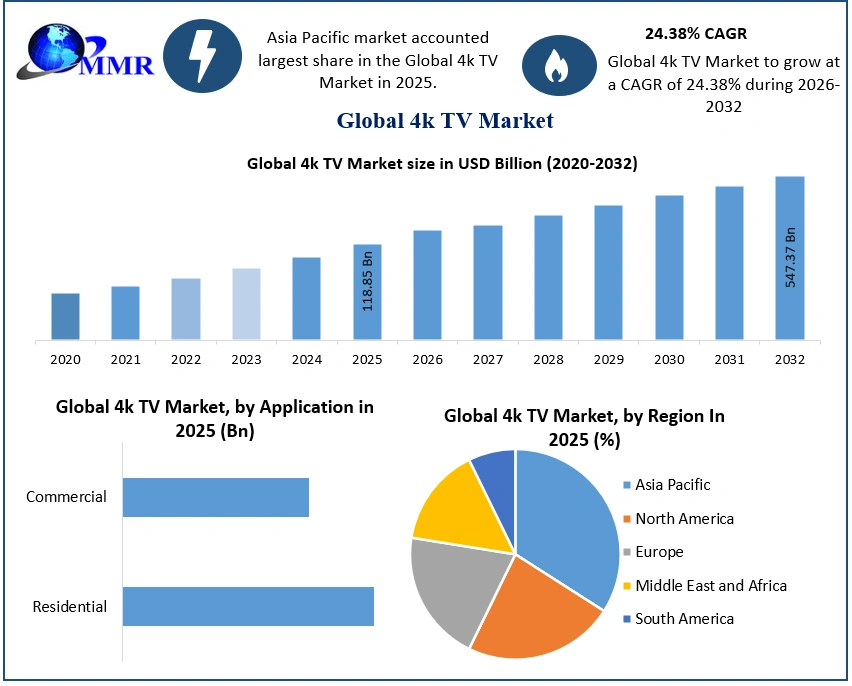
    The 4k TV Market size was valued at USD 118.85 Billion in 2025 and the total 4k TV revenue is expected to grow at a CAGR of 24.38%
    0 Comments 0 Shares 1K Views 0 Reviews
  • The global manufacturing and enterprise IT landscape is facing an unprecedented integration challenge. With rising operational complexity across factory floors, hybrid clouds, and connected systems, the role of system integrators has become more essential than ever.

    According to latest industry research, the Global System Integrator Market is projected to grow from USD 29.65 Billion in 2025 to USD 45.02 Billion by 2032, expanding at a steady 6.15% CAGR.

    Key market dynamics shaping this transformation:

    IT-OT Convergence: Breaking down silos between shop-floor control systems (SCADA, PLCs, DCS) and corporate enterprise platforms (ERP, MES, Cloud) to unlock real-time intelligence.

    Industry 4.0 & Smart Automation: Autonomous robotics, AMRs, and machine-vision quality inspection demand vendor-agnostic middleware and unified control architectures.

    Hybrid Cloud & Edge Computing: Deploying low-latency computing at the industrial edge while keeping global data pipelines synchronized with enterprise hyperscalers.

    Zero-Trust Industrial Cybersecurity: Implementing IEC 62443 standards and deep network segmentation to protect legacy operational infrastructure against expanding threat vectors.

    Explore in-depth market forecasts, technological segmentations, and strategic insights:

    Download PDF Brochure: https://www.maximizemarketresearch.com/request-sample/34603/

    Full Strategic Report: https://www.maximizemarketresearch.com/market-report/global-system-integrator-market/34603/

    #SystemIntegrator #Industry40 #SmartManufacturing #ITOTConvergence #IndustrialAutomation #CloudIntegration #CyberSecurity #DigitalTransformation #MarketResearch
    The global manufacturing and enterprise IT landscape is facing an unprecedented integration challenge. With rising operational complexity across factory floors, hybrid clouds, and connected systems, the role of system integrators has become more essential than ever. According to latest industry research, the Global System Integrator Market is projected to grow from USD 29.65 Billion in 2025 to USD 45.02 Billion by 2032, expanding at a steady 6.15% CAGR. Key market dynamics shaping this transformation: IT-OT Convergence: Breaking down silos between shop-floor control systems (SCADA, PLCs, DCS) and corporate enterprise platforms (ERP, MES, Cloud) to unlock real-time intelligence. Industry 4.0 & Smart Automation: Autonomous robotics, AMRs, and machine-vision quality inspection demand vendor-agnostic middleware and unified control architectures. Hybrid Cloud & Edge Computing: Deploying low-latency computing at the industrial edge while keeping global data pipelines synchronized with enterprise hyperscalers. Zero-Trust Industrial Cybersecurity: Implementing IEC 62443 standards and deep network segmentation to protect legacy operational infrastructure against expanding threat vectors. Explore in-depth market forecasts, technological segmentations, and strategic insights: Download PDF Brochure: https://www.maximizemarketresearch.com/request-sample/34603/ Full Strategic Report: https://www.maximizemarketresearch.com/market-report/global-system-integrator-market/34603/ #SystemIntegrator #Industry40 #SmartManufacturing #ITOTConvergence #IndustrialAutomation #CloudIntegration #CyberSecurity #DigitalTransformation #MarketResearch
    WWW.MAXIMIZEMARKETRESEARCH.COM
    Request Sample
    for Request Sample fill the form
    0 Comments 0 Shares 2K Views 0 Reviews
  • The death of single-purpose hardware?

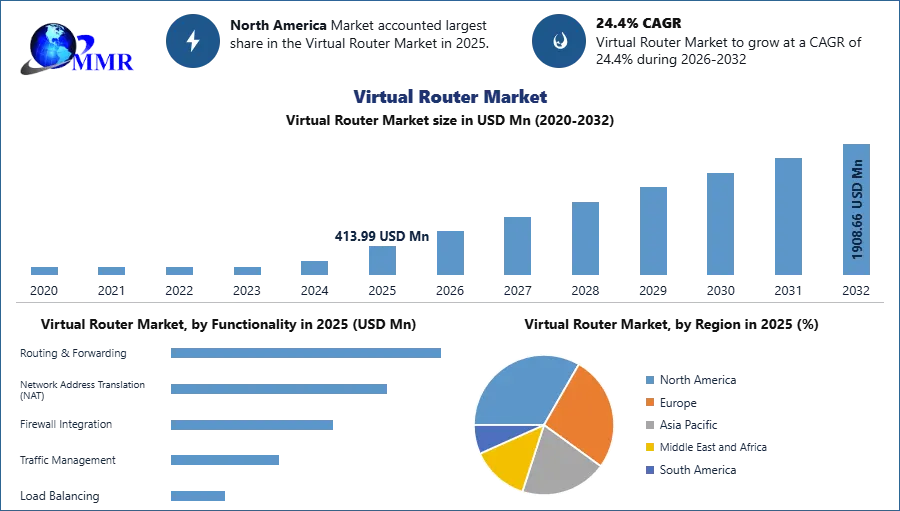
    The global Virtual Router Market is projected to grow from $413.99M in 2025 to $1,908.66M by 2032, expanding at an aggressive 24.4% CAGR!

    Legacy hardware routers can no longer keep up with dynamic multi-cloud workloads, hybrid workforces, and 5G network slicing. By decoupling packet routing from proprietary silicon and running on agile x86/COTS servers and containerized microservices (CNFs), enterprises are:
    Slashing CapEx & hardware refresh costs

    Provisioning branch routing in minutes via automated CI/CD & IaC

    Achieving line-rate 100+ Gbps packet throughput using DPDK & VPP

    Explore the strategic industry report: https://www.maximizemarketresearch.com/market-report/virtual-router-market/14461/

    Download the free brochure: https://www.maximizemarketresearch.com/request-sample/14461/

    #VirtualRouter #Networking #CloudComputing #SDWAN #5G #EnterpriseIT #MarketResearch
    🚀 The death of single-purpose hardware? The global Virtual Router Market is projected to grow from $413.99M in 2025 to $1,908.66M by 2032, expanding at an aggressive 24.4% CAGR! Legacy hardware routers can no longer keep up with dynamic multi-cloud workloads, hybrid workforces, and 5G network slicing. By decoupling packet routing from proprietary silicon and running on agile x86/COTS servers and containerized microservices (CNFs), enterprises are: 🔹 Slashing CapEx & hardware refresh costs 🔹 Provisioning branch routing in minutes via automated CI/CD & IaC 🔹 Achieving line-rate 100+ Gbps packet throughput using DPDK & VPP 👉 Explore the strategic industry report: https://www.maximizemarketresearch.com/market-report/virtual-router-market/14461/ 📥 Download the free brochure: https://www.maximizemarketresearch.com/request-sample/14461/ #VirtualRouter #Networking #CloudComputing #SDWAN #5G #EnterpriseIT #MarketResearch
    WWW.MAXIMIZEMARKETRESEARCH.COM
    Virtual Router Market - Global Industry Analysis and Forecast (2026-2032)
    Virtual Router Market size is expected to reach nearly USD 1908.66 Mn by 2032 with the CAGR of 24.4% during the forecast period.
    0 Comments 0 Shares 873 Views 0 Reviews
  • Professional Cloud Computing Training in Amritsar

    NSPL RTC provides Professional Cloud Computing Training in Amritsar according to exact profile specifications and technical requirements. We help you to learn cloud computing from scratch to most advanced APP Building Topics. Our Cloud Computing Training Course provide students to enhanced their knowledge regarding cloud computing, tools and strategies used in cloud computing. Our course helps you become an expert in designing, planning, and scaling cloud implementations.

    https://nsplrtc.com/cloud-computing-professional-training-amritsar.php
    #cloudcomputingtrainingamritsar
    Professional Cloud Computing Training in Amritsar NSPL RTC provides Professional Cloud Computing Training in Amritsar according to exact profile specifications and technical requirements. We help you to learn cloud computing from scratch to most advanced APP Building Topics. Our Cloud Computing Training Course provide students to enhanced their knowledge regarding cloud computing, tools and strategies used in cloud computing. Our course helps you become an expert in designing, planning, and scaling cloud implementations. https://nsplrtc.com/cloud-computing-professional-training-amritsar.php #cloudcomputingtrainingamritsar
    0 Comments 0 Shares 1K Views 0 Reviews
  • Industrial Edge Market Forecast: Real‑Time Analytics & Predictive Maintenance

    Industrial Edge Market Set to Transform Industry Automation with Nearly USD 68 Billion Valuation by 2032

    The Industrial Edge Market is rapidly emerging as a cornerstone of digital transformation across key sectors, enabling real‑time data processing, enhanced automation, and tangible improvements in operational efficiency. According to Stellar Market Research, the market is valued at USD 20.31 billion in 2024 and projected to reach USD 67.97 billion by 2032, expanding at a robust CAGR of 16.3% during the forecast period.

    Get Request Free Sample Report : https://www.stellarmr.com/report/req_sample/industrial-edge-market/2593
    Market Estimation & Definition
    Industrial edge refers to the deployment of computing resources, analytics tools, and data management capabilities at or near the source of data generation — typically within industrial environments such as factories, energy plants, and logistics hubs. By processing data locally rather than transmitting it to distant cloud servers, industrial edge solutions enable real‑time analytics, low latency communication, and improved responsiveness for critical workflows.

    This approach bridges Information Technology (IT) and Operational Technology (OT), empowering industries to move beyond traditional cloud‑centric models. Key drivers — including Industrial IoT (IIoT), artificial intelligence (AI), machine learning, and 5G connectivity — are accelerating enterprise investments in edge architectures.

    Market Growth Drivers & Opportunity
    Several macro and technology‑centric factors are propelling the Industrial Edge Market forward:

    1. Real‑Time Decision‑Making Needs:
    Modern industries generate massive volumes of sensor and machine‑level data. Traditional cloud dependency introduces latency, hindering mission‑critical decisions. Edge computing processes this data closer to the source, allowing faster insights and actions, particularly in manufacturing and logistics.

    2. Industry 4.0 Adoption:
    Industrial automation, robotics, and connected equipment characterize Industry 4.0. Industrial edge is fundamental to enabling intelligent operations, predictive maintenance, quality control, and autonomous systems, creating an enormous growth runway across sectors.

    Get Request Free Sample Report : https://www.stellarmr.com/report/req_sample/industrial-edge-market/2593

    Conclusion
    The Industrial Edge Market is on a strong growth trajectory, accelerating digital transformation across critical industrial segments. With real‑time processing, AI integration, enhanced security, and 5G‑powered connectivity, edge computing is redefining how industries operate and innovate. As markets in the United States and Germany continue expansion alongside rapid adoption in Asia‑Pacific, the future holds tremendous momentum for edge solutions that foster smarter, faster, and more resilient industrial systems.

    About us

    Phase 3,Navale IT Zone, S.No. 51/2A/2,

    Office No. 202, 2nd floor,

    Near, Navale Brg,Narhe,

    Pune, Maharashtra 411041

    sales@stellarmr.com

    Industrial Edge Market Forecast: Real‑Time Analytics & Predictive Maintenance Industrial Edge Market Set to Transform Industry Automation with Nearly USD 68 Billion Valuation by 2032 The Industrial Edge Market is rapidly emerging as a cornerstone of digital transformation across key sectors, enabling real‑time data processing, enhanced automation, and tangible improvements in operational efficiency. According to Stellar Market Research, the market is valued at USD 20.31 billion in 2024 and projected to reach USD 67.97 billion by 2032, expanding at a robust CAGR of 16.3% during the forecast period. Get Request Free Sample Report : https://www.stellarmr.com/report/req_sample/industrial-edge-market/2593 Market Estimation & Definition Industrial edge refers to the deployment of computing resources, analytics tools, and data management capabilities at or near the source of data generation — typically within industrial environments such as factories, energy plants, and logistics hubs. By processing data locally rather than transmitting it to distant cloud servers, industrial edge solutions enable real‑time analytics, low latency communication, and improved responsiveness for critical workflows. This approach bridges Information Technology (IT) and Operational Technology (OT), empowering industries to move beyond traditional cloud‑centric models. Key drivers — including Industrial IoT (IIoT), artificial intelligence (AI), machine learning, and 5G connectivity — are accelerating enterprise investments in edge architectures. Market Growth Drivers & Opportunity Several macro and technology‑centric factors are propelling the Industrial Edge Market forward: 1. Real‑Time Decision‑Making Needs: Modern industries generate massive volumes of sensor and machine‑level data. Traditional cloud dependency introduces latency, hindering mission‑critical decisions. Edge computing processes this data closer to the source, allowing faster insights and actions, particularly in manufacturing and logistics. 2. Industry 4.0 Adoption: Industrial automation, robotics, and connected equipment characterize Industry 4.0. Industrial edge is fundamental to enabling intelligent operations, predictive maintenance, quality control, and autonomous systems, creating an enormous growth runway across sectors. Get Request Free Sample Report : https://www.stellarmr.com/report/req_sample/industrial-edge-market/2593 Conclusion The Industrial Edge Market is on a strong growth trajectory, accelerating digital transformation across critical industrial segments. With real‑time processing, AI integration, enhanced security, and 5G‑powered connectivity, edge computing is redefining how industries operate and innovate. As markets in the United States and Germany continue expansion alongside rapid adoption in Asia‑Pacific, the future holds tremendous momentum for edge solutions that foster smarter, faster, and more resilient industrial systems. About us Phase 3,Navale IT Zone, S.No. 51/2A/2, Office No. 202, 2nd floor, Near, Navale Brg,Narhe, Pune, Maharashtra 411041 sales@stellarmr.com

    0 Comments 0 Shares 5K Views 0 Reviews
  • Global Semiconductor Lasers Market Expands Rapidly with Surge in Optical Communication, AR/VR, and Medical Applications

    The global semiconductor lasers market is witnessing strong growth momentum, driven by the rapid expansion of high-speed communication networks, advancements in medical technologies, and increasing adoption across emerging applications such as LiDAR, AR/VR devices, and industrial automation. Semiconductor lasers, known for their compact size, high efficiency, and cost-effectiveness, are becoming indispensable components in modern digital infrastructure and advanced electronic systems.

    Request Free Sample Report : https://www.stellarmr.com/report/req_sample/semiconductor-lasers-market/2296

    Market Estimation & Definition

    The semiconductor lasers market was valued at approximately USD 8.18 billion in 2024 and is projected to reach nearly USD 21.46 billion by 2032, growing at a CAGR of about 12.80% during the forecast period.

    Semiconductor lasers are specialized diode lasers built from heavily doped p-type and n-type semiconductor materials such as gallium arsenide (GaAs) and indium phosphide (InP), which enable efficient light emission. These lasers are widely used in optical communication, healthcare devices, defense applications, sensors, and consumer electronics. Their ability to deliver high-speed data transmission and precision makes them essential in next-generation digital and photonic systems.

    The increasing shift toward optical technologies and photonics-based systems is accelerating the role of semiconductor lasers as core enabling components across multiple industries.

    Market Growth Drivers & Opportunity

    A key driver for market expansion is the rising demand for high-speed data transfer and optical communication systems. With increasing internet usage, cloud computing, and the proliferation of IoT devices, fiber-optic communication networks rely heavily on semiconductor lasers to deliver high bandwidth and low-latency data transmission.

    Another major growth factor is the rapid adoption of semiconductor lasers in emerging technologies such as autonomous vehicles, LiDAR systems, and AR/VR devices. These technologies require precise optical sensing and projection capabilities, creating new opportunities for semiconductor laser integration.

    Healthcare applications also represent a significant growth avenue. Semiconductor lasers are increasingly used in ophthalmology, dermatology, dentistry, and surgical procedures due to their accuracy and minimal invasiveness. Additionally, defense and aerospace sectors are contributing to market demand through applications such as target marking, range finding, and advanced laser systems.

    Continuous investment in R&D, product innovation, and telecommunications infrastructure—particularly 5G and future 6G networks—is expected to unlock new revenue streams for industry players.

    What Lies Ahead: Emerging Trends Shaping the Future

    The semiconductor lasers market is being reshaped by several transformative trends. One of the most prominent is the rapid advancement of high-power and energy-efficient laser technologies, enabling new industrial and medical applications. Manufacturers are focusing on improving output power, efficiency, and compact design to enhance product performance and reliability.

    Another key trend is the integration of semiconductor lasers into data centers and high-performance computing systems. Vertical-cavity surface-emitting lasers (VCSELs) are becoming widely used for optical interconnects and high-speed data transmission in modern data infrastructure.

    The expansion of smart cities, AI-driven systems, and cloud computing platforms is also increasing the demand for advanced optical components. Additionally, the growing use of blue and green lasers for display technologies and precision manufacturing is creating new avenues for market expansion.

    Request Free Sample Report : https://www.stellarmr.com/report/req_sample/semiconductor-lasers-market/2296

    Press Release Conclusion

    The global semiconductor lasers market is poised for robust expansion as digital transformation, high-speed communication, and advanced healthcare technologies continue to evolve. The increasing integration of optical systems in telecommunications, data centers, consumer electronics, and industrial applications is creating sustained demand for semiconductor lasers.

    With ongoing technological advancements, expanding 5G infrastructure, and rising adoption of AI-driven and photonics-based systems, the semiconductor lasers market is expected to deliver strong long-term growth opportunities. Industry participants focusing on innovation, efficiency, and application diversification will be best positioned to capitalize on the next wave of market development.

    About us

    Phase 3,Navale IT Zone, S.No. 51/2A/2,

    Office No. 202, 2nd floor,

    Near, Navale Brg,Narhe,

    Pune, Maharashtra 411041

    sales@stellarmr.com
    Global Semiconductor Lasers Market Expands Rapidly with Surge in Optical Communication, AR/VR, and Medical Applications The global semiconductor lasers market is witnessing strong growth momentum, driven by the rapid expansion of high-speed communication networks, advancements in medical technologies, and increasing adoption across emerging applications such as LiDAR, AR/VR devices, and industrial automation. Semiconductor lasers, known for their compact size, high efficiency, and cost-effectiveness, are becoming indispensable components in modern digital infrastructure and advanced electronic systems. Request Free Sample Report : https://www.stellarmr.com/report/req_sample/semiconductor-lasers-market/2296 Market Estimation & Definition The semiconductor lasers market was valued at approximately USD 8.18 billion in 2024 and is projected to reach nearly USD 21.46 billion by 2032, growing at a CAGR of about 12.80% during the forecast period. Semiconductor lasers are specialized diode lasers built from heavily doped p-type and n-type semiconductor materials such as gallium arsenide (GaAs) and indium phosphide (InP), which enable efficient light emission. These lasers are widely used in optical communication, healthcare devices, defense applications, sensors, and consumer electronics. Their ability to deliver high-speed data transmission and precision makes them essential in next-generation digital and photonic systems. The increasing shift toward optical technologies and photonics-based systems is accelerating the role of semiconductor lasers as core enabling components across multiple industries. Market Growth Drivers & Opportunity A key driver for market expansion is the rising demand for high-speed data transfer and optical communication systems. With increasing internet usage, cloud computing, and the proliferation of IoT devices, fiber-optic communication networks rely heavily on semiconductor lasers to deliver high bandwidth and low-latency data transmission. Another major growth factor is the rapid adoption of semiconductor lasers in emerging technologies such as autonomous vehicles, LiDAR systems, and AR/VR devices. These technologies require precise optical sensing and projection capabilities, creating new opportunities for semiconductor laser integration. Healthcare applications also represent a significant growth avenue. Semiconductor lasers are increasingly used in ophthalmology, dermatology, dentistry, and surgical procedures due to their accuracy and minimal invasiveness. Additionally, defense and aerospace sectors are contributing to market demand through applications such as target marking, range finding, and advanced laser systems. Continuous investment in R&D, product innovation, and telecommunications infrastructure—particularly 5G and future 6G networks—is expected to unlock new revenue streams for industry players. What Lies Ahead: Emerging Trends Shaping the Future The semiconductor lasers market is being reshaped by several transformative trends. One of the most prominent is the rapid advancement of high-power and energy-efficient laser technologies, enabling new industrial and medical applications. Manufacturers are focusing on improving output power, efficiency, and compact design to enhance product performance and reliability. Another key trend is the integration of semiconductor lasers into data centers and high-performance computing systems. Vertical-cavity surface-emitting lasers (VCSELs) are becoming widely used for optical interconnects and high-speed data transmission in modern data infrastructure. The expansion of smart cities, AI-driven systems, and cloud computing platforms is also increasing the demand for advanced optical components. Additionally, the growing use of blue and green lasers for display technologies and precision manufacturing is creating new avenues for market expansion. Request Free Sample Report : https://www.stellarmr.com/report/req_sample/semiconductor-lasers-market/2296 Press Release Conclusion The global semiconductor lasers market is poised for robust expansion as digital transformation, high-speed communication, and advanced healthcare technologies continue to evolve. The increasing integration of optical systems in telecommunications, data centers, consumer electronics, and industrial applications is creating sustained demand for semiconductor lasers. With ongoing technological advancements, expanding 5G infrastructure, and rising adoption of AI-driven and photonics-based systems, the semiconductor lasers market is expected to deliver strong long-term growth opportunities. Industry participants focusing on innovation, efficiency, and application diversification will be best positioned to capitalize on the next wave of market development. About us Phase 3,Navale IT Zone, S.No. 51/2A/2, Office No. 202, 2nd floor, Near, Navale Brg,Narhe, Pune, Maharashtra 411041 sales@stellarmr.com
    0 Comments 0 Shares 8K Views 0 Reviews
  • How the Secure Multiparty Computation Market Is Set to Expand With Rising Data Privacy Needs

    Secure Multiparty Computation Market Outlook: Definition, Growth Drivers, Trends, Segmentation, Regional Landscape, Competitive Review and Future Prospects

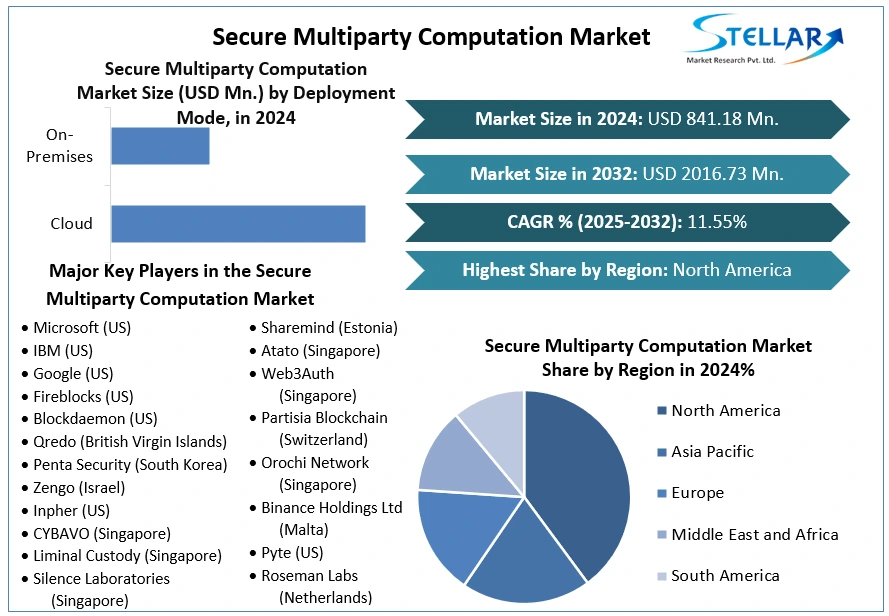
    The global Secure Multiparty Computation (SMPC) Market is emerging as a pivotal segment within cybersecurity and privacy‑preserving technologies. According to the most recent industry analysis, the market was valued at approximately USD 841.18 million in 2024, and is projected to expand at a compound annual growth rate (CAGR) of around 11.55 percent between 2025 and 2032, reaching nearly USD 2.02 billion by 2032. This trajectory reflects the increasing demand for robust cryptographic solutions that safeguard sensitive data while enabling secure collaborative computation across diverse sectors.

    Request Free Sample Report : https://www.stellarmr.com/report/req_sample/Secure-Multiparty-Computation-Market/2167

    Market Estimation & Definition

    Secure multiparty computation (SMPC) is a breakthrough cryptographic protocol that allows multiple parties to jointly compute a function over their inputs while ensuring that none of the individual parties ever discloses their private data. Instead of centralizing sensitive data in one location, computation is distributed across participating entities, enabling privacy‑preserving collaboration and analysis. This technology has become especially critical as organizations pursue data‑driven innovation while complying with stringent data privacy regulations globally.

    By design, SMPC protocols ensure that computation results can be obtained without exposing confidential inputs — a powerful capability in sectors such as finance, healthcare, government, and IT services. With the proliferation of artificial intelligence and machine learning models that require cross‑organizational data sharing, SMPC stands at the forefront of privacy‑enhancing technologies.

    Market Growth Drivers & Opportunity

    A primary force driving the Secure Multiparty Computation Market is the intensifying demand for data privacy and confidentiality. In an era marked by frequent data breaches, privacy regulations like the California Consumer Privacy Act (CCPA) and the European Union’s GDPR have compelled businesses to adopt technologies that enable secure data collaboration without violating privacy norms. SMPC not only supports compliance but also enables competitive computing in privacy‑sensitive contexts.

    The integration of SMPC with artificial intelligence (AI) and machine learning (ML) is another critical growth driver. Modern AI/ML applications often rely on large, geographically dispersed datasets to generate accurate insights. SMPC enables organizations to jointly compute these datasets without exposing raw data, thus facilitating privacy‑preserving analytics for fraud detection, predictive modelling, joint risk assessment, and other cross‑enterprise use cases.

    In industries such as banking and financial services, SMPC allows institutions to collaborate on fraud detection and anti‑money laundering analyses without disclosing proprietary data. Similarly, in healthcare, secure collaborative analytics can accelerate medical research while protecting patient confidentiality. These use cases present substantial opportunities for market expansion.

    Request Free Sample Report : https://www.stellarmr.com/report/req_sample/Secure-Multiparty-Computation-Market/2167

    Press Release Conclusion

    The Secure Multiparty Computation Market stands at the intersection of privacy, data collaboration and regulatory compliance, driving a new era of privacy‑preserving computing. As organizations across industries seek secure ways to extract meaningful insights from sensitive data, SMPC technologies are becoming indispensable. Ongoing advancements in cryptography, cloud computing integration and enterprise data strategies will continue to elevate the SMPC market’s prominence, positioning it as a cornerstone of secure digital transformation in the decade ahead.

    About us

    Phase 3,Navale IT Zone, S.No. 51/2A/2,

    Office No. 202, 2nd floor,

    Near, Navale Brg,Narhe,

    Pune, Maharashtra 411041

    sales@stellarmr.com
    How the Secure Multiparty Computation Market Is Set to Expand With Rising Data Privacy Needs Secure Multiparty Computation Market Outlook: Definition, Growth Drivers, Trends, Segmentation, Regional Landscape, Competitive Review and Future Prospects The global Secure Multiparty Computation (SMPC) Market is emerging as a pivotal segment within cybersecurity and privacy‑preserving technologies. According to the most recent industry analysis, the market was valued at approximately USD 841.18 million in 2024, and is projected to expand at a compound annual growth rate (CAGR) of around 11.55 percent between 2025 and 2032, reaching nearly USD 2.02 billion by 2032. This trajectory reflects the increasing demand for robust cryptographic solutions that safeguard sensitive data while enabling secure collaborative computation across diverse sectors. Request Free Sample Report : https://www.stellarmr.com/report/req_sample/Secure-Multiparty-Computation-Market/2167 Market Estimation & Definition Secure multiparty computation (SMPC) is a breakthrough cryptographic protocol that allows multiple parties to jointly compute a function over their inputs while ensuring that none of the individual parties ever discloses their private data. Instead of centralizing sensitive data in one location, computation is distributed across participating entities, enabling privacy‑preserving collaboration and analysis. This technology has become especially critical as organizations pursue data‑driven innovation while complying with stringent data privacy regulations globally. By design, SMPC protocols ensure that computation results can be obtained without exposing confidential inputs — a powerful capability in sectors such as finance, healthcare, government, and IT services. With the proliferation of artificial intelligence and machine learning models that require cross‑organizational data sharing, SMPC stands at the forefront of privacy‑enhancing technologies. Market Growth Drivers & Opportunity A primary force driving the Secure Multiparty Computation Market is the intensifying demand for data privacy and confidentiality. In an era marked by frequent data breaches, privacy regulations like the California Consumer Privacy Act (CCPA) and the European Union’s GDPR have compelled businesses to adopt technologies that enable secure data collaboration without violating privacy norms. SMPC not only supports compliance but also enables competitive computing in privacy‑sensitive contexts. The integration of SMPC with artificial intelligence (AI) and machine learning (ML) is another critical growth driver. Modern AI/ML applications often rely on large, geographically dispersed datasets to generate accurate insights. SMPC enables organizations to jointly compute these datasets without exposing raw data, thus facilitating privacy‑preserving analytics for fraud detection, predictive modelling, joint risk assessment, and other cross‑enterprise use cases. In industries such as banking and financial services, SMPC allows institutions to collaborate on fraud detection and anti‑money laundering analyses without disclosing proprietary data. Similarly, in healthcare, secure collaborative analytics can accelerate medical research while protecting patient confidentiality. These use cases present substantial opportunities for market expansion. Request Free Sample Report : https://www.stellarmr.com/report/req_sample/Secure-Multiparty-Computation-Market/2167 Press Release Conclusion The Secure Multiparty Computation Market stands at the intersection of privacy, data collaboration and regulatory compliance, driving a new era of privacy‑preserving computing. As organizations across industries seek secure ways to extract meaningful insights from sensitive data, SMPC technologies are becoming indispensable. Ongoing advancements in cryptography, cloud computing integration and enterprise data strategies will continue to elevate the SMPC market’s prominence, positioning it as a cornerstone of secure digital transformation in the decade ahead. About us Phase 3,Navale IT Zone, S.No. 51/2A/2, Office No. 202, 2nd floor, Near, Navale Brg,Narhe, Pune, Maharashtra 411041 sales@stellarmr.com

    0 Comments 0 Shares 4K Views 0 Reviews
  • China Laptop Market Forecast Outlook: Urbanization, Disposable Income and Tech Adoption Impact

    China Laptop Market 2024–2030: A High‑Growth Landscape Fueled by Digital Transformation and Gaming Demand

    Market Estimation & Definition
    The China laptop market has emerged as one of the fastest‑growing regional computing segments globally. Characterized by rapid adoption of portable computing solutions across education, business, personal use, and performance‑driven gaming, this market reflects China’s status as both a leading technology manufacturer and an increasingly affluent consumer base. According to industry estimates, the China laptop market was valued at approximately USD 6.45 billion in 2023 and is forecast to reach nearly USD 15.20 billion by 2030, exhibiting a robust Compound Annual Growth Rate (CAGR) of 13.03 % between 2024 and 2030.

    Laptops are defined as portable personal computers that integrate processing, memory, storage, display, and connectivity within a single compact unit. They serve diverse applications, from basic productivity and multimedia tasks to high‑performance gaming and enterprise computing. Their mobility, versatility, and expanding feature sets continue to underpin widespread demand in China’s tech‑driven economy.

    Request Free Sample Report : https://www.stellarmr.com/report/req_sample/China-Laptop-Market/2097

    Market Growth Drivers & Opportunity
    Several key drivers are propelling the China laptop market forward:

    Urbanization and Rising Incomes: China’s ongoing urbanization and economic growth are enhancing disposable incomes and IT product affordability. Urban consumers increasingly view laptops as essential for work, education, entertainment, and communication.

    Remote Work & Digital Learning: The shift toward flexible work environments and remote learning has reinforced the need for reliable portable computing solutions. Students, freelancers, and professionals all require laptops capable of handling collaborative tools, video conferencing, and multimedia applications.

    Gaming and High‑Performance Devices: A notable trend within the China market is the rising popularity of gaming laptops. Enthusiasts and competitive gamers are demanding powerful hardware, advanced graphics, and enhanced cooling solutions, contributing to elevated sales within this high‑growth segment.

    Broadening Application Areas: Beyond personal use, demand from business and enterprise sectors is on the rise. Organizations upgrading their computing fleets and embracing digital workflows offer opportunities for manufacturers and service providers alike.

    What Lies Ahead: Emerging Trends Shaping the Future
    Several emerging trends are expected to shape the trajectory of the China laptop market:

    Performance and Portability: There is growing consumer preference for laptops that balance high performance with light, slim form factors. This trend supports uptake of ultrabooks and thin‑and‑light models suited to mobile lifestyles and on‑the‑go productivity.

    Integration of Advanced Technologies: The integration of AI acceleration, improved connectivity options (including emerging 5G and Wi‑Fi standards), and enhanced security features is increasingly influencing purchasing decisions.

    Gaming Ecosystem Expansion: As China’s gaming community expands, demand for laptops tailored for immersive experiences — featuring powerful GPUs, high‑refresh‑rate displays, and efficient cooling systems — is on the rise. This positions the market for continued innovation and premium product development.

    Local Brand Strength and Value‑Driven Products: Chinese manufacturers are expanding their influence by offering competitive performance, local customer support, and value‑oriented models. This trend enhances market dynamism and invites international brands to adapt pricing and product positioning strategies.

    Request Free Sample Report : https://www.stellarmr.com/report/req_sample/China-Laptop-Market/2097

    Segmentation Analysis
    The China laptop market is segmented based on type and application:

    By Type:
    • Traditional Laptops — These held approximately 65% market share in 2023 and are favored for their balanced performance and feature sets.
    • 2‑in‑1 Laptops — Convertible devices that offer tablet‑style flexibility alongside laptop functionality, appealing to professionals and students seeking versatility.

    As innovations in performance, form factors, and connectivity continue to influence purchasing decisions, the market is likely to maintain its expansion trajectory. The evolving needs of gaming communities, remote professionals, and students ensure laptops remain vital computing platforms — positioning China as both a production powerhouse and a dynamic consumer market in the global technology ecosystem.

    About us

    Phase 3,Navale IT Zone, S.No. 51/2A/2,

    Office No. 202, 2nd floor,

    Near, Navale Brg,Narhe,

    Pune, Maharashtra 411041

    sales@stellarmr.com
    China Laptop Market Forecast Outlook: Urbanization, Disposable Income and Tech Adoption Impact China Laptop Market 2024–2030: A High‑Growth Landscape Fueled by Digital Transformation and Gaming Demand Market Estimation & Definition The China laptop market has emerged as one of the fastest‑growing regional computing segments globally. Characterized by rapid adoption of portable computing solutions across education, business, personal use, and performance‑driven gaming, this market reflects China’s status as both a leading technology manufacturer and an increasingly affluent consumer base. According to industry estimates, the China laptop market was valued at approximately USD 6.45 billion in 2023 and is forecast to reach nearly USD 15.20 billion by 2030, exhibiting a robust Compound Annual Growth Rate (CAGR) of 13.03 % between 2024 and 2030. Laptops are defined as portable personal computers that integrate processing, memory, storage, display, and connectivity within a single compact unit. They serve diverse applications, from basic productivity and multimedia tasks to high‑performance gaming and enterprise computing. Their mobility, versatility, and expanding feature sets continue to underpin widespread demand in China’s tech‑driven economy. Request Free Sample Report : https://www.stellarmr.com/report/req_sample/China-Laptop-Market/2097 Market Growth Drivers & Opportunity Several key drivers are propelling the China laptop market forward: Urbanization and Rising Incomes: China’s ongoing urbanization and economic growth are enhancing disposable incomes and IT product affordability. Urban consumers increasingly view laptops as essential for work, education, entertainment, and communication. Remote Work & Digital Learning: The shift toward flexible work environments and remote learning has reinforced the need for reliable portable computing solutions. Students, freelancers, and professionals all require laptops capable of handling collaborative tools, video conferencing, and multimedia applications. Gaming and High‑Performance Devices: A notable trend within the China market is the rising popularity of gaming laptops. Enthusiasts and competitive gamers are demanding powerful hardware, advanced graphics, and enhanced cooling solutions, contributing to elevated sales within this high‑growth segment. Broadening Application Areas: Beyond personal use, demand from business and enterprise sectors is on the rise. Organizations upgrading their computing fleets and embracing digital workflows offer opportunities for manufacturers and service providers alike. What Lies Ahead: Emerging Trends Shaping the Future Several emerging trends are expected to shape the trajectory of the China laptop market: Performance and Portability: There is growing consumer preference for laptops that balance high performance with light, slim form factors. This trend supports uptake of ultrabooks and thin‑and‑light models suited to mobile lifestyles and on‑the‑go productivity. Integration of Advanced Technologies: The integration of AI acceleration, improved connectivity options (including emerging 5G and Wi‑Fi standards), and enhanced security features is increasingly influencing purchasing decisions. Gaming Ecosystem Expansion: As China’s gaming community expands, demand for laptops tailored for immersive experiences — featuring powerful GPUs, high‑refresh‑rate displays, and efficient cooling systems — is on the rise. This positions the market for continued innovation and premium product development. Local Brand Strength and Value‑Driven Products: Chinese manufacturers are expanding their influence by offering competitive performance, local customer support, and value‑oriented models. This trend enhances market dynamism and invites international brands to adapt pricing and product positioning strategies. Request Free Sample Report : https://www.stellarmr.com/report/req_sample/China-Laptop-Market/2097 Segmentation Analysis The China laptop market is segmented based on type and application: By Type: • Traditional Laptops — These held approximately 65% market share in 2023 and are favored for their balanced performance and feature sets. • 2‑in‑1 Laptops — Convertible devices that offer tablet‑style flexibility alongside laptop functionality, appealing to professionals and students seeking versatility. As innovations in performance, form factors, and connectivity continue to influence purchasing decisions, the market is likely to maintain its expansion trajectory. The evolving needs of gaming communities, remote professionals, and students ensure laptops remain vital computing platforms — positioning China as both a production powerhouse and a dynamic consumer market in the global technology ecosystem. About us Phase 3,Navale IT Zone, S.No. 51/2A/2, Office No. 202, 2nd floor, Near, Navale Brg,Narhe, Pune, Maharashtra 411041 sales@stellarmr.com

    0 Comments 0 Shares 4K Views 0 Reviews
  • Secure Multiparty Computation Market Outlook: Rising Demand for Privacy‑Preserving Technologies

    Secure Multiparty Computation Market: Enabling Privacy‑Preserving Collaboration in the Age of Data Security

    The Secure Multiparty Computation (SMPC) Market is rapidly emerging as a critical pillar in the global cybersecurity and privacy landscape. As data volumes surge and industries seek to leverage shared insights without exposing sensitive information, SMPC — a cryptographic protocol that enables multiple parties to jointly compute functions over private data without revealing their individual inputs — is gaining traction across sectors such as finance, healthcare, IT, government, and beyond. According to recent industry analysis, the global market was valued at around USD 841.18 million in 2024 and is projected to expand to nearly USD 2,016.73 million by 2032, growing at a CAGR of approximately 11.55% during the forecast period.

    Request Free Sample Report : https://www.stellarmr.com/report/req_sample/Secure-Multiparty-Computation-Market/2167

    Market Estimation & Definition

    Secure Multiparty Computation refers to a class of cryptographic technologies and protocols that allow distributed parties to securely compute joint results without revealing their private data to each other. This is particularly important in scenarios where sensitive information — such as financial records, medical data, or proprietary analytics — must be processed collectively without compromising privacy. SMPC achieves this by distributing computations across multiple nodes or participants in ways that keep individual data encrypted or obscured while enabling collaborative processing.

    The market’s valuation in 2024 reflects early adoption across high‑security sectors and increasing regulatory pressures around data protection. Forecasts indicate that continued advancements in privacy‑preserving cryptographic frameworks, greater enterprise awareness of data protection measures, and the need for secure analytics in decentralized AI and machine learning will fuel robust growth through 2032.

    Market Growth Drivers & Opportunity

    A primary driver of SMPC market growth is the growing global concern for data privacy and compliance with stringent regulatory requirements. Laws such as the EU’s General Data Protection Regulation (GDPR) and California’s Consumer Privacy Act (CCPA) mandate that organizations implement robust data protection strategies that often extend beyond traditional encryption. SMPC enables organizations to collaborate on data‑driven insights without violating privacy norms, making it increasingly attractive for sectors handling regulated or sensitive information.

    Another key driver is the rise of collaborative data analytics and privacy‑preserving AI. As enterprises adopt artificial intelligence and machine learning models that require diverse datasets, SMPC allows secure joint computation without exposing raw data — a critical requirement in multi‑institutional research, federated learning applications, and cross‑organizational analytics. For example, in financial services, SMPC supports secure fraud detection across institutions while protecting transactional privacy.

    Industrial adoption also benefits from the integration of cloud computing. Cloud‑based SMPC offerings provide scalable infrastructure and remove the need for heavy on‑premises investment in cryptographic compute resources. According to market insights, cloud deployments are increasingly chosen by organizations for SMPC due to flexible computing power and advanced security features that support regulatory compliance and multi‑party collaboration.

    What Lies Ahead: Emerging Trends Shaping the Future

    Several emerging trends are set to shape the trajectory of the secure multiparty computation market:

    Request Free Sample Report : https://www.stellarmr.com/report/req_sample/Secure-Multiparty-Computation-Market/2167

    About us

    Phase 3,Navale IT Zone, S.No. 51/2A/2,

    Office No. 202, 2nd floor,

    Near, Navale Brg,Narhe,

    Pune, Maharashtra 411041

    sales@stellarmr.com
    Secure Multiparty Computation Market Outlook: Rising Demand for Privacy‑Preserving Technologies Secure Multiparty Computation Market: Enabling Privacy‑Preserving Collaboration in the Age of Data Security The Secure Multiparty Computation (SMPC) Market is rapidly emerging as a critical pillar in the global cybersecurity and privacy landscape. As data volumes surge and industries seek to leverage shared insights without exposing sensitive information, SMPC — a cryptographic protocol that enables multiple parties to jointly compute functions over private data without revealing their individual inputs — is gaining traction across sectors such as finance, healthcare, IT, government, and beyond. According to recent industry analysis, the global market was valued at around USD 841.18 million in 2024 and is projected to expand to nearly USD 2,016.73 million by 2032, growing at a CAGR of approximately 11.55% during the forecast period. Request Free Sample Report : https://www.stellarmr.com/report/req_sample/Secure-Multiparty-Computation-Market/2167 Market Estimation & Definition Secure Multiparty Computation refers to a class of cryptographic technologies and protocols that allow distributed parties to securely compute joint results without revealing their private data to each other. This is particularly important in scenarios where sensitive information — such as financial records, medical data, or proprietary analytics — must be processed collectively without compromising privacy. SMPC achieves this by distributing computations across multiple nodes or participants in ways that keep individual data encrypted or obscured while enabling collaborative processing. The market’s valuation in 2024 reflects early adoption across high‑security sectors and increasing regulatory pressures around data protection. Forecasts indicate that continued advancements in privacy‑preserving cryptographic frameworks, greater enterprise awareness of data protection measures, and the need for secure analytics in decentralized AI and machine learning will fuel robust growth through 2032. Market Growth Drivers & Opportunity A primary driver of SMPC market growth is the growing global concern for data privacy and compliance with stringent regulatory requirements. Laws such as the EU’s General Data Protection Regulation (GDPR) and California’s Consumer Privacy Act (CCPA) mandate that organizations implement robust data protection strategies that often extend beyond traditional encryption. SMPC enables organizations to collaborate on data‑driven insights without violating privacy norms, making it increasingly attractive for sectors handling regulated or sensitive information. Another key driver is the rise of collaborative data analytics and privacy‑preserving AI. As enterprises adopt artificial intelligence and machine learning models that require diverse datasets, SMPC allows secure joint computation without exposing raw data — a critical requirement in multi‑institutional research, federated learning applications, and cross‑organizational analytics. For example, in financial services, SMPC supports secure fraud detection across institutions while protecting transactional privacy. Industrial adoption also benefits from the integration of cloud computing. Cloud‑based SMPC offerings provide scalable infrastructure and remove the need for heavy on‑premises investment in cryptographic compute resources. According to market insights, cloud deployments are increasingly chosen by organizations for SMPC due to flexible computing power and advanced security features that support regulatory compliance and multi‑party collaboration. What Lies Ahead: Emerging Trends Shaping the Future Several emerging trends are set to shape the trajectory of the secure multiparty computation market: Request Free Sample Report : https://www.stellarmr.com/report/req_sample/Secure-Multiparty-Computation-Market/2167 About us Phase 3,Navale IT Zone, S.No. 51/2A/2, Office No. 202, 2nd floor, Near, Navale Brg,Narhe, Pune, Maharashtra 411041 sales@stellarmr.com
    0 Comments 0 Shares 3K Views 0 Reviews
  • US Laptop Market Outlook 2025–2032: Size, Trends & Forecast

    US Laptop Market
    Market Definition & Core Dynamics: This market encompasses the sale of portable personal computers within the United States, segmented by type (notebooks, 2-in-1 convertibles, gaming laptops, business laptops), end-user (consumer, commercial, education), screen size, and price tier. Growth is primarily driven by the evolution of remote/hybrid work and learning models, the continuous demand for hardware refreshes in the enterprise sector, and innovations in form factor (e.g., foldable displays, ARM-based processors), battery life, and performance (e.g., AI-capable chips). The market is mature and highly competitive, characterized by thin margins and rapid technological obsolescence.

    Purchase This Research Report at up to 30% Off @ https://www.stellarmr.com/report/req_sample/US-Laptop-Market/2096

    Market Estimation & Growth Trajectory:

    Market Valuation: The US Laptop Market was valued at approximately USD [X.X] billion in [Base Year, e.g., 2023]. It is projected to grow at a Compound Annual Growth Rate (CAGR) of [X.X]%, reaching nearly USD [Y.Y] billion by [Forecast Year, e.g., 2030].

    Key Driver: The single most significant driver is the structural shift to hybrid work and learning models, which has created a sustained demand for portable, powerful computing devices for both professional and personal use. The enterprise refresh cycle and the need for modern hardware to run advanced software and AI applications provide a steady baseline demand.

    Market Segmentation & Dominant Segments:

    About us

    Phase 3,Navale IT Zone, S.No. 51/2A/2,

    Office No. 202, 2nd floor,

    Near, Navale Brg,Narhe,

    Pune, Maharashtra 411041

    sales@stellarmr.com
    US Laptop Market Outlook 2025–2032: Size, Trends & Forecast US Laptop Market Market Definition & Core Dynamics: This market encompasses the sale of portable personal computers within the United States, segmented by type (notebooks, 2-in-1 convertibles, gaming laptops, business laptops), end-user (consumer, commercial, education), screen size, and price tier. Growth is primarily driven by the evolution of remote/hybrid work and learning models, the continuous demand for hardware refreshes in the enterprise sector, and innovations in form factor (e.g., foldable displays, ARM-based processors), battery life, and performance (e.g., AI-capable chips). The market is mature and highly competitive, characterized by thin margins and rapid technological obsolescence. Purchase This Research Report at up to 30% Off @ https://www.stellarmr.com/report/req_sample/US-Laptop-Market/2096 Market Estimation & Growth Trajectory: Market Valuation: The US Laptop Market was valued at approximately USD [X.X] billion in [Base Year, e.g., 2023]. It is projected to grow at a Compound Annual Growth Rate (CAGR) of [X.X]%, reaching nearly USD [Y.Y] billion by [Forecast Year, e.g., 2030]. Key Driver: The single most significant driver is the structural shift to hybrid work and learning models, which has created a sustained demand for portable, powerful computing devices for both professional and personal use. The enterprise refresh cycle and the need for modern hardware to run advanced software and AI applications provide a steady baseline demand. Market Segmentation & Dominant Segments: About us Phase 3,Navale IT Zone, S.No. 51/2A/2, Office No. 202, 2nd floor, Near, Navale Brg,Narhe, Pune, Maharashtra 411041 sales@stellarmr.com
    0 Comments 0 Shares 1K Views 0 Reviews
  • Tunnel Automation Market Price, Trends, Growth, Analysis, Key Players, Outlook, Report, Forecast 2025-2032

    Global Tunnel Automation Market Poised for Robust Growth, Driven by Safety and Infrastructure Modernization
    FOR IMMEDIATE RELEASE

    Purchase This Research Report at up to 30% Off @ https://www.stellarmr.com/report/req_sample/Tunnel-Automation-Market/2177

    Global Tunnel Automation Market Poised for Robust Growth, Driven by Safety and Infrastructure Modernization

    1. Market Estimation & Definition

    The global tunnel automation market is on a strong growth trajectory, driven by the critical need for safer, more efficient, and sustainable underground infrastructure. Valued at USD 4.54 Billion in 2024, the market is projected to expand at a Compound Annual Growth Rate (CAGR) of 8.1%, reaching approximately USD 8.46 Billion by 2032. Tunnel automation involves the integration of advanced hardware, software, and control systems to manage key functions such as ventilation, lighting, signalization, and traffic flow within tunnels. This market serves a critical target audience, including government infrastructure agencies, private tunnel operators, and large-scale transportation projects, all seeking to enhance operational control and passenger safety.

    2. Market Growth Drivers & Key Opportunities

    The market's expansion is fueled by a confluence of global infrastructure trends and technological progress. A primary driver is the global surge in urbanization and massive infrastructure investments, particularly in ambitious rail and road projects that require state-of-the-art management systems. Projects like the Fehmarnbelt Tunnel in Europe and China's underwater high-speed rail tunnel in Zhejiang exemplify this trend. Alongside new construction, there is a strong regulatory and societal emphasis on enhanced safety and energy efficiency, pushing operators to adopt intelligent systems for real-time monitoring, incident prevention, and optimized resource use.

    Significant opportunities lie in the integration of transformative technologies. The adoption of Internet of Things (IoT) sensors, cloud computing, and Artificial Intelligence (AI) enables predictive maintenance, advanced traffic management, and data-driven decision-making, moving operations from reactive to proactive. Furthermore, the fastest-growing region, Asia-Pacific, presents immense potential due to rapid urbanization and initiatives like China's Belt and Road, which include numerous large-scale tunnel projects.

    3. Emerging Trends Shaping the Future

    The future of tunnel automation is being defined by connectivity, intelligence, and robotics. The deepening integration of IoT and cloud platforms is creating "smart tunnels" capable of seamless, real-time data exchange for centralized control. This is closely followed by the advancement of AI and data analytics to interpret vast data streams for predictive maintenance and dynamic operational adjustments. A notable innovative trend is the exploration of robotics and autonomous systems for inspection and maintenance tasks in hazardous environments, improving worker safety, as seen with the AXEL robot tested in the Turin-Lyon base tunnel.

    4. Segmentation Analysis

    By Tunnel Type: The Railway Tunnels segment held the largest market share in 2024 and is expected to grow at the highest CAGR. The global push for expanding and modernizing rail networks for passenger and freight transport demands the high reliability, safety, and efficiency that automation provides.

    By Component: Key system segments include Lighting & Power Supply, Signalization, and HVAC (Heating, Ventilation, and Air Conditioning). These are essential subsystems that automation integrates and optimizes.

    By Offering: The market comprises Hardware (sensors, controllers), Software (SCADA, management platforms), and Services (integration, maintenance). Major players like Siemens and ABB provide comprehensive solutions across this spectrum.

    About Us

    Phase 3,Navale IT Zone, S.No. 51/2A/2,

    Office No. 202, 2nd floor,

    Near, Navale Brg,Narhe,

    Pune, Maharashtra 411041

    sales@stellarmr.com
    Tunnel Automation Market Price, Trends, Growth, Analysis, Key Players, Outlook, Report, Forecast 2025-2032 Global Tunnel Automation Market Poised for Robust Growth, Driven by Safety and Infrastructure Modernization FOR IMMEDIATE RELEASE Purchase This Research Report at up to 30% Off @ https://www.stellarmr.com/report/req_sample/Tunnel-Automation-Market/2177 Global Tunnel Automation Market Poised for Robust Growth, Driven by Safety and Infrastructure Modernization 1. Market Estimation & Definition The global tunnel automation market is on a strong growth trajectory, driven by the critical need for safer, more efficient, and sustainable underground infrastructure. Valued at USD 4.54 Billion in 2024, the market is projected to expand at a Compound Annual Growth Rate (CAGR) of 8.1%, reaching approximately USD 8.46 Billion by 2032. Tunnel automation involves the integration of advanced hardware, software, and control systems to manage key functions such as ventilation, lighting, signalization, and traffic flow within tunnels. This market serves a critical target audience, including government infrastructure agencies, private tunnel operators, and large-scale transportation projects, all seeking to enhance operational control and passenger safety. 2. Market Growth Drivers & Key Opportunities The market's expansion is fueled by a confluence of global infrastructure trends and technological progress. A primary driver is the global surge in urbanization and massive infrastructure investments, particularly in ambitious rail and road projects that require state-of-the-art management systems. Projects like the Fehmarnbelt Tunnel in Europe and China's underwater high-speed rail tunnel in Zhejiang exemplify this trend. Alongside new construction, there is a strong regulatory and societal emphasis on enhanced safety and energy efficiency, pushing operators to adopt intelligent systems for real-time monitoring, incident prevention, and optimized resource use. Significant opportunities lie in the integration of transformative technologies. The adoption of Internet of Things (IoT) sensors, cloud computing, and Artificial Intelligence (AI) enables predictive maintenance, advanced traffic management, and data-driven decision-making, moving operations from reactive to proactive. Furthermore, the fastest-growing region, Asia-Pacific, presents immense potential due to rapid urbanization and initiatives like China's Belt and Road, which include numerous large-scale tunnel projects. 3. Emerging Trends Shaping the Future The future of tunnel automation is being defined by connectivity, intelligence, and robotics. The deepening integration of IoT and cloud platforms is creating "smart tunnels" capable of seamless, real-time data exchange for centralized control. This is closely followed by the advancement of AI and data analytics to interpret vast data streams for predictive maintenance and dynamic operational adjustments. A notable innovative trend is the exploration of robotics and autonomous systems for inspection and maintenance tasks in hazardous environments, improving worker safety, as seen with the AXEL robot tested in the Turin-Lyon base tunnel. 4. Segmentation Analysis By Tunnel Type: The Railway Tunnels segment held the largest market share in 2024 and is expected to grow at the highest CAGR. The global push for expanding and modernizing rail networks for passenger and freight transport demands the high reliability, safety, and efficiency that automation provides. By Component: Key system segments include Lighting & Power Supply, Signalization, and HVAC (Heating, Ventilation, and Air Conditioning). These are essential subsystems that automation integrates and optimizes. By Offering: The market comprises Hardware (sensors, controllers), Software (SCADA, management platforms), and Services (integration, maintenance). Major players like Siemens and ABB provide comprehensive solutions across this spectrum. About Us Phase 3,Navale IT Zone, S.No. 51/2A/2, Office No. 202, 2nd floor, Near, Navale Brg,Narhe, Pune, Maharashtra 411041 sales@stellarmr.com
    0 Comments 0 Shares 6K Views 0 Reviews
More Results