


US Emergency Response Software Market Forecast 2026–2034: Trends and Insights
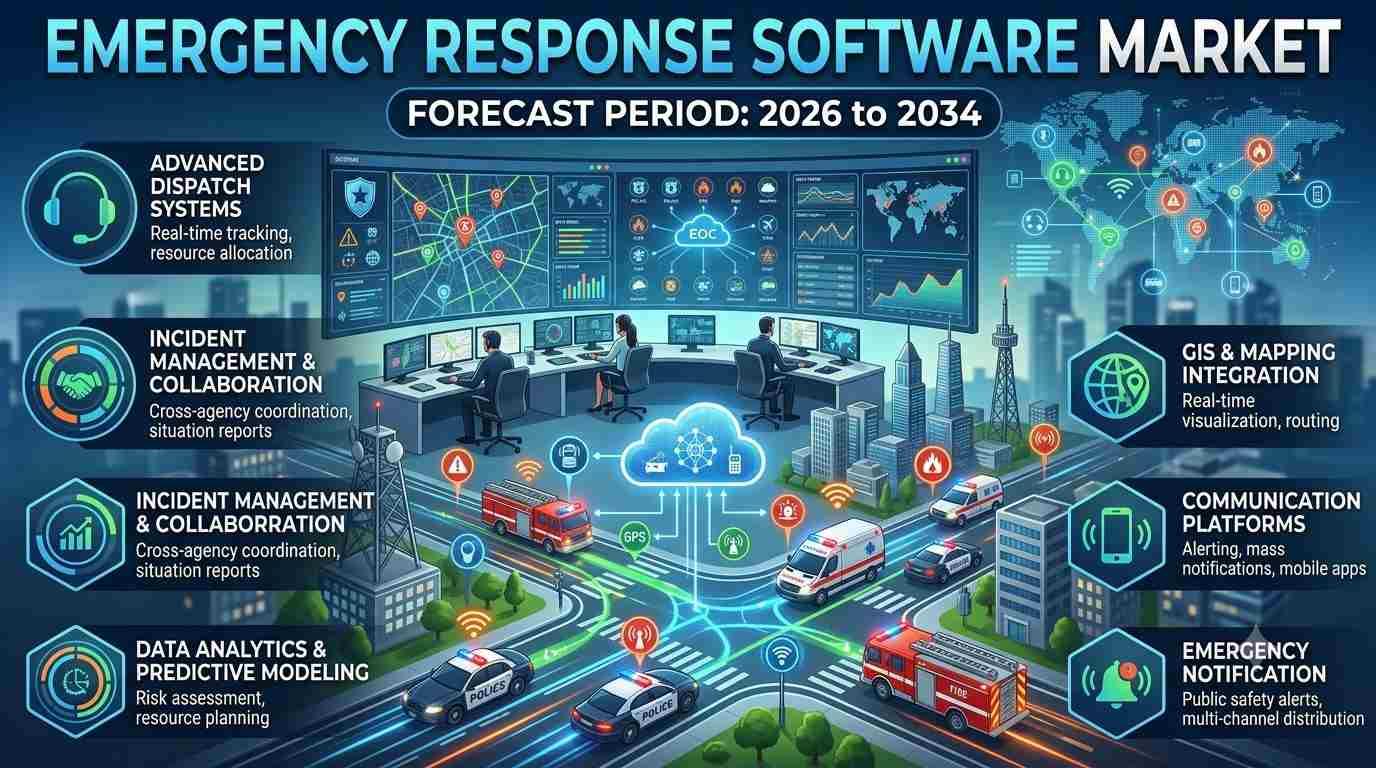
The US Emergency Response Software Market is experiencing steady growth as organizations across government, healthcare, education, transportation, manufacturing, and corporate sectors increasingly adopt digital platforms to improve emergency preparedness and incident management. Emergency response software enables real-time communication, automated alerts, incident tracking, resource coordination, and streamlined collaboration among emergency personnel and stakeholders.
The Emergency Response Software Market size is expected to reach US$ 13.76 billion by 2034 from US$ 5.35 billion in 2025. The market is anticipated to register a CAGR of 11.5% during 2026–2034.
What is driving the market?
Rising frequencies of severe climate-driven natural disasters, industrial accidents, and public safety threats are the principal growth drivers. Emergency service providers and enterprise risk officers are increasingly required to replace fragmented legacy dispatching methods with unified situational awareness platforms. Municipalities, transport hubs, and critical infrastructure providers are seeking software that improves call-to-dispatch timelines without compromising data accuracy, inter-agency security, or system reliability under network stress.
The transition is moving beyond simple mass notification toward predictive, automated incident command systems. Software vendors are investing heavily in AI-driven dispatching, geospatial tracking (GIS), automated sensor ingestion (IoT), and real-time video/data feeds. High initial deployment complexity, legacy IT integration friction, cybersecurity vulnerabilities, and constrained municipal budgets remain important constraints.
Download Sample Report@ https://www.theinsightpartners.com/sample/TIPRE00042242
Which region leads?
North America leads the market, accounting for an estimated 38%–41% share in 2025, supported by robust public safety infrastructure, stringent federal disaster management standards, and early adoption of cloud-based emergency platforms. The U.S. represents a significant share due to sustained investments in FirstNet, NG911 systems, and municipal emergency management upgrades.
Asia Pacific is the fastest-growing region with a projected CAGR of 7.5%–8.9% through 2033. Expansion is driven by rapid urbanization, high vulnerability to extreme weather, expanding smart city projects, and expanding disaster management investments in China, India, and Japan. Europe holds an estimated 27%–30% share, supported by regional public safety frameworks and cross-border emergency coordination mandates.
Which segment leads?
Software & Incident Command Solutions represents the leading component segment, accounting for an estimated 58%–63% of market revenue in 2025. Its position is supported by widespread adoption of computer-aided dispatch (CAD), GIS mapping, and command center platform consolidation. Cloud-Based deployment is identified as the fastest-growing model (63% market share), as remote field accessibility and lower upfront capital expenses drive adoption over on-premise setups.
By end-user, Government & Defense leads with an estimated 35%–40% share in 2025, reflecting high adoption among first responders, police, fire, and municipal disaster management bodies. Healthcare & Public Health is identified as the fastest-growing sector, driven by medical surge planning, hospital incident management systems, and emergency transport tracking.
Which companies are prominent?
The report identifies Everbridge, Inc., Motorola Solutions, Inc., Hexagon AB (Safety & Infrastructure), IBM Corporation, Honeywell International Inc., Veoci Inc., Esri Inc., Siemens, NEC Corporation, and BlackBerry (Crisis Response) as prominent market participants.
These companies compete across critical event management (CEM), public safety CAD/RMS systems, first responder communications, geospatial intelligence, and enterprise risk software. Strategic differentiation increasingly depends on real-time data integration, AI video/audio processing, platform interoperability, mobile field functionality, and high-uptime cloud infrastructure. The list reflects the report's competitive landscape rather than a revenue-ranked market-share table.
What is changing in 2026?
The market is shifting from reactive notification platforms toward predictive, agentic AI-driven emergency ecosystems. Software specifications increasingly mandate end-to-end data encryption, real-time multimedia ingestion (photos, live video, vehicular crash telematics), automated resource allocation, and dynamic situational mapping. Regulatory compliance standards for data handling and public safety network integration have tightened globally.
Vendors are accelerating the deployment of AI co-pilots for 911 dispatchers, automated drone-feed integration, connected worker safety sensors, and predictive crisis risk modeling. Procurement decisions are increasingly linked to evidence of interoperability across agency boundaries rather than siloed software capabilities, driving collaboration between CAD developers, telecom operators, and GIS mapping providers.
What are the major investment opportunities?
The strongest opportunities lie in Next-Generation emergency communication technology, cloud-native CAD migration, AI-based dispatch assistance, and integrated smart-city sensor networks. Investment in edge computing and automated triage analytics can significantly improve processing speed for critical caller data. Strategic software integration partnerships with IoT hardware providers offer sustainable advantages in real-time environmental and facility monitoring.
Additional opportunities exist in specialized enterprise crisis software for critical infrastructure, supply chain risk management, healthcare surge tracking, and mobile responder applications. Software-as-a-Service (SaaS) and managed emergency operation models create predictable recurring revenue where small-to-midsize municipalities lack dedicated in-house IT management.
Asia Pacific offers attractive expansion potential through rapid smart city infrastructure builds and state-sponsored public safety digital overhauls. Investors should prioritize platforms that offer verified zero-downtime reliability, strong cybersecurity postures, flexible cloud hybrid deployments, and seamless integration with localized government dispatch protocols.
Get Full Copy of This Report @ https://www.theinsightpartners.com/buy/TIPRE00042242
The Insight Partners provides comprehensive syndicated and tailored market research services in the healthcare, technology, and industrial domains. Renowned for delivering strategic intelligence and practical insights, the firm empowers businesses to remain competitive in ever-evolving global markets.
• Email: sales@theinsightpartners.com
• Website: theinsightpartners.com
• Phone: +1-646-491-9876
 Spanish
 English
 Arabic
 French
 Portuguese
 Deutsch
 Turkish
 Dutch
 Italiano
 Russian
 Romaian
 Portuguese (Brazil)
 Greek