


US Asset Reliability Software Market Trends, Demand, and Industry Outlook to 2034
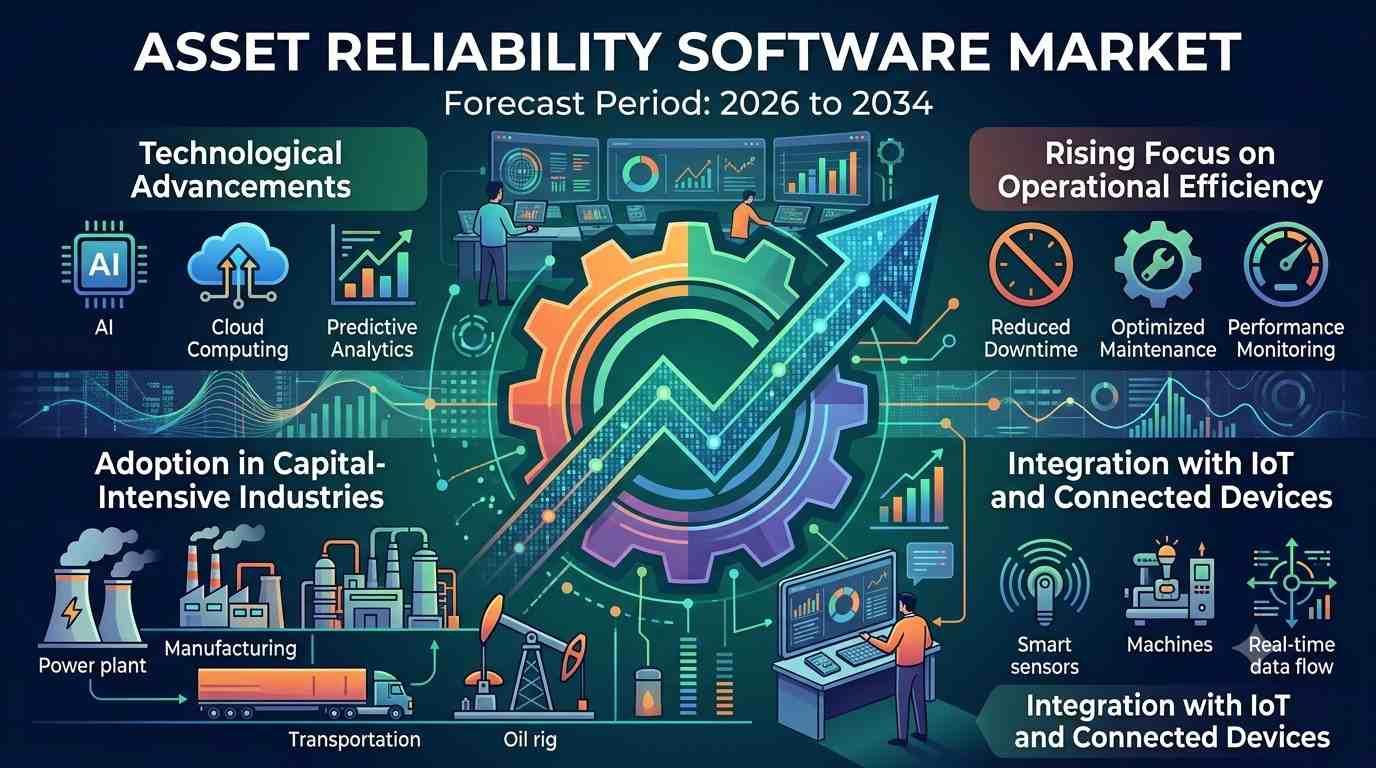
The Asset Reliability Software Market in the United States is experiencing steady growth as organizations across manufacturing, energy and utilities, transportation, oil and gas, and other asset-intensive industries increasingly prioritize equipment reliability and operational efficiency. US businesses are adopting asset reliability software to monitor asset health, identify potential equipment failures, optimize maintenance schedules, and reduce unplanned downtime.
The asset reliability software market is projected to grow from US$ 4.5 Billion in 2025 to US$ 10.0 Billion by 2034, registering a CAGR of 9.28% during 2026–2034.
Key Market Drivers
- Shift Toward Predictive Maintenance: Traditional time-based maintenance often leads to unnecessary servicing or unexpected equipment failure. Asset reliability software leverages predictive analytics to detect micro-anomalies in temperature, vibration, and pressure, allowing maintenance teams to repair components before catastrophic breakdowns occur.
- Integration of Industrial IoT (IIoT) Sensors: The proliferation of low-cost IIoT sensors across industrial plants provides asset reliability software with real-time operational metrics. Continuous data collection enhances algorithmic precision, enabling early failure detection and precise health scoring for critical assets.
- Stringent Safety and Environmental Regulations: Regulators across energy, chemical processing, and manufacturing sectors enforce high compliance standards to protect workers and prevent industrial accidents. Asset reliability tools simplify compliance through automated audit trails, safety incident tracking, and risk assessment workflows.
Emerging Market Opportunities
- AI and Generative Analytics Integration: Software vendors are integrating artificial intelligence and natural language query models directly into reliability platforms. Field technicians can instantly access repair histories, troubleshoot machinery issues via AI assistant interfaces, and generate dynamic root-cause analysis reports.
- Expansion in Distributed Energy and Renewables: The global transition toward renewable energy infrastructure, including offshore wind turbines, solar farms, and battery storage systems, creates a large market for remote asset reliability software. Automated telemetry monitoring ensures stable energy transmission across spread-out green assets.
- SaaS and Hybrid Deployment in Mid-Market Enterprises: Small and medium-sized enterprises (SMEs) are increasingly adopting asset reliability solutions. Software-as-a-Service (SaaS) models reduce initial capital expenditure, allowing smaller plant operators to access enterprise-grade reliability analytics on flexible subscription terms.
Market Segmentation
The global asset reliability software market is segmented by component, deployment type, enterprise size, and end-use industry:
By Component
- Software: Root Cause Analysis (RCA), Reliability Centered Maintenance (RCM), Failure Mode and Effects Analysis (FMEA), Asset Health Indexing, Condition Monitoring.
- Services: Professional Services (Implementation, System Integration, Consulting) and Managed Services.
By Deployment Type
- Cloud-Based: SaaS platforms offering rapid deployment, remote access, and lower infrastructure overhead.
- On-Premises / Hybrid: Deployment models chosen by highly regulated industries prioritizing localized data security and hybrid operational controls.
By End-Use Industry
- Oil & Gas: Offshore platforms, refineries, and pipelines requiring zero-downtime operations and rigorous risk management.
- Manufacturing & Automotive: High-throughput production lines dependent on continuous robotic and assembly machinery reliability.
- Power & Utilities: Power generation plants and distribution grids focused on continuous uptime.
- Chemicals & Petrochemicals: Process industries managing hazardous material operations.
- Mining & Metals, Aerospace, and Logistics.
Industry News and Recent Developments
- Enterprise AI Partnerships: Major enterprise software players continue to partner with industrial automation specialists to build native physics-informed AI models into asset management platforms.
- Strategic Mergers and Acquisitions: Leading technology vendors are acquiring specialized niche vendors focused on acoustic monitoring, thermal imaging, and vibration analytics to expand their asset health software suites.
- Edge-to-Cloud Interoperability Standards: Industry consortia are advancing open API frameworks and unified data models, enabling asset reliability software to ingest data from diverse legacy hardware without custom integration scripts.
Competitive Landscape & Top Market Players
The asset reliability software market features a competitive landscape comprising global industrial conglomerates, enterprise software giants, and specialized reliability point-solution providers. Tier-1 leaders compete by delivering comprehensive Enterprise Asset Management (EAM) and Asset Performance Management (APM) suites with native reliability modules. Specialized vendors stand out through industry-tailored failure-prediction algorithms and rapid deployment capabilities.
Top Market Players Include:
- ABB Ltd.
- Bentley Systems, Incorporated
- DNV Group AS
- Emerson Electric Co.
- GE Vernova / GE Digital
- Honeywell International Inc.
- IBM Corporation
- Rockwell Automation, Inc.
- SAP SE
- Schneider Electric SE
- Siemens AG
Future Outlook
Heading toward 2034, the asset reliability software market will evolve from diagnostic dashboards toward fully autonomous self-healing asset ecosystems. Future software suites will not only predict asset degradation but also autonomously adjust operating parameters to limit wear and schedule maintenance tasks without human intervention. The deep integration of digital twin technology, real-time edge analytics, and predictive carbon tracking will establish asset reliability platforms as core systems for operational excellence, safety, and sustainability across global industrial enterprise operations.
The Insight Partners provides comprehensive syndicated and tailored market research services in the healthcare, technology, and industrial domains. Renowned for delivering strategic intelligence and practical insights, the firm empowers businesses to remain competitive in ever-evolving global markets.
• Email: sales@theinsightpartners.com
• Website: theinsightpartners.com
• Phone: +1-646-491-9876
 Spanish
 English
 Arabic
 French
 Portuguese
 Deutsch
 Turkish
 Dutch
 Italiano
 Russian
 Romaian
 Portuguese (Brazil)
 Greek