


United States Automotive Multi-Domain Controller Industry Market Size & Future Trends 2034
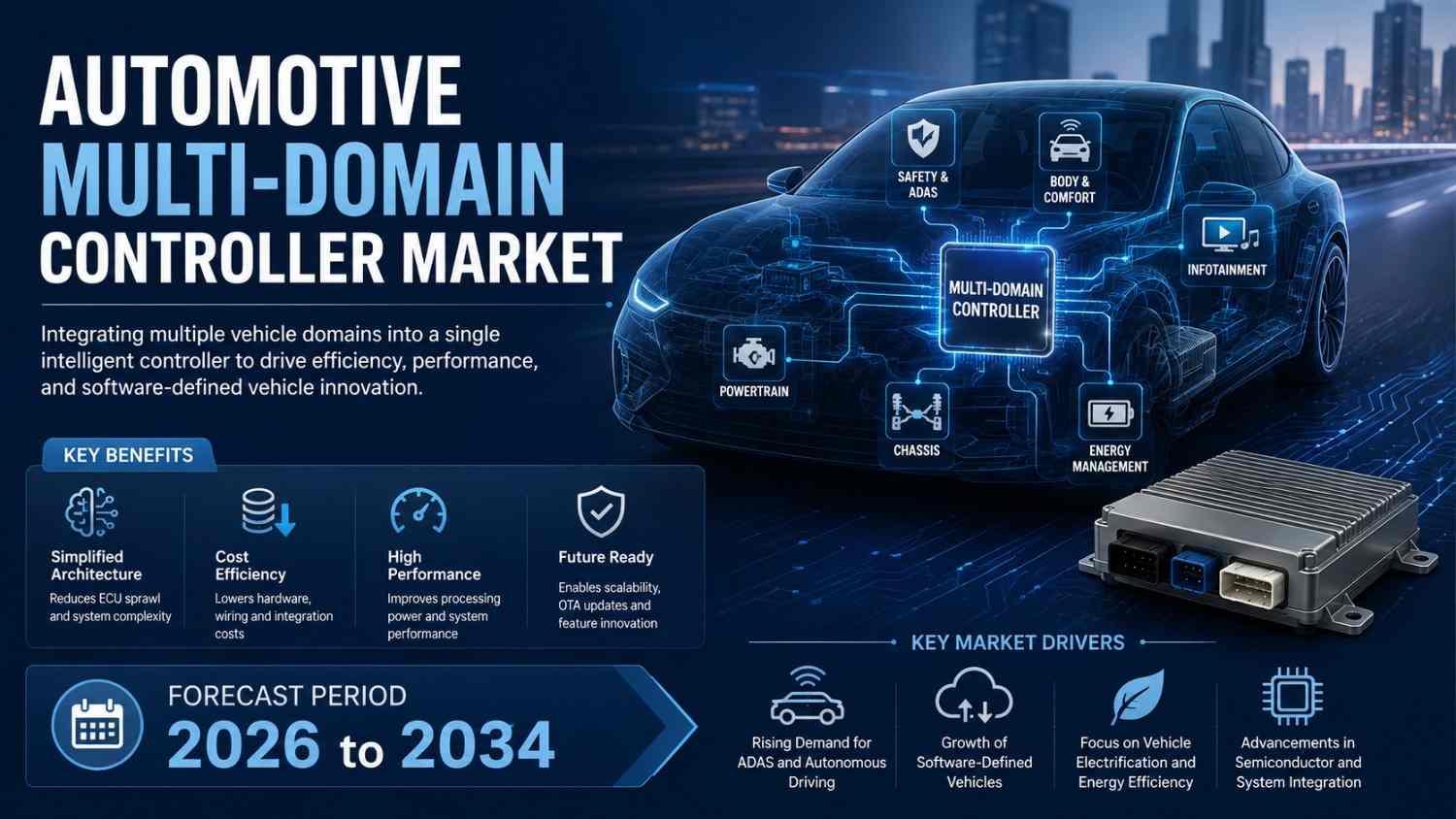
The US Automotive Multi-Domain Controller Market is witnessing steady growth as automakers increasingly adopt centralized vehicle computing architectures to support advanced vehicle functions, connected technologies, and software-defined vehicle platforms. The growing integration of advanced driver assistance systems (ADAS), infotainment, body electronics, powertrain management, and connectivity is driving demand for multi-domain controllers that can consolidate computing functions and improve vehicle performance, scalability, and cost efficiency.
The automotive multi-domain controller market was valued at US$ 6.54 billion in 2025 and is projected to reach US$ 18.86 billion by 2034, registering a CAGR of 12.48% during 2026–2034.
Key Market Drivers
- Transition Toward Software-Defined Vehicles (SDVs): Automobile manufacturers are redesigning vehicles to prioritize software features. Multi-domain controllers provide the unified computational foundation needed to support continuous Over-the-Air (OTA) software updates, allowing features to be upgraded long after the vehicle leaves the assembly line.
- Reduction of ECU Complexity and Wiring Harness Weight: Combining disparate functional modules into centralized multi-domain controllers reduces overall ECU count. This consolidation significantly streamlines vehicle wiring harnesses, cutting production costs, improving assembly efficiency, and reducing overall curb weight.
- Proliferation of ADAS and Autonomous Driving Technologies: As Level 2+ and Level 3 semi-autonomous features expand globally, vehicles must process massive streams of sensor data from cameras, radar, and LiDAR simultaneously. Multi-domain controllers deliver the high computing power and low latency required for real-time sensor fusion and decision-making.
- Surge in Electric Vehicle (EV) Production: EVs demand precise coordination across battery management systems, power electronics, thermal management, and regenerative braking. MDCs allow seamless cross-domain communication, optimizing energy efficiency and extending driving range.
Growth Opportunities
- Convergence of Cockpit and ADAS Domains: A major opportunity lies in the single-chip fusion of digital cockpit interfaces and entry-level ADAS functions. Blending infotainment systems with basic safety automation into a unified processor reduces system costs for mid-tier passenger cars.
- Automotive Chiplet Architecture: The emergence of automotive chiplets and unified interconnect ecosystems allows chipmakers and Tier-1 suppliers to customize MDCs with high-performance System-on-Chips (SoCs). This modular design lowers developmental overhead and accelerates time-to-market.
- Expansion in Commercial Vehicle Fleets: While passenger cars lead early adoption, commercial logistics providers are seeking MDCs to enable predictive diagnostics, real-time fleet tracking, and fuel optimization, unlocking new revenue streams for Tier-1 suppliers.
Market Segmentation
The automotive multi-domain controller market is segmented across several operational categories:
- By Application:
- Advanced Driver Assistance Systems (ADAS) and Safety
- Cockpit & Infotainment
- Powertrain & Energy Management
- Body & Chassis Control
- By Operating System:
- QNX (BlackBerry)
- AUTOSAR-based Systems
- Linux / Automotive Grade Linux (AGL)
- Android Automotive OS
- By Vehicle Type:
- Passenger Vehicles (Sedans, SUVs, Hatchbacks)
- Commercial Vehicles (Light Commercial Vehicles, Heavy-Duty Trucks)
- By Propulsion:
- Electric Vehicles (BEV, HEV, PHEV)
- Internal Combustion Engine (ICE) Vehicles
Market News and Recent Developments
Industry leaders are engaging in strategic partnerships, acquisitions, and technology launches to secure competitive positioning:
- High-Performance Multi-Domain Computing Launches: Key automotive suppliers continue releasing next-generation domain controllers capable of running concurrent operating systems. For instance, advanced multi-domain platforms now isolate critical safety features running on QNX alongside infotainment tasks running on Android Auto on a single, energy-efficient controller.
- Acquisitions for Software Middleware: Chipmakers and Tier-1 suppliers are actively acquiring safety-critical middleware specialists. Strategic acquisitions enable hardware suppliers to integrate safety software stacks (ASIL-D compliant), streamlining cross-domain system integration for OEMs.
- Strategic Collaboration between Silicon and Tier-1 Suppliers: Leading semiconductor manufacturers are forming direct co-development agreements with automotive Tier-1 providers to build customizable multi-domain reference designs, shortening hardware integration cycles.
Market Analysis and Competitive Landscape
The global automotive multi-domain controller market is highly consolidated and competitive, characterized by strong technical barriers to entry. Tier-1 automotive suppliers, in tandem with leading semiconductor vendors, dominate the ecosystem due to their deep expertise in functional safety standards (ISO 26262), real-time operating systems, and complex automotive supply chains.
Geographically, the Asia-Pacific region maintains a commanding position in terms of market volume, driven by rapid EV deployment in China, strong electronic manufacturing ecosystems, and aggressive adoption of connected car technologies. Europe and North America follow closely, propelled by strict safety mandates, high demand for luxury autonomous-capable vehicles, and heavy investments in SDV development.
Top Market Players:
- Robert Bosch GmbH
- Continental AG
- ZF Friedrichshafen AG
- Aptiv PLC
- Denso Corporation
- Harman International
- Hyundai Mobis
- Mobileye N.V.
- Valeo SA
- Visteon Corporation
Future Outlook
Looking ahead to 2034, the automotive multi-domain controller market will serve as the backbone of next-generation intelligent transportation. As centralized zonal E/E architectures become standard across mass-market platforms, multi-domain platforms will evolve into ultra-high-compute central computers. The ultimate integration of cockpit, safety, and powertrain domains into scalable, software-defined computing hubs will reduce hardware footprints while accelerating the rollout of autonomous, fully connected vehicles worldwide.
The Insight Partners provides comprehensive syndicated and tailored market research services in the healthcare, technology, and industrial domains. Renowned for delivering strategic intelligence and practical insights, the firm empowers businesses to remain competitive in ever-evolving global markets.
• Email: sales@theinsightpartners.com
• Website: theinsightpartners.com
• Phone: +1-646-491-9876

 English
 Arabic
 Spanish
 Portuguese
 Deutsch
 Turkish
 Dutch
 Italiano
 Russian
 Romaian
 Portuguese (Brazil)
 Greek