


Sudoku: A Simple Puzzle That Builds Powerful Logical Thinking Skills
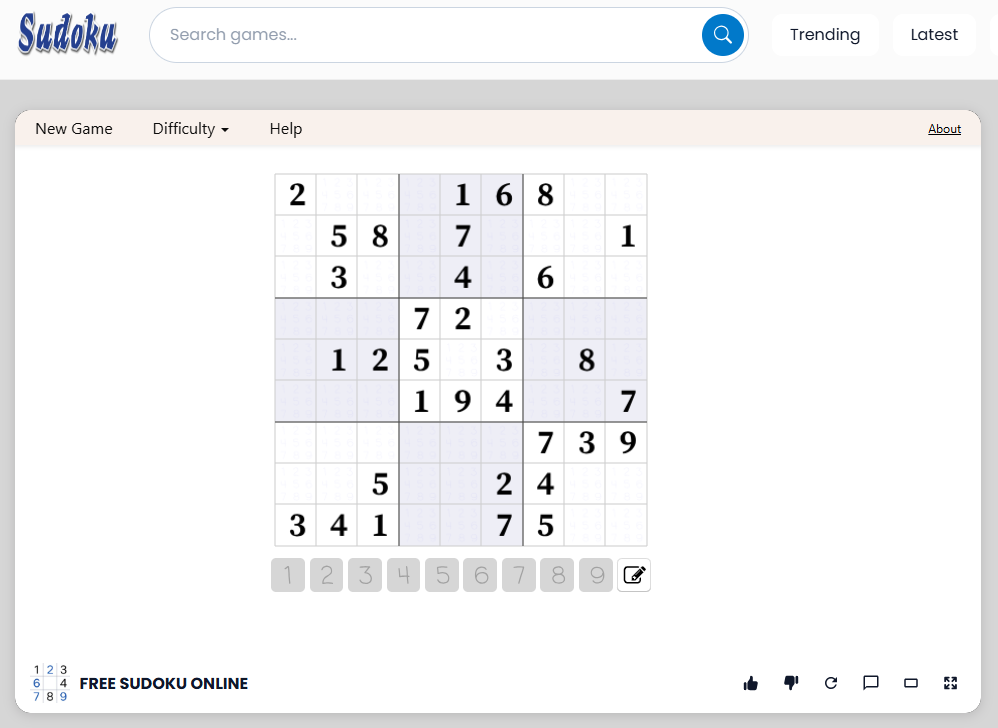
Sudoku is one of the most popular number puzzles in the world. Simple to understand but challenging to master, Sudoku attracts players who enjoy logic, concentration, and problem solving. The puzzle does not require advanced mathematics or complicated calculations. Instead, success depends on careful observation, logical deduction, and patience.
Modern Sudoku can be played in newspapers, puzzle books, mobile applications, and online game platforms. The familiar 9×9 grid provides an easy starting point, while different difficulty levels create challenges for both beginners and experienced players. Understanding the basic rules and learning effective solving methods can make every Sudoku session more enjoyable.
What Is Sudoku?
Sudoku is a logic puzzle based on a 9×9 grid divided into nine smaller 3×3 boxes. The main objective is to fill every empty cell with numbers from 1 to 9. Each number must appear exactly once in every row, column, and 3×3 box.
Sudoku does not depend on mathematical formulas. Players use the information already provided in the grid to determine which numbers can logically fit into empty spaces. This makes Sudoku accessible to many age groups and skill levels.
Understanding the Sudoku Grid
A standard Sudoku puzzle contains 81 cells. Some cells already contain numbers, while the remaining cells are empty. The given numbers act as clues that guide the solving process.
Every row must contain numbers from 1 to 9 without repetition. The same rule applies to every column and every 3×3 box. A correct solution must satisfy all three conditions at the same time.
The Basic Rules of Sudoku
The rules of Sudoku are straightforward. A player must place numbers from 1 to 9 in the empty cells. No number can appear twice in the same row, column, or 3×3 box.
Because every placement affects several parts of the grid, one correct number can provide useful information for multiple empty cells. This relationship between rows, columns, and boxes creates the central challenge of Sudoku.
Why Sudoku Is So Popular
Sudoku has become popular because the game combines simplicity with mental challenge. Anyone can learn the rules within a few minutes, but advanced puzzles can require considerable concentration.
Another reason for the popularity of Sudoku is the variety of available difficulty levels. Easy puzzles help new players learn basic techniques, while medium and hard puzzles require deeper logical reasoning.
Sudoku and Mental Focus
Playing Sudoku requires sustained attention. Players need to examine several parts of the grid and remember which numbers are possible in different positions. Regular puzzle solving can therefore provide an engaging way to practice concentration.
The puzzle also encourages careful thinking. Random guesses are usually less effective than logical deduction, so players learn to examine evidence before making a decision.
Sudoku as a Relaxing Activity
Sudoku can also be a relaxing form of entertainment. Focusing on a structured puzzle can temporarily shift attention away from everyday distractions. Many people enjoy solving a short puzzle during a break, while others prefer longer sessions with difficult challenges.
How to Solve Sudoku More Effectively
A strong Sudoku strategy begins with simple observations. Instead of immediately searching for complicated patterns, players can first identify numbers that have very limited possible positions.
Start With Easy Numbers
The first step is to examine rows, columns, and boxes that already contain many numbers. When only one empty cell remains in a section, the missing number can usually be placed immediately.
Players can also examine each number individually. For example, if a 3 already appears in several rows and boxes, the remaining possible locations for 3 may become easy to identify.
Use Candidate Numbers
Candidate numbers are possible values that can fit into an empty cell. Writing down candidates can make difficult puzzles easier to understand.
If a cell can only contain 2 or 7, those two numbers become candidates. When another clue eliminates one possibility, the remaining number becomes the correct choice.
Look for Hidden Patterns
More advanced Sudoku solving involves recognizing relationships between candidate numbers. A number may have only one possible location within a particular row, column, or box even when several cells remain empty.
Players can also search for pairs or groups of candidates that restrict other possibilities. These techniques reduce the number of choices and gradually reveal the solution.
Common Mistakes in Sudoku
Sudoku rewards accuracy, so a small mistake can affect an entire puzzle. One incorrect placement may create false limitations in several rows, columns, and boxes.
Avoid Random Guessing
Guessing can sometimes appear useful when a puzzle becomes difficult, but it can make the solving process confusing. Logical deduction provides a more reliable approach.
When no clear move is available, reviewing existing candidates and searching for another pattern is often better than making an unsupported guess.
Check Every Placement
Before entering a number, players should verify the related row, column, and 3×3 box. This simple habit prevents many common errors.
Online Sudoku platforms may provide automatic error detection, but solving without assistance can improve attention to detail and logical reasoning.
Different Sudoku Difficulty Levels
Sudoku puzzles are commonly classified as easy, medium, hard, or expert. Difficulty depends on the number of clues and the type of reasoning required.
Easy Sudoku
Easy Sudoku puzzles usually contain many starting numbers and offer several straightforward placements. They are ideal for beginners who are learning the basic rules.
Medium and Hard Sudoku
Medium puzzles require more candidate analysis and logical deduction. Hard puzzles may involve advanced patterns that are not immediately visible. These levels are suitable for players who already understand basic solving techniques.
Expert Sudoku
Expert Sudoku can require multiple advanced strategies and significant concentration. These puzzles are designed for experienced players who enjoy complex logical challenges.
Benefits of Playing Sudoku
Sudoku offers more than simple entertainment. The game encourages concentration, structured thinking, patience, and attention to detail.
Players must organize information and evaluate possibilities before making decisions. This process makes Sudoku an engaging mental exercise for people who enjoy logic-based activities.
Conclusion
Sudoku remains popular because the concept is simple while the challenge can become remarkably deep. The 9×9 grid provides a familiar structure, yet every puzzle creates a different logical problem.
By learning the rules, using candidate numbers, avoiding random guesses, and practicing regularly, players can steadily improve their solving ability. Whether used as a short daily activity or a serious logic challenge, Sudoku offers an enjoyable way to test concentration and problem solving skills.

 Arabic
 French
 Spanish
 Portuguese
 Deutsch
 Turkish
 Dutch
Dutch
 Italiano
 Russian
 Romaian
 Portuguese (Brazil)
 Greek
Greek